



Seven Trusted Sources for Ethically Sourced Buddhist Statues
Seven Trusted Sources for Ethically Sourced Buddhist Statues
Quick Summary
Buy ethically sourced Buddhist statues from specialty galleries that can name the workshop, describe the materials, and show export paperwork for each piece. Contemporary statues carved in Nepal, Thailand, and Cambodia are a strong alternative, since a living carver can document exactly how the work was made.
- Ethical sourcing rests on three tests: transparent materials, fair labor, and respectful cultural handling.
- A certificate of authenticity printed by the seller is not provenance and proves nothing on its own.
- Ask for export paperwork, workshop details, and the return window in writing before buying.
- Specialty galleries offer detailed per-piece documentation; marketplaces leave verification to the buyer.
- Place a meditation statue at or slightly above eye level when you are seated.
Table of Contents
- What Ethically Sourced Buddhist Statues Actually Means
- Buddhist Statue Provenance: What Real Documentation Looks like
- Questions to Ask When Buying a Buddha Statue
- Comparing Where to Buy: Specialty Galleries vs. Marketplaces
- Contemporary Buddhist Statues: A Strong Alternative to Antiques
- Buddhist Statues for Meditation Spaces: Sizing and Placement
- Browse the Curated Collection at HD Asian Art
- Frequently Asked Questions
What Ethically Sourced Buddhist Statues Actually Means
Ethically sourced Buddhist statues are pieces whose materials, labor, and cultural handling can be traced and defended, not simply labeled handmade. That distinction matters because a handmade claim alone proves nothing about how a workshop treats its carvers or where the bronze originated. True transparency requires a deeper investigation into the supply chain, as identifying ethically sourced materials often involves scrutinizing the origins of every component, including the gemstones embedded within sacred figures.
Sourcing is best treated as a chain of custody question rather than a marketing badge. A piece earns the label only when the seller can name the workshop, describe the material, and explain how the object left its country of origin lawfully.
Three criteria separate real ethical sourcing from a vague claim:
- Transparent materials. The seller states what the statue is made of and where that material came from.
- Fair labor. Carvers and casters are paid and treated under known terms, not anonymous piecework.
- Respectful cultural handling. Sacred objects are documented and exported according to the rules that govern them.
U.S. Customs and Border Protection guidance on importing cultural property sets out how restricted archaeological and ethnological material must be declared and documented on entry, which is why paperwork matters before a statue ever reaches a shelf.
For the full set of criteria we apply, see our guide to ethical sourcing of antique Buddhist art.
Buddhist Statue Provenance: What Real Documentation Looks like
Buddhist statue provenance is the recorded history of an object's ownership and movement, and real documentation shows a continuous trail rather than a single certificate.
A genuine file usually contains a bill of sale or gallery invoice, prior exhibition or collection records, photographs with dates, and export paperwork where the piece crossed a border. Vague statements like "from a private collection" carry no weight without names and dates attached.
Watch out: a certificate of authenticity printed by the seller proves only that the seller printed it. It is not provenance.
Our walkthrough on how to verify provenance for Buddhist antiquities shows what each document should contain.
Questions to Ask When Buying a Buddha Statue
The questions to ask when buying a Buddha statue should test documentation, material, and labor, in that order. Buyers who lead with price usually end up asking about provenance after the money has moved, which is the wrong sequence.
Here is the checklist we would use ourselves:
- Can you send the export or import paperwork for this piece?
- Which workshop made it, and how are its carvers paid?
- What is the statue made of, and is any part cast rather than carved?
- Has it been repaired or restored, and where?
- What does shipping protection cover if the piece arrives damaged?
- What is the return window, and who pays return freight?
A seller who answers these in writing is a seller worth continuing with. One who deflects to "our pieces are all authentic" is telling you something useful too.
Our guide to finding reputable antique Buddhist art dealers covers how to vet a seller before you ask.
Comparing Where to Buy: Specialty Galleries vs. Marketplaces
Specialty galleries and general marketplaces solve different problems. A gallery curates, documents, and stands behind individual pieces; a marketplace offers volume and price spread but leaves verification to the buyer.
| Source | Documentation depth | Curation | Buyer protection | Best for |
|---|---|---|---|---|
| Specialty gallery | Detailed, per piece | High, hand-selected | Seller-backed terms | Collectors who need a paper trail |
| General marketplace | Varies by seller | None | Platform policy only | Browsing and price comparison |
| Auction house | Catalogued, sometimes thin | Moderate | Condition reports on request | Experienced bidders |
| Direct from workshop | Basic | Low | Depends on the workshop | Contemporary pieces, simple materials |
Marketplaces are not dishonest by default. They simply place the burden of proof on you, and most buyers do not have the reference material to carry it.
What most guides miss is that the cheapest listing is rarely the cheapest purchase. A statue with a documented history holds its meaning and its value; an undocumented one is a decoration with a story attached.
For a direct comparison of purchase routes, read where to buy authentic high-end Buddhist statues.
Contemporary Buddhist Statues: A Strong Alternative to Antiques
Contemporary Buddhist statues solve the problem antiques create: a living carver can tell you exactly where the stone came from and how the piece was made. That answers the sourcing question at the source.
Modern workshops in Nepal, Thailand, and Cambodia continue carving and casting traditions that stretch back centuries. A newly made statue in those traditions carries the same iconography and often the same handwork, without the gaps that antique paperwork tends to have.
Contemporary pieces suit buyers who want a specific figure at a specific size, or collectors who want documented work without verifying an antique's full history.
The trade-off is honest: a contemporary piece will not appreciate the way a well-documented antique can. Buy it for the practice and the craft, not as a store of value.
Buddhist Statues for Meditation Spaces: Sizing and Placement
Buddhist statues for meditation spaces work best when the figure sits at or slightly above eye level when you are seated, and when the scale matches the room rather than the room's potential. A small apartment corner suits a modest statue better than a large one.
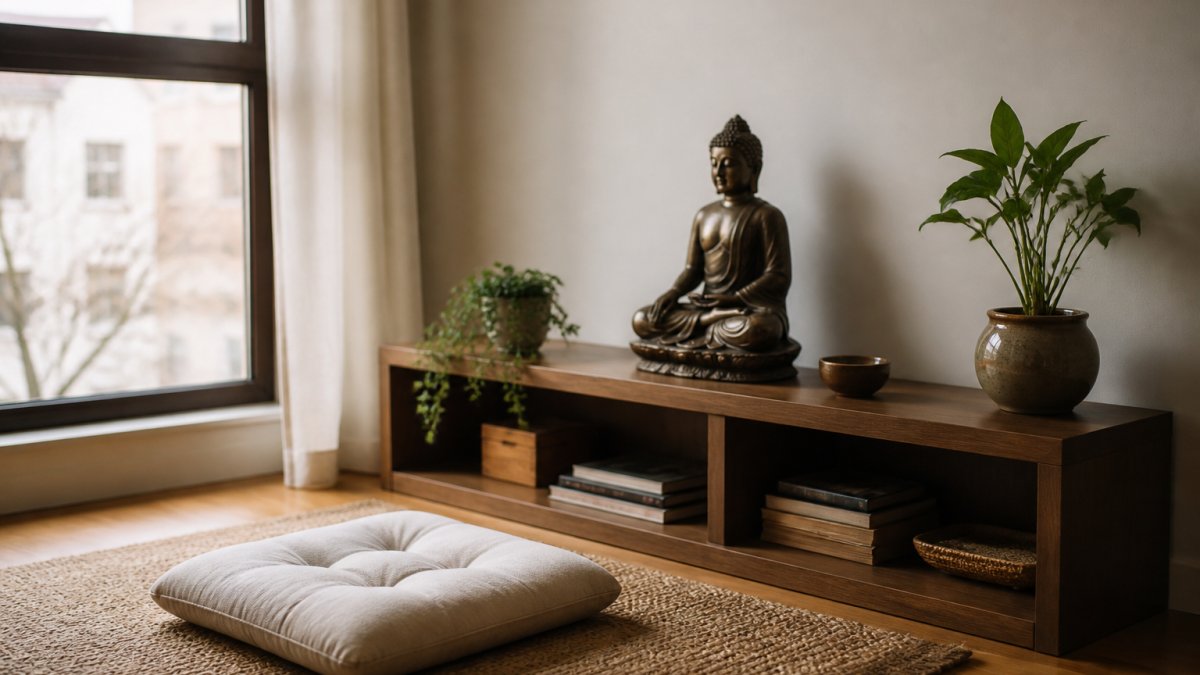
General sizing guidance for different spaces:
- Small corner or shelf: a statue under about 20 cm tall reads as intentional when it stands alone.
- Dedicated alcove: 30 to 45 cm gives the figure presence without crowding.
- Full room altar: 60 cm and above, with clear space around it.
Place the statue on a stable, clean surface facing the room, keep clutter away, and avoid direct harsh sunlight that fades finishes over time. A single figure with space around it looks more considered than a crowded shelf.
Our guide to choosing a Buddha statue for your home altar walks through sizing for different room types.
Browse the Curated Collection at HD Asian Art
Buying well comes down to one habit: ask for the paperwork before you fall in love with the object. Everything above is a version of that single test.
HD Asian Art curates Buddhist and Hindu statues alongside Khmer and Southeast Asian sculptures, with handpicked antique and contemporary pieces chosen for altars, meditation spaces, and refined home interiors. Free shipping is offered, and the collection is built for buyers who care where a piece came from as much as how it looks.
Start with the piece that fits your space, then ask us for its documentation. We would rather answer the hard questions up front.
Frequently Asked Questions
How can I tell whether a Buddhist statue is ethically sourced?
Ask for documentation, not assurances. A seller should be able to name the country and region where a piece was made, describe the workshop or artisan, and explain how the piece was acquired. A handmade label alone does not establish ethical sourcing, so look for transparent materials, fair labor details, and respectful cultural handling. If a seller cannot answer basic origin questions in writing, treat that as a red flag and keep looking.
What should I ask a seller about a Buddhist statue's origin?
Start with four questions: Where exactly was this piece made? Who made it, and how were they compensated? How did the seller acquire it, and can that be documented? What materials were used, and were they sourced responsibly? Request answers in writing and ask for photos of any paperwork. Reputable sellers answer these questions directly. Vague provenance language, such as claims of an unnamed private collection, should prompt you to slow down before committing.
Are contemporary Buddhist statues a good alternative to antiques?
For many buyers, yes. Contemporary Buddhist statues made by working artisans offer clear provenance, since the maker and workshop are known, and they often suit modern interiors better than fragile antiques. Antiques carry history, but that history is only valuable when it is documented. If provenance matters to you and paperwork is thin, a well-made contemporary piece is the safer choice.
How do I choose a Buddhist statue for a meditation space?
Measure your space first, then choose a statue that fits without crowding it. A small apartment corner can hold a modest piece on a low shelf or table, while a dedicated room can take a larger focal statue. Consider the figure and its meaning, the material's weight and finish, and whether the piece will sit at or near eye level when you are seated. HD Asian Art curates pieces for altars, meditation spaces, and refined home interiors.
What makes a Buddhist statue respectful to display?
Placement and intent matter more than price. Set the statue on a clean, stable surface at or above seated eye level, keep it out of high-traffic or bathroom areas, and avoid using it as a casual decorative prop. Provide a simple, uncluttered setting, and handle the piece with care. If you are unsure about a figure's traditional context, ask the seller before you buy. Respectful display starts with knowing what the statue represents and treating it accordingly.
The challenge is not finding a beautiful statue. It is finding one you can defend. Browse the HD Asian Art collection to find a piece with a history you can trace, backed by free shipping and a curated selection of Buddhist, Hindu, Khmer, and Southeast Asian sculpture.

