



Symbolic Art for Mindful Living: A Guide for Collectors
Symbolic Art for Mindful Living: A Guide for Collectors
Symbolic art for mindful living means traditional Asian Buddhist and Hindu statues and temple art whose iconography — mudras, poses, attributes, and deity marks — encodes spiritual teachings and supports meditation, devotion, and mindful presence. These are functional sacred images, not decorative objects.
A Cambodian bronze Avalokiteshvara placed at eye level in a meditation room operates differently from the same figure set on a bookshelf among unrelated objects. HDAsianArt specializes in museum-quality pieces from Cambodia, Thailand, Indonesia, Sri Lanka, and Vietnam, each individually researched and documented to support exactly this kind of intentional use.
Symbolic art for mindful living = authenticated sacred images whose iconography supports practice and presence.
Table of Contents
How to read the signs: mudras, poses, attributes, and marks
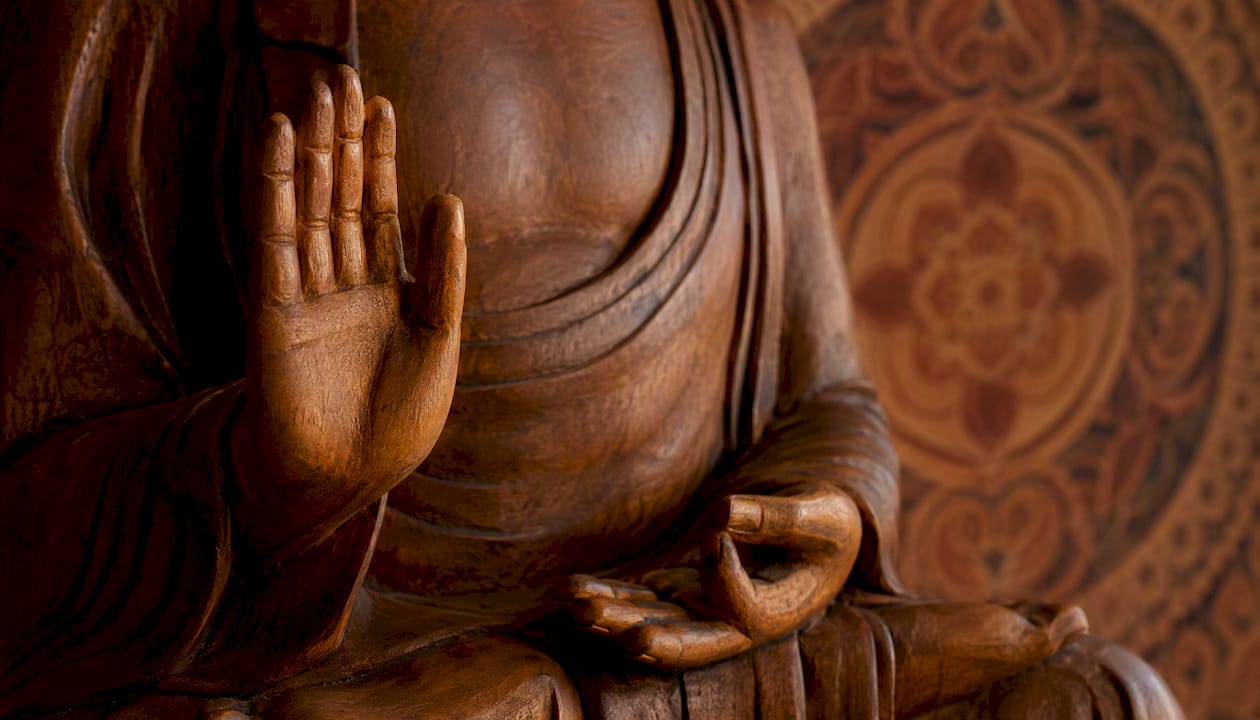
Indian and Himalayan sacred art relies on standardized iconography to convey idealized spiritual meaning rather than literal realism. Learning a short set of visual keys dramatically improves correct identification. The mudra — a hand gesture — is among the most precise identifiers, though its textual history is complex and terminology varies across traditions.
| Visual Feature | Common Example | Meaning |
|---|---|---|
| Mudra: Abhaya | Right hand raised, palm out | Protection, fearlessness |
| Mudra: Varada | Right hand lowered, palm out | Gift-giving, generosity |
| Mudra: Dhyana | Both hands in lap, palms up | Meditation, inner focus |
| Mudra: Dharmachakra | Both hands at chest, fingers touching | Teaching, turning the wheel of Dharma |
| Pose: Padmasana | Full lotus seat | Meditation, transcendence |
| Pose: Lalitasana | One leg pendant, relaxed | Royal ease, accessibility |
| Pose: Tribhanga | Triple-flexed stance | Grace, dynamic presence (common in Hindu figures) |
| Pose: Samabhanga | Upright, symmetrical | Formal authority, equilibrium |
| Attribute: Chakra | Spinning disc | Vishnu’s sovereign power |
| Attribute: Trident (Trishula) | Three-pronged staff | Shiva’s triple aspect |
| Attribute: Vajra | Thunderbolt scepter | Indestructible wisdom in Buddhist iconography |
| Attribute: Lotus | Flower or bud | Purity, spiritual unfolding |
| Mark: Ushnisha | Cranial protuberance | Enlightened wisdom (Buddha figures) |
| Mark: Urna | Dot between brows | Third eye, spiritual sight |
| Mark: Shrivatsa | Curl on chest | Auspicious mark of Vishnu |
Mudras, mandalas, and tantric attributes are technical systems tied to ritual texts. Regional styles add further variation: Thai bronzes favor elongated flame ushnishas; Khmer stone figures use a lotus-bud crown; Javanese pieces often blend Hindu and Buddhist elements in a single figure.
How do you assess museum-quality authenticity and condition?
Museum-quality means correct iconography, appropriate materials, and verifiable provenance. All three must align.
| Material | Age Markers | Red Flags |
|---|---|---|
| Bronze | Even green or brown patina, casting seams consistent with period technique | Bright or patchy patina, modern tool marks, inconsistent alloy color |
| Stone | Surface weathering consistent with claimed origin, tool marks period-appropriate | Fresh cuts, mismatched surface texture, repairs in modern filler |
| Wood | Shrinkage cracks, insect channels consistent with age, original pigment traces | Uniform color suggesting refinishing, new wood visible at joins |
| Lacquer | Layered buildup, period-appropriate ground materials | Plastic-like surface sheen, modern adhesives at seams |
A well-made figure is shaped by proportion systems and craft care that communicate presence even to viewers unfamiliar with the symbolism. Proportion and artisanal attention are value indicators in their own right — not secondary to provenance, but parallel to it.
Only consecrated images, filled and sealed during formal rites, carry traditional liturgical status. Tourist-market reproductions are not automatically sacred. Request high-resolution photographs of all surfaces, a written condition report, and any available provenance documentation before purchase.
Ethical and legal considerations for U.S. buyers
Verify clean title and export documentation before purchase. Acquiring objects with suspect provenance creates legal and ethical liability under U.S. law.
| Check | What to Request | Why It Matters |
|---|---|---|
| Provenance chain | Written history of ownership from country of origin | Required for U.S. Customs; establishes legal title |
| Export permit | Country-of-origin export documentation | Mandatory for legal import; absence is a red flag |
| CITES compliance | CITES certificate for any ivory, bone, or elephant-derived material | U.S. Fish & Wildlife Service enforces strict import rules |
| U.S. Customs | Commercial invoice, country of origin, declared value | Required for all international shipments |
| Cultural property laws | Check against CPAC bilateral agreements | U.S. has agreements restricting import of certain categories from specific countries |
For high-value or ambiguous pieces, consult a provenance researcher before completing a purchase. When displaying objects from living traditions, add interpretive signage that acknowledges the object’s original devotional context.
Practical buying and shipping expectations for U.S. collectors
Provenance-backed museum-quality pieces command significant prices and require insured, tracked shipping with customs clearance.
| Stage | Typical Timeline |
|---|---|
| Pre-purchase research and iconography verification | 1–2 weeks |
| Authentication and condition report | 1–2 weeks |
| Packing and export documentation | 1–2 weeks |
| Insured international transit (DHL or equivalent) | 5 business days |
| U.S. Customs clearance | 2–5 business days |
| Local delivery | 1–3 business days |
Price ranges for museum-quality pieces vary widely by material, age, rarity, and provenance. Entry-level authenticated pieces typically start in the low hundreds of dollars; mid-range bronzes and stone figures with documented provenance run into the thousands; exceptional or rare pieces with institutional-grade provenance can reach five figures or more. Always request a condition report, high-resolution photographs of all surfaces, export permits, insured shipping terms, and a clear return policy before confirming any purchase.
How HDAsianArt meets the collector’s needs
HDAsianArt offers curated, individually researched museum-quality pieces with provenance documentation and worldwide insured DHL shipping. Each listing includes expert iconographic descriptions, high-resolution photography, and condition notes.
Every piece in the HDAsianArt collection is individually researched, photographed, and described by specialists — so collectors receive the documentation needed for display, insurance, and long-term custodianship, not just an object in a box.
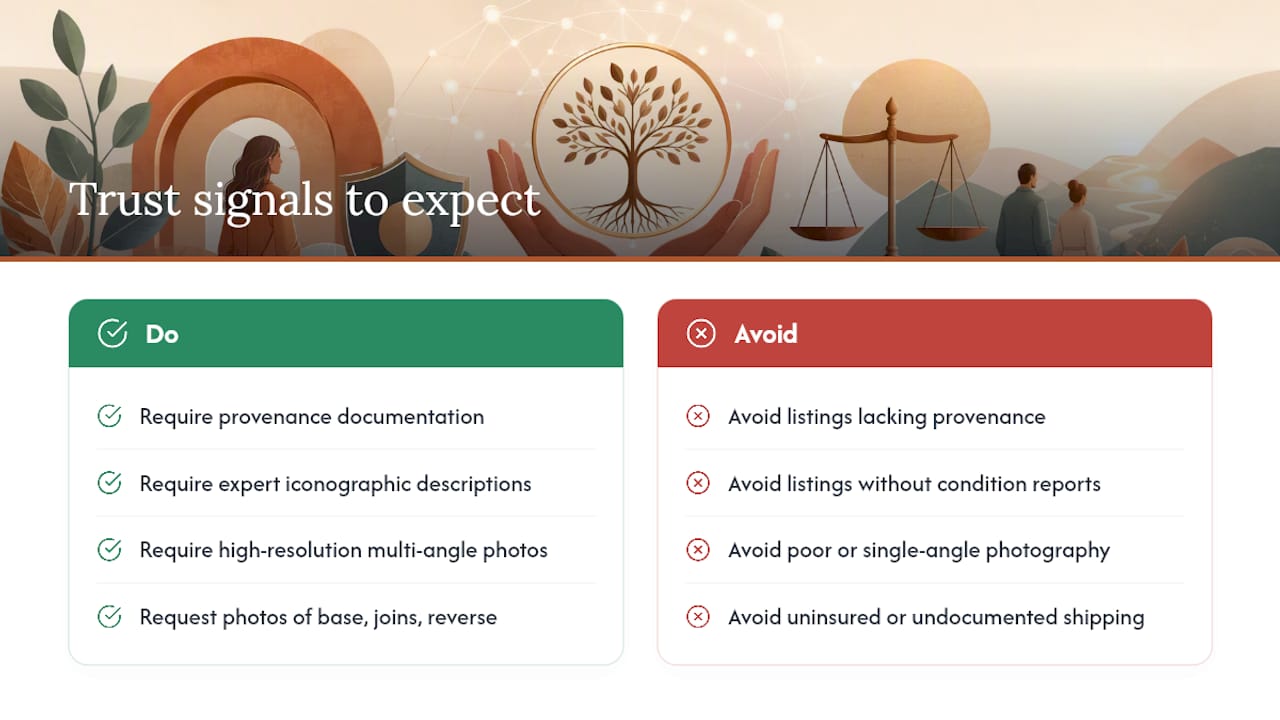
Trust signals to expect from a responsible gallery: expert object descriptions, high-resolution multi-angle photography, written condition reports, export documentation, insured DHL shipping, and a transparent return policy. HDAsianArt provides all of these as standard.
Pro Tip: When contacting HDAsianArt about a specific piece, request additional photographs of the base, any joins, and the reverse — these surfaces reveal the most about age, repairs, and original condition.
For a concrete example of what a documented listing looks like, the Javanese Avalokiteshvara Bodhisattva listing shows the level of photographic and descriptive detail applied to each piece.
Key Takeaways
Museum-quality Asian Buddhist and Hindu sculptures function as sacred images when their iconography is correctly identified, their provenance is verified, and they are displayed with appropriate elevation, lighting, and context.
| Point | Details |
|---|---|
| Definition | Symbolic art for mindful living means authenticated sacred images whose iconography supports meditation, devotion, and mindful presence. |
| Iconography first | Learn mudras, poses, and attributes before purchasing — they determine a figure’s function and correct placement. |
| Provenance and export | Always request a written provenance chain, export permit, and CITES compliance documentation before completing a U.S. purchase. |
| Display principles | Elevate above floor level, clear surrounding space, use directed lighting, and add interpretive context in institutional settings. |
| HDAsianArt | Offers individually researched, photographed, and documented pieces with insured DHL shipping — a direct source for U.S. collectors. |
A curator’s perspective on integrating sacred objects in Western spaces
The most common mistake collectors make is treating iconography as optional context rather than functional instruction. A Shiva Nataraja placed without acknowledgment of its cosmological meaning is not just a missed opportunity — it is a mislabeled object. The figure’s tribhanga pose, the ring of fire, the demon underfoot: each element is a precise statement about creation, preservation, and dissolution. When a collector understands that, the placement decision changes. The figure needs space, elevation, and a sightline that allows the full composition to read.
Provenance shapes these decisions too. A piece with a documented temple origin and a clean export chain carries a different weight than an undocumented market find. That weight is not just legal — it is curatorial. Knowing where an object came from, and that it left its country of origin legally, allows a collector or institution to display it with confidence and to tell its story honestly.
Sourcing authenticated pieces through HDAsianArt
HDAsianArt’s online gallery is a direct source for U.S. collectors who need authenticated, researched pieces with full documentation. The collection spans bronze, stone, wood, and Burmese lacquerware from Cambodia, Thailand, Indonesia, Sri Lanka, Vietnam, and beyond. Every piece ships worldwide via insured DHL with export documentation included.
To move forward: browse the current inventory at HDAsianArt, identify a piece of interest, and contact the gallery directly to request a full condition report, additional surface photographs, export paperwork, and a shipping and insurance quote for your U.S. address. The gallery’s standard process covers all of these as part of the purchase.
This article provides general information for collectors and is not legal or conservation advice. Confirm current U.S. import requirements and cultural property regulations with U.S. Customs and Border Protection or a qualified legal professional before completing an international purchase.
