



Sukhothai vs Ayutthaya Buddha Sculpture Styles
Sukhothai vs Ayutthaya Buddha Sculpture Styles
Table of Contents
- Sukhothai vs Ayutthaya: A Side-by-Side Comparison
- Sukhothai Buddha Sculpture History: The Golden Age
- Sukhothai Buddha Statue Characteristics: Grace and Fluidity
- Ayutthaya Buddha Statue Characteristics: Authority and Variation
- Thai Buddha Statue Styles Comparison: Posture, Gesture, and Face
- Materials, Casting, and Workshop Practices
- Visual Identification Guide: Telling Sukhothai from Ayutthaya
- What Style Labels Can and Cannot Tell You
- Frequently Asked Questions
Sukhothai vs Ayutthaya: A Side-by-Side Comparison
Sukhothai vs Ayutthaya separates two golden ages of Thai Buddhist art, and the difference comes down to one tension: grace versus gravity.
The short answer: Sukhothai sculpture pursues an idealized, fluid beauty, while Ayutthaya sculpture builds toward presence and authority. Smarthistory's analysis of the Sukhothai walking Buddha describes smooth long limbs, an oval face, and smoothly modeled clothing; Britannica's entry on the Sukhothai style notes sinuous curves and cylindrical forms. Ayutthaya figures read differently on the shelf: fuller faces, broader shoulders, a more grounded stance.
Below, we break down the visual markers, historical development, and identification habits that let you tell them apart at a glance.
Quick Comparison Table
| Feature | Sukhothai Style | Ayutthaya Style |
|---|---|---|
| Overall silhouette | Elongated, fluid, weightless | Fuller, grounded, authoritative |
| Face | Oval, serene smile, low gaze | Rounder, fuller, more formal |
| Shoulders and torso | Narrow, smooth modeling | Broader shoulders, stronger torso |
| Signature form | Walking Buddha | Seated and standing royal-ornament figures |
| Ornamentation | Minimal, unadorned | Increasingly elaborate over time |
| Best for | Meditation spaces seeking calm | Collectors wanting monumental presence |
That table is the summary. The rest of this guide explains why each row exists.
Sukhothai Buddha Sculpture History: The Golden Age
Sukhothai Buddha sculpture history begins with a kingdom that flourished from 1238 to 1438 CE, and that century and a half produced what many consider the high point of Thai Buddhist art. The Sukhothai school drew from several artistic traditions and synthesized them into something recognizably its own. Sawitree Wisetchat's study of Sukhothai Buddha evolution traces how a distinct style developed across the period rather than appearing fully formed.
What changed most was the body: sculptors softened joints, lengthened limbs, and smoothed drapery until the figure seemed to float rather than sit. The goal was not anatomical accuracy but the suggestion of a being freed from physical weight.
This period gave Thai art its most original contribution to Buddhist iconography and set the benchmark every later style was measured against.
Sukhothai Buddha Statue Characteristics: Grace and Fluidity
Sukhothai Buddha statue characteristics are easy to spot once you know the formula: elongated limbs, an oval face, a serene expression with a low gaze, and clothing modeled so smoothly it reads as water rather than fabric. The silhouette is the giveaway. Where later styles build volume, Sukhothai subtracts it.
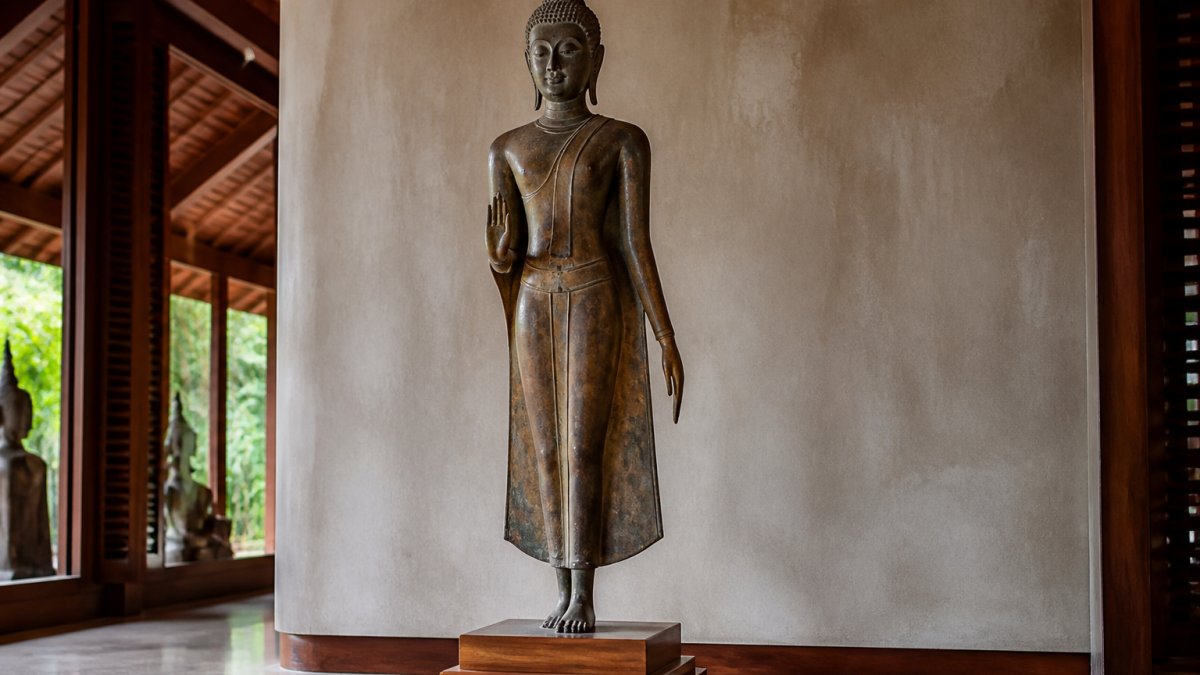
The face carries an inward quality: eyes looking down, a faint, self-contained smile, calm attention rather than engagement with the viewer. Proportions follow an idealized canon, long arms, tapered fingers, a narrow waist.
A common mistake is assuming this smoothness means simplicity. In practice, the smooth modeling is harder to cast well than heavy ornamentation, because there is nowhere to hide a flaw.
The Walking Buddha: Sukhothai's Original Creation
The walking Buddha is Sukhothai's signature invention, and no other Thai style produced it with the same conviction. The figure is shown mid-stride, one heel lifted, one hand raised in a gesture of reassurance, the body curving in a gentle S that suggests motion suspended in air.
Look at the trailing foot. In a good example, the heel lifts and the toes trail with a lightness that seems to defy gravity. That detail is where the style either succeeds or fails.
Ayutthaya Buddha Statue Characteristics: Authority and Variation
Ayutthaya Buddha statue characteristics shift the emphasis from weightlessness to presence. Figures from this period, which ran from 1351 to 1767 CE, tend to have fuller faces, broader shoulders, and a stronger torso. Butuzou's comparison of Thai Buddha statue styles describes Ayutthaya Buddhas as having broader shoulders and a stronger torso, with a more grounded, authoritative appearance.
The shift makes sense historically: Ayutthaya was a cosmopolitan capital absorbing Khmer, Sukhothai, and later foreign influences, and its sculpture reflected a court that valued regal bearing. Where Sukhothai figures feel ascending, Ayutthaya figures feel presiding.
Ornamentation increases too. Crowns, jewelry, and elaborate robes appear more frequently, especially in later periods. The face loses some of the inward softness and gains a more formal, frontal composure.
How Ayutthaya Sculpture Changed by Period
Ayutthaya sculpture is not one style but several. The standard art-historical breakdown runs in three broad phases, each changing what you should look for on the shelf.
Early Ayutthaya (roughly the 14th into the 15th century). This phase causes the most mislabeling.
Middle Ayutthaya (roughly the 15th into the 17th century). Figures grow broader and more muscular. The torso thickens, the shoulders square off, and the modeling becomes heavier and more frontal.
Late Ayutthaya (roughly the 17th century to 1767). Work turns ornate: crowned and bejeweled images become common, with elaborate robes, diadems, and applied ornament reading as much royal portrait as religious icon.
That chronology matters because the visual signals are not evenly distributed.
Thai Buddha Statue Styles Comparison: Posture, Gesture, and Face
Any serious Thai Buddha statue styles comparison has to move past silhouette into posture and hand gesture, which carry much of the stylistic information.
The Subduing Mara gesture, with the right hand reaching down to touch the earth, appears in both traditions, but the treatment differs. Sukhothai versions keep the arm slender and the fingers tapered.
Facial features follow the same logic: Sukhothai gives the serene smile and low gaze of an inward-facing figure, Ayutthaya a fuller face with a more frontal, composed expression. Neither is more spiritual; they describe different relationships between figure and viewer.
Meditation posture is common to both, and it is the safest ground for comparison because the differences show up clearly: Sukhothai seated figures keep the tapered waist and floating quality, while Ayutthaya seated figures sit heavier and more squarely.
Materials, Casting, and Workshop Practices
Materials and casting tell a quieter story than iconography but matter for anyone handling these pieces in person.
The dominant method in both periods was lost-wax casting: a wax model is coated in clay, fired so the wax runs out, then filled with molten bronze. The technique rewards fine modeling, which is why the best Sukhothai work carries tapered fingers and unbroken drapery lines.
Stone and stucco appear too, especially in temple complexes where large figures were integrated into brick chedi structures. Stucco was modeled over a brick or laterite core, which is why so much architectural sculpture survives only as fragments.
A practical point follows: material and construction should agree with the style label. A piece claiming Sukhothai origin but showing heavy applied ornament, visible joins, or stucco-over-core construction deserves closer scrutiny.
The Metropolitan Museum of Art's collection of Thai Buddhist sculpture is a useful reference for comparing construction details across dated examples, and museum catalog entries often note whether a figure is cast solid or hollow, which is one of the fastest ways to separate workshop practice from later reproduction.
Visual Identification Guide: Telling Sukhothai from Ayutthaya
Here is the practical checklist we use when a piece arrives and the label is uncertain. Work through it in order, because the early signals are more reliable than the later ones.
- Silhouette test: Does the figure feel elongated and weightless, or grounded and full? Elongated points to Sukhothai; grounded points to Ayutthaya.
- Face test: Oval with a faint inward smile, or rounder with a frontal, formal composure?
- Shoulder test: Narrow and smooth, or broad with visible mass?
- Hand test: Tapered, fluid fingers, or firmer, heavier hands?
- Ornament test: Minimal and unadorned, or crowned and bejeweled?
- Drapery test: Smooth, water-like modeling, or defined folds with applied detail?
- Pose test: Walking Buddha strongly suggests Sukhothai; elaborate royal-ornament seated figures suggest later Ayutthaya.
Score each item and count. A piece that reads Sukhothai on five or more of the seven is likely Sukhothai or early Ayutthaya. A piece that splits evenly is probably transitional, and transitional pieces are common enough that the ambiguity is itself a clue.
What Style Labels Can and Cannot Tell You
Style labels are useful shorthand, not certificates. Sukhothai and Ayutthaya overlapped, borrowed from each other, and shared workshop traditions, so a clean one-feature-per-period comparison oversimplifies what survives today.
Ayutthaya sculpture absorbed Sukhothai and Khmer elements, and Sukhothai sculpture drew on several traditions. That mutual influence means some pieces genuinely sit between categories, and forcing them into one label does the object a disservice.
Labels orient you: they tell you roughly when and where a piece's visual language developed, helping you judge whether material, modeling, and ornament agree with its stated origin. They cannot replace provenance, physical inspection, and a seller willing to answer hard questions about where a piece came from.
Our collection of Buddhist and Southeast Asian sculptures is curated with that same discipline, and every piece ships free.
Frequently Asked Questions
What are the main differences between Sukhothai and Ayutthaya Buddha sculptures?
Sukhothai figures favor elongated, fluid forms: smooth long limbs, an oval face, and a serene expression with a low gaze. Ayutthaya images are more robust and authoritative, with broader shoulders, a fuller face, and a stronger torso. Sukhothai is also known for its original walking Buddha, while Ayutthaya sculpture combined Sukhothai grace with Khmer regal qualities and varied across its long period.
How can you recognize a Sukhothai-style Buddha image?
Look for graceful contours and smooth modeling. Smarthistory describes the Sukhothai Buddha as having smooth long limbs, an oval face, and smoothly modeled clothing; Britannica characterizes the style as sinuous curves and cylindrical forms. The walking Buddha, a Sukhothai original, is the clearest giveaway. The flame-shaped finial and serene, low-gazing expression are also common in Sukhothai examples.
What are the defining features of Ayutthaya Buddha sculpture?
Ayutthaya figures tend to have fuller faces, broader shoulders, and more robust, muscular bodies than Sukhothai examples. One source describes Ayutthaya sculpture as drawing on Sukhothai grace and Khmer regal qualities, giving the images a grounded, authoritative presence. Because the Ayutthaya period was long, characteristics varied by phase, so a single checklist does not fit every image.
Is Sukhothai older than Ayutthaya?
Yes. The Sukhothai period is dated to 1238-1438 CE, and the Sukhothai style developed within that window. Ayutthaya rose later and absorbed both Sukhothai and Khmer influences. That chronology matters for collectors: Ayutthaya sculpture often shows stylistic transitions from earlier Sukhothai models rather than a clean break, which complicates simple one-feature-per-period labels.
Which Thai Buddha sculpture style is known for its flame-shaped finial?
The flame-shaped finial, or halo-like flame atop the head, is most associated with Sukhothai sculpture, where it complements the elongated silhouette and serene expression. Ayutthaya images also carry finials, but the overall effect is heavier and more grounded. When judging a piece, treat the finial as one clue among many, alongside body proportions, facial features, and posture.
The real challenge with Sukhothai and Ayutthaya sculpture is not telling them apart on a chart. It is finding pieces whose material, modeling, and history actually hold up when you see them in person.
That is where we put our effort at HD Asian Art: carefully curated Buddhist and Hindu statues, handpicked antique and contemporary pieces, and temple-inspired decor built for meditation spaces and refined spiritual home interiors. Browse the collection and see the difference the details make.
