



Statues of Hindu Gods: Deities, Styles and Symbols
Statues of Hindu Gods: Deities, Styles and Symbols
You're three photographs into an online listing, and the fourth shows the base: a lotus, a couple of chipped petals, and a small animal that could be a mouse or could be a lion. The title says "antique Hindu bronze deity". The price is in pounds. What you want to know is who the figure is, whether it's old, and whether it will survive a courier.
That's the right order to ask in, though most listings answer it backwards, leading with a style label and letting everything else trail behind. Statues of Hindu gods cover an enormous range: a palm-sized brass Ganesha that sits on a car dashboard, a Chola-style Nataraja close to a metre tall, a Khmer stone torso with no hands and no inscription. Bronze, stone, wood and terracotta behave differently in a centrally heated flat, and each carries its own risks in transit.
What follows is the order a museum cataloguer works in, translated into the decisions a private buyer faces. Identify first. Then place and date. Then examine material and condition. Only then worry about the shelf, the customs form and the courier.
Table of Contents
- Recognising Hindu Gods by Their Attributes
- Telling Hindu and Buddhist Statues Apart
- Regional Styles from India to Southeast Asia
- Judging Material, Identity and Condition Before You Buy
- Placing and Caring for Statues Respectfully
- Deciding Whether to Buy a Statue Across Borders
Recognising Hindu Gods by Their Attributes
Stand in front of a four-armed bronze in a museum case and the label does most of the thinking for you. Take the label away and the figure becomes a puzzle: a tall crown, a wrist snapped off where something was held, an animal at the base that might be a lion, a bull or a mouse.
There's a substantial audience for solving that puzzle in Britain. The 2021 Census for England and Wales recorded approximately 1.0 million people identifying as Hindu, or 1.7% of the population, up from 818,000 people (1.5%) in 2011. The religion question was voluntary, yet 94.0% of usual residents, some 56.0 million people, answered it. Those figures measure identity rather than worship or collecting habits, so read them as evidence that explanations of Hindu iconography serve a large UK readership, not as a count of shrines.
A reference table for ten deities
Hindu iconography is a system rather than a secret code. Each deity carries a recognisable set of attributes, a vehicle and a habitual posture, and the three together narrow identification fast.
| Deity | Defining attributes | Vahana (vehicle) | Usual pose |
|---|---|---|---|
| Ganesha | Elephant head, broken tusk, modak sweet, axe, rope | Mouse (mushika) | Seated, often with one hand raised |
| Shiva | Trishula (trident), crescent moon, third eye, serpent, damaru drum | Nandi the bull | Seated in meditation, or dancing as Nataraja |
| Vishnu | Shankha (conch), chakra (discus), gada (mace), lotus | Garuda | Standing, or reclining as Anantashayana |
| Lakshmi | Lotus, gold coins falling from the hands, elephants | Owl in some traditions | Seated or standing on a lotus |
| Durga | Multiple arms holding weapons, slain buffalo demon | Lion or tiger | Standing, poised for combat |
| Saraswati | Veena, book, akshamala (rosary) | Swan (hamsa) or peacock | Seated, playing the veena |
| Krishna | Flute, peacock feather crown, cowherd motifs | None; sometimes a cow | Standing in tribhanga (three-bend) pose |
| Hanuman | Monkey face, gada (mace), devotional bearing | None | Standing or kneeling with hands folded |
| Brahma | Four heads, four arms, Vedas, kamandalu (water pot), lotus | Hamsa (swan) | Seated, often on a lotus |
| Murugan (Kartikeya) | Vel (spear), peacock, rooster | Peacock | Standing with the spear |
Two steps, and one limit
Work through it in a fixed order rather than grabbing at whatever you notice first.
- Read the loudest attribute. Ganesha's elephant head needs no interpretation. Shiva's trident and crescent moon are equally direct. Vishnu's conch and discus are held in two of his four hands, and Durga's weapons fill several of hers.
- Confirm with a second signal. The vehicle or the posture does the confirming: Nandi beneath or beside Shiva, Garuda with Vishnu, the peacock with Murugan, the tribhanga sway with Krishna. One attribute can be borrowed or broken. Two that agree are a working identification.
Then accept the limit. Attributes shift between regions and between schools, and a single match is a lead to test rather than a verdict. A figure holding a lotus isn't automatically Lakshmi, because Vishnu and Brahma hold one too. Our guide to Hindu deity attributes and symbols sets out which emblems belong to which name, which is the right place to check before you start looking at condition and material.
Telling Hindu and Buddhist Statues Apart
Dealers who stock both traditions get this wrong constantly, and the mistakes run in both directions. A serene crowned bronze on a lotus base gets sold as "Buddha" when it's a Hindu deity, and a Buddha with a flame-shaped halo gets sold as "Hindu". Catalogues inherit the error, and the error gets passed on to the buyer.
Three features separate the traditions more reliably than anything else: what the hands are doing, what sits on the head, and what frames the body.
| Feature | Buddhist statue | Hindu statue |
|---|---|---|
| Hands | Mudras such as bhumisparsha (earth-touching) | Weapons and emblems such as trishula or shankha |
| Head | Ushnisha bump and tight curls | Crown (mukuta), or matted hair in Shiva |
| Halo | Plain or lotus-petalled halo | Aureole, often flame-edged in Shiva Nataraja |
| Robes and jewellery | Monastic robe, often draped over one shoulder | Dhoti, sacred thread and ornate jewellery |
| Companions | Attendants, bodhisattvas, lotus base | Vehicle (vahana), consort or attendant deities |
The three core signals are worth knowing as a set, because each one is easy to misread alone.
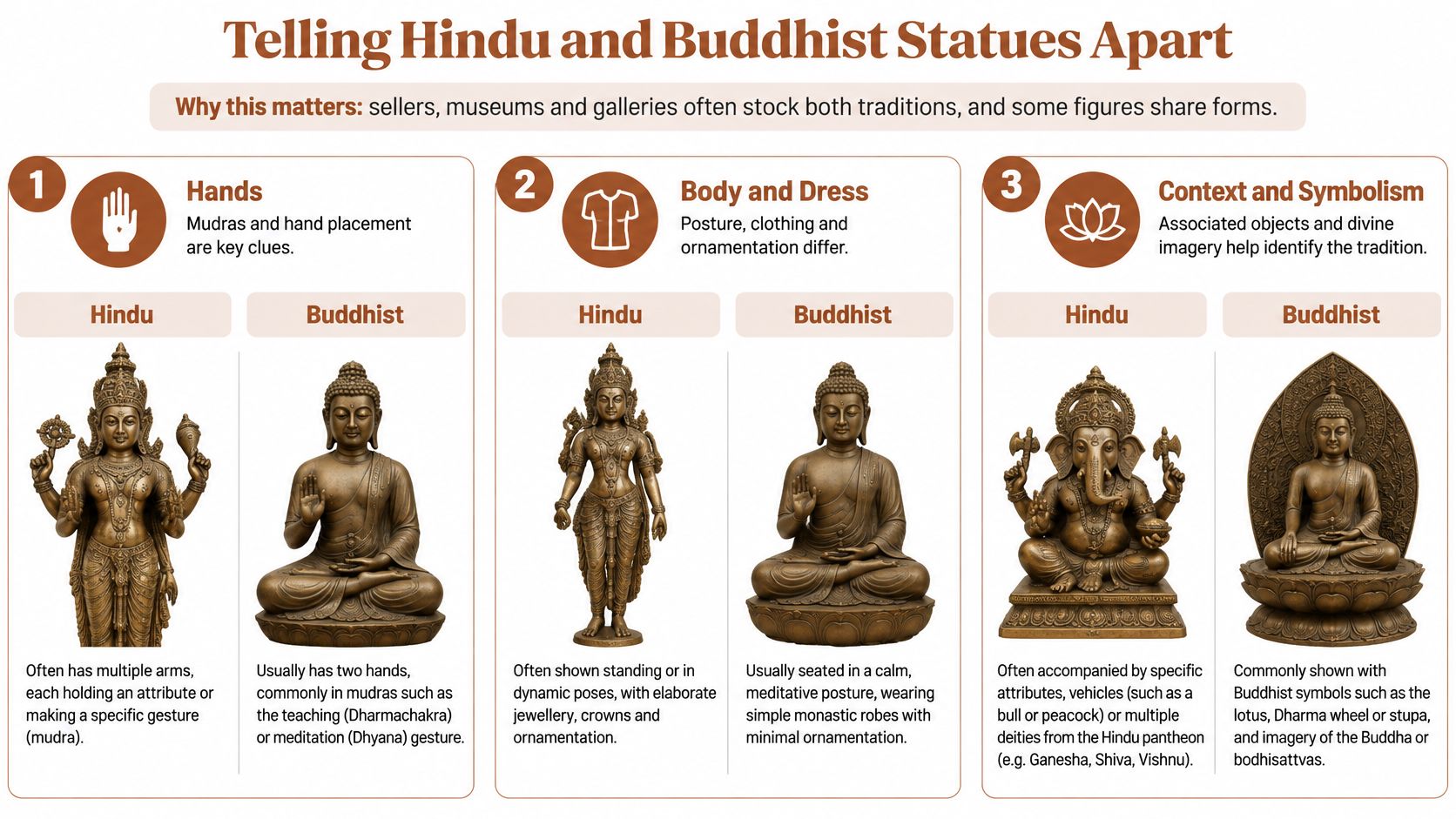
Hands are the fastest test. Buddhist figures are usually shaping a gesture with an empty palm, and the earth-touching gesture in particular is close to diagnostic. Hindu deities are usually holding something, even when the object itself has snapped off, and the grip tells you it existed. Heads come next. A cranial bump under tight snail-shell curls reads as a Buddha; a conical crown or a mass of matted hair tied at the top reads as a Hindu deity. Halos finish the job in most cases, since flame-edged aureoles ring Shiva Nataraja and the plainer rings belong to Buddhist work.
Where the single feature fails
Hindu and Buddhist imagery overlapped for centuries across Java and Cambodia, and sculptors there used each other's vocabulary deliberately. A Hindu deity can stand on a lotus, a Buddhist emblem of purity, without any contradiction. Temple complexes in the region were founded by dynasties that married across religious lines, so shared forms reflect real patronage rather than sloppy copying.
A caution worth keeping: if only one feature fits, you don't have an identification. You have a question.
So run the whole set: hands, head, halo, robes, ornaments, companions. When four of five agree, the fifth is probably damage or regional variation. When only two agree, treat the label as unproven. Our longer piece on how to tell if a statue is Hindu or Buddhist walks through the ambiguous cases.
Regional Styles from India to Southeast Asia
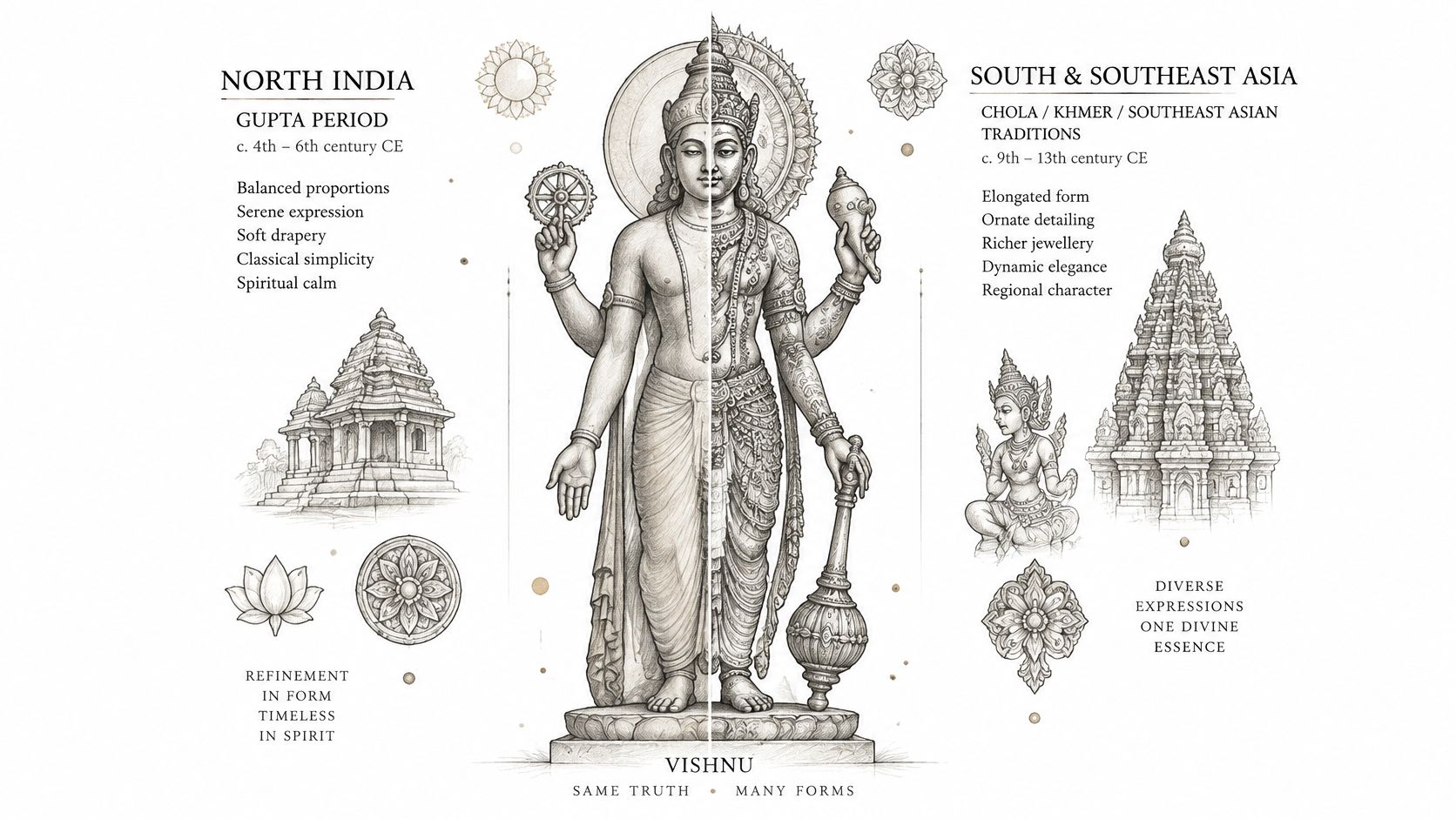
The same god looks different depending on where the sculptor worked and when. Regional style is often a better dating tool than iconography, because a Vishnu from northern India in the fourth century and a Vishnu from Java in the fourteenth can share every emblem while sharing almost nothing else.
| Region and school | Typical period | Typical material | Visual hallmarks |
|---|---|---|---|
| Gupta, northern India | 4th to 6th century CE | Sandstone, terracotta | Halo, balanced modelling, soft drapery |
| Chola, South India | 9th to 13th century CE | Copper-alloy bronze | Slender figures, lost-wax casting, dynamic Nataraja |
| Khmer, Cambodia | 9th to 13th century CE | Bronze, sandstone, wood | Heavy lidded eyes, tall crowns, patterned garments |
| Thai, Sukhothai and Ayutthaya | 13th to 18th century CE | Bronze, gilded bronze | Flame-shaped ushnisha, elongated faces |
| Majapahit, Java | 13th to 16th century CE | Bronze, stone | Strong standing stance, blended Hindu and Buddhist forms |
Northern Indian stone carving of the Gupta period favours restraint. Bodies are smoothly modelled, drapery clings and falls in soft folds, and a carved halo often frames the head. South Indian Chola bronzes go the other way: slender waists, long limbs, and a casting method that lets a sculptor balance a dancing Shiva on one bent leg without the figure collapsing.
A worked example in Khmer style
Say a seated Ganesha comes up for sale with no provenance and a single line of description. If the eyes are heavy-lidded and set beneath a tall, tiered crown, and the robe edge is picked out with a repeating pattern, the piece is reading as Khmer. The elephant head identifies the deity; the crown, eyelids and garment treatment place the school.
That's how attribution works in practice. You don't ask "what does the label say", you ask which features in combination belong together. A Ganesha with a Khmer crown and a very different treatment of the trunk, say a more naturalistic one, is worth comparing against Thai work before you accept the first answer.
Attribution is a judgement, not a rule
Museum catalogues get revised, sometimes decades after publication, when a better comparison turns up. Treat any attribution as a well-supported opinion rather than a fact, and look for the two things that improve it: comparison photographs of securely provenanced pieces, and documented ownership history.
Period and region also change what you should expect to see. Majapahit work in Java mixes Hindu and Buddhist elements in single objects, which is a feature of the period rather than a sign that something is wrong. Our overview of Indian Hindu sculpture from Chola bronze to Rajasthani stone covers how those transitions show up in the metal and the stone.
Judging Material, Identity and Condition Before You Buy
Naming the deity gets you a name. It says nothing about whether the object will survive your hallway, whether a repair is hiding a break, or whether the piece is stable enough to travel. Identity, material and condition are three separate questions, and treating them as one is where first-time buyers get caught. A confident attribution does not make a flaking stone safe to ship, and a pristine surface does not prove the hands are original.
Start with how the thing was made. The British Museum records a South Indian Shiva sculpture as bronze produced by lost-wax casting, also called cire perdue. A wax model is encased in a refractory mould, the assembly is heated so the wax runs out, and molten alloy fills the cavity left behind. That process is what allows multiple arms, attached weapons, fine jewellery and dynamic poses. It also means the mould is generally destroyed after casting, so no production run exists to compare against. Documentation and comparative provenance carry the weight instead.
Four materials, four risks
Each material fails in its own way, and each failure leaves a different signature on the surface.
| Material | How it is made | Typical look and feel |
|---|---|---|
| Bronze | Lost-wax casting: wax model in a mould, wax melted out, molten alloy poured in | Fine, crisp detail and a warm patina |
| Stone (sandstone, granite) | Carved from a block by removing material | Grounded, architectural and heavy |
| Wood | Carved, often lacquered or gilded | Warm and light, sensitive to humidity |
| Terracotta | Shaped from clay and fired | Earthy, porous and fragile |
Bronze holds the crispest detail, and that detail is your best evidence. Carved stone shows tool marks and a different kind of wear, and it fails in ways metal doesn't. Wood moves with the seasons and cracks along the grain when a room dries out. Terracotta loses surface first.
A five-step audit before you commit
- List every visible attribute. Crown type, arm count, hand gestures, what's held or gripped, the vehicle, companions, posture. Write them down rather than eyeballing them.
- Note what's missing, and whether the loss hides identity. A broken wrist matters more when it held the only emblem that distinguishes two similar deities.
- Match the surviving set against the deity table and call it a hypothesis. One match is a lead. Two or three that agree are an identification.
- Separate original material from later work. Look for casting seams, joins at the shoulders, separately fixed arms or weapons, later gilding, patina that stops abruptly, and wear that falls where handling would put it. Judging what a repair does to value sits inside a larger skill, and this walkthrough on how to tell if antiques are valuable covers condition, rarity and provenance in the order a valuer would.
- Request high-resolution photographs of the base, flakes, cracks and repairs. Blurry phone shots hide exactly the detail that decides the price.
Damage doesn't erase identity. The British Museum's Ancient India gallery guide notes that a damaged sandstone figure remains identifiable as Vishnu from its tall crown and the garland draped over the arms, even though the original composition also included a club, conch shell, discus and a spherical representation of the earth. Crown type, arm count, gesture, vehicle, companions and posture all function as diagnostic data, and they survive partial loss better than a single emblem does.
Condition governs transport and display
The same gallery guide describes a sandstone goddess with twelve arms on a lotus base as extremely fragile, with flaking, and records that stone conservation advice strongly recommended it not travel. Size and apparent solidity tell you nothing about shipping suitability. Granular stone decay and delamination get worse with vibration, handling and environmental swings, so an object with active deterioration shouldn't be in a courier's van at all.
Metal isn't automatically safer. Incompatible metals inside one sculpture, such as an iron reinforcement set into a flame aureole, can oxidise, expand and crack the surrounding bronze over time. The weakness hides inside the piece, where a photograph of the front will never show it.
Ask for the base. Cracks, filler and old repairs show up there first, and the base carries the load.
A listing that states height, width, depth and approximate weight, as HD Asian Art's do, gives you the starting figures for this check. For display, that means a load-rated plinth, stable indoor humidity, protection from vibration, and a periodic look at aureoles, bases, attachments and repaired areas. Check those four places every year, with a torch.
Placing and Caring for Statues Respectfully
Search for advice and you'll find confident rules: Ganesha goes by the entrance, the deity faces east, never put a shrine in a bedroom. Some of that is tradition, some is modern etiquette, and some is straight conservation. Mixing the three is how people end up rubbing oil into a bronze that then corrodes.
Tradition-specific practice
Rules of placement and worship vary by community, by region of origin and by household. Shaivite, Vaishnavite and Shakta families don't follow identical conventions, and a family's own lineage and teacher settle questions that no article can. If a statue is going into an active shrine, the person whose practice it is decides the ritual rules. Everyone else, including the seller, is guessing.
Modern household convention
A clean, calm position, off the floor, away from bins and bathrooms, at a height where you can see the face. These are courtesies rather than commandments, and they're the layer most interior-led advice describes. They matter because they shape how a room feels, not because a text requires them.
Conservation requirements
This layer applies to every object regardless of belief.
- Keep humidity stable. Radiators, air conditioning vents and open fires are the enemies, especially for wood.
- Don't anoint bronze or stone with oil, ghee or sandalwood paste unless you accept the change it makes to the surface. Oils trap dust, darken porous stone and can feed corrosion at joints.
- Keep incense smoke from depositing on polished surfaces. It leaves a sticky film that's difficult to remove without disturbing the patina.
- Support the weight properly. A vibration-free, level, load-rated shelf, not a floating bracket.
A workable rule: let the owner's tradition set the ritual, and let the material set the practical limits.
The questions people actually ask
Whether an antique needs ritual activation is a decision for the owner and their teacher, and many collectors keep antique pieces as art while reserving worship for a household image. Anointing is a conservation question first: a stone that has absorbed oil for decades is a different object from one that hasn't. Photographing a sacred image for a listing or an insurance file is fine, and the usual courtesies apply, so shoot the whole figure rather than cropping the face for effect and don't place it among unrelated clutter.
One number deserves care. The Office for National Statistics defines the 2021 religion measure as the religion with which people connect or identify, "whether or not they practise or hold a belief in it"; the detailed dataset comes from Census Day, 21 March 2021. So the figure of about 1.0 million Hindu-identifying residents is not a count of worshippers, temple attendees or home altars, and no single rule describes every household.
Geography reinforces the point. ONS local-authority data puts Harrow highest in England and Wales at 25.8% of residents identifying as Hindu, with Leicester second at 17.9%, up from 15.2% in 2011. Practice concentrates in particular places for particular reasons, which is the opposite of a universal placement rule.
The arrangement that satisfies all three layers is simple: a stable, level surface at eye level, out of direct sun, with the ritual details left to the owner's own tradition.
Deciding Whether to Buy a Statue Across Borders
A statue can clear UK import rules and still stall for weeks on the way to a buyer in France or Italy. That's the trap. Sellers reassure buyers that British import is straightforward, which is true, and buyers hear that delivery is straightforward, which doesn't follow.
From 28 June 2025, EU rules on cultural goods split into two regimes. For antique sculptures more than 200 years old and valued at €18,000 or more, the buyer files an importer statement on entry to the EU. Import licences are a separate requirement, applying to archaeological and ethnographic objects rather than sculpture generally. The rules do not apply to imports into Great Britain. A UK seller shipping to an EU customer still has to explain the buyer's obligations in the destination country, because those obligations land on the importer.
A decision path, in the order the paperwork arrives
- Establish age. Is the piece antique or contemporary? An object made last year and an object made in 1780 travel through different systems.
- Check the value against the €18,000 threshold. For objects over 200 years old, this is the line that triggers an importer statement on entry to the EU.
- Confirm origin, including school and country. "Khmer" or "Thai" is a style, not a location of export, and customs wants the latter.
- Identify the destination and any onward route. A statue bought in London and forwarded from Amsterdam needs both sets of rules satisfied.
- Gather provenance documents. Provenance is the recorded ownership history. Museums treat documenting it as a legal and ethical duty, and a private buyer benefits from the same habit.
- Agree who handles customs, in writing, before you pay. Clearing agents, duties and licence applications cost money and time, and someone has to own them.
The point worth holding on to: "UK import permitted" and "EU delivery uncomplicated" are two different statements.
Legality and ethics are two separate checks
A clean licence doesn't answer the ethical question, and an ethical purchase doesn't clear customs by itself. Run both. Ask when the object left its country of origin, what documentation follows it, and whether the seller can name the chain of owners rather than describing it as "old European collection". A vague chain is a question, not a reassurance.
Notice how the checks interlock. Identity tells you which rules apply, because an 1820 bronze and a 2020 casting sit in different regimes. Material tells you how the piece survives the journey, because a stone figure and a hollow-cast bronze need different packing. Shipping risk tells you who carries the cost if something goes wrong. Skipping any one of the three leaves the other two half answered.
Matching a statue to your space is where a specialist can help early rather than after the shipping quote. We'll help you choose the right statue if you share photographs, measurements of your space, and your preferences such as deity, material or style. Every product description on the site sets out the statue's stylistic origin, whether Khmer, Thai or Indian school, and whether the piece is antique, vintage or a high-quality contemporary work inspired by historic temple art.
Start this week with one piece you're seriously considering: photograph it, measure the wall or plinth it would sit on, note its age and destination, and check all three before you commit.
Statues of Hindu gods reward buyers who look at identity, material and risk as one problem rather than three. At HD Asian Art we hold museum quality Hindu and Buddhist sculpture in bronze, stone and wood, from Ganesha and Shiva to Durga, Lakshmi and Murugan, and most of the pieces are one-off or limited works where the specific object is the thing worth examining. Send us photographs and measurements of the space you have in mind, and we'll help you match deity, material and scale before you decide.
