



7th–11th Century 'Kali' in Indonesia: Verify Durga Forms, Provenance
7th–11th Century 'Kali' in Indonesia: Verify Durga Forms, Provenance
For collectors, “Kali in Indonesia” means Hindu goddess figures and syncretic Durga/Kali statues carved or cast in Indonesian temple and antique sculpture traditions, not the Indonesian word for river.
These pieces appear mainly in bronze, stone, and wood, and date approximately from early medieval to late medieval periods. Read on to learn how to spot correct iconography, judge provenance, and handle acquisition and long-term care.
Key Features:
- Most Indonesian goddess figures are stylized Durga in her fierce form, with multiple arms and a dynamic stance, often mistaken for Kali but usually representing Durga.
- Provenance, export permits, and detailed condition reports are essential to verify authenticity and legal export, especially for high-value statues.
- Older bronze, stone, and wood pieces from the 7th to 11th centuries exhibit specific stylistic and tool marks that help estimate their age, but lab testing is preferred.
- Reputable galleries ship via insured couriers, require export documentation, and advise buyers to budget for import duties and customs broker fees.
- Proper care involves controlling humidity, securely mounting tall statues, and avoiding pieces with signs of recent temple removal or artificial patina.
Table of Contents
- What Does Kali Look Like in Indonesian Sculpture?
- Historical and Archaeological Context: Why These Figures Appear in Indonesia
- Reading Material and Style to Estimate Age and Origin
- What Should You Check Before Buying an Indonesian Kali Statue?
- How Should US Collectors Buy and Import These Pieces?
- Caring for and Displaying an Indonesian Goddess Statue
- Why Do Collectors and Designers Value These Figures?
- An Editorial Note on Buying Indonesian Goddess Sculpture
- Find Authentic Indonesian Goddess Sculpture Through HD Asian Art
- Sources
- FAQ
What Does Kali Look Like in Indonesian Sculpture?
Most Indonesian representations of the goddess are technically Durga in her fierce Mahishasuramardini form, slaying the buffalo demon, rather than Kali as she appears in later Indian Tantric paintings. Collectors run into this overlap constantly, and it matters for how a piece gets described and priced.
Look for these recurring traits:
- Multiple arms (commonly four to eight) holding a kartika (sacrificial knife), a chakra, a conch, a mace, or a small shakti figure
- A dynamic, often lunging or triumphant stance, sometimes with one foot on the buffalo demon’s head or back
- A calm or serene facial expression despite the violent narrative, a stylistic choice distinct from South Asian ferocious Kali imagery
- Attendant figures, dwarfish ganas or guardians, flanking the base
The overlap between Durga and Kali in Indonesia isn’t sloppy labeling. Scholarship on Balinese temple sculpture shows that several major images sit inside a Tantric Buddhist context alongside Hindu iconography, which is why a single figure can carry both names depending on the temple, the era, and the scholar describing it.
Pro Tip: Before buying from a photo listing, ask the seller for close-up shots of the hands and any surviving attributes. Weapon shape and hand position narrow down the deity and the region faster than the overall pose does.
Historical and Archaeological Context: Why These Figures Appear in Indonesia
Hindu and Tantric Buddhist iconography moved into the archipelago through maritime trade routes connecting the northeastern Indian subcontinent to Sumatra and Bali between roughly the 7th and 11th centuries. These weren’t isolated imports. Comparative scholarship on Padang Lawas Heruka imagery and Balinese Durga statues shows stylistic parallels that point to shared workshops or traveling artisans, not just shared iconography.
Two reference objects anchor the timeline for collectors:
- A granite goddess statue found at Tanjung Priok in North Jakarta, dated to roughly the 7th or 8th century CE, seated cross-legged with four arms, now held in the Jakarta History Museum
- The Durga image at Pura Bukit Dharma in Bali, an eight-armed figure over 2.2 meters tall, dated to around the 11th century and considered the largest of several comparable Balinese examples
Regional style diverges in useful ways. Central and East Javanese work from the 9th through 13th centuries tends toward more naturalistic proportions and denser relief ornament, reflecting Majapahit-era court aesthetics. Balinese pieces often show more angular, ritual-focused carving tied to active temple worship rather than palace patronage. Sumatran finds are rarer and generally show closer ties to the Tantric Buddhist material coming through Padang Lawas.
Reading Material and Style to Estimate Age and Origin
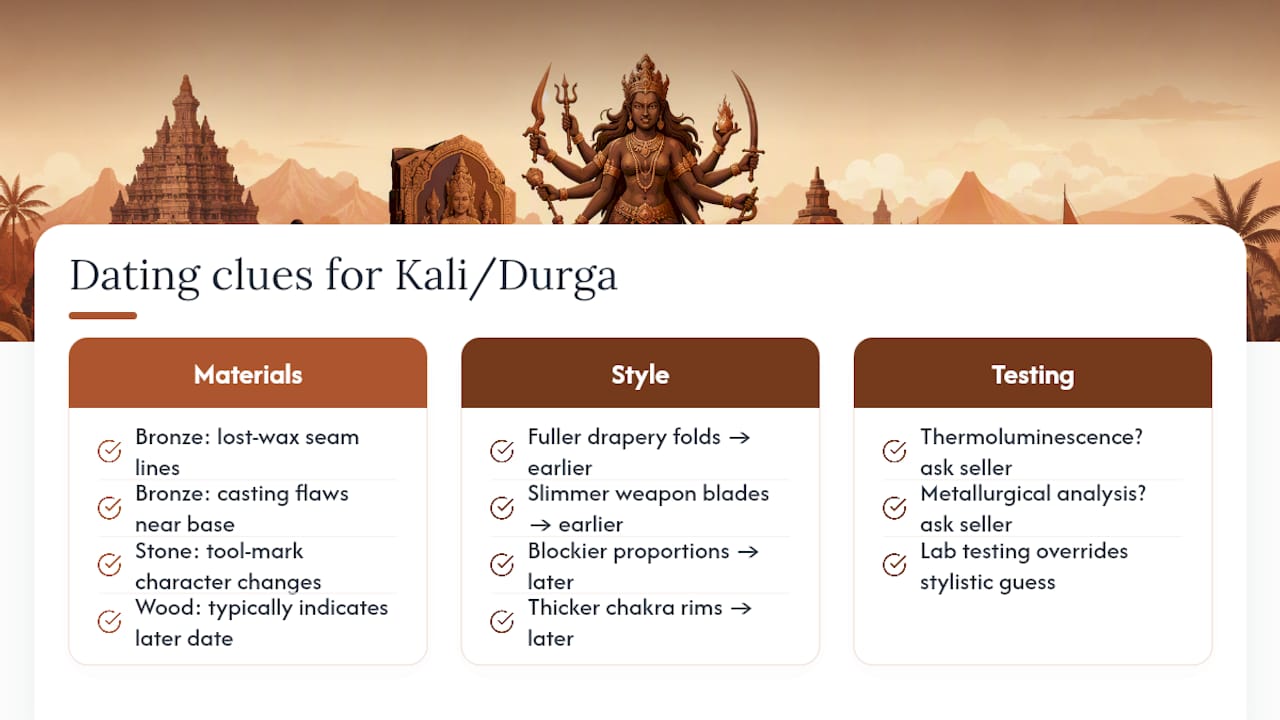
Bronze figures were typically produced through lost-wax casting, which leaves faint seam lines and, on unrestored pieces, small casting flaws near the base or limbs. Stone sculptures, usually andesite or granite in Java and volcanic stone in Bali, carry tool marks that shift character across centuries. Wood pieces, less common in surviving Kali/Durga forms because of the tropical climate, usually indicate a later production date simply because older wood rarely survives intact.
Style narrows the picture further. Fuller drapery folds and slimmer weapon blades tend to track earlier Central Javanese work, while blockier proportions and thicker chakra rims show up more in later regional variants. None of this replaces lab testing. When a seller claims an early date on a high-value piece, ask whether thermoluminescence or metallurgical analysis has ever been performed.
What Should You Check Before Buying an Indonesian Kali Statue?
Provenance separates a collectible from a liability. Before committing to a purchase, require the following:
- A written ownership history, ideally traceable through prior sales, auction records, or museum loan documentation
- Any export permit or customs paperwork tied to the piece’s original departure from Indonesia
- Comparative citations, meaning does the seller or a third party reference catalog entries similar to how the National Museum of Asian Art documents comparable Devi imagery
- Condition disclosure covering repairs, replaced limbs, or surface treatment
- High-resolution, object-level photography showing the underside, interior cavities, and any inscription
Technical red flags include uniform, artificially even patina, machine-tool marks on supposedly ancient stone, and casting seams that look too clean for lost-wax work. A gallery that publishes individually researched and photographed object descriptions rather than generic stock imagery is signaling that it has actually inspected the piece.
Pro Tip: Ask directly whether a lab test has been performed on any statue priced above a few thousand dollars. A reputable seller won’t be offended, and a reluctant answer is itself useful information.
How Should US Collectors Buy and Import These Pieces?
Specialist galleries remain the most reliable channel for Indonesian goddess sculpture, largely because they maintain relationships with source-country exporters and can produce documentation that private sellers usually cannot.
Before you commit to a purchase, confirm the following:
- The gallery ships via an insured international courier, with DHL being a common standard for antique statuary
- There’s a clear condition-on-arrival policy, so damage in transit is covered rather than disputed after delivery
- The seller can provide or point you toward Indonesian export documentation for the specific object
- You’ve budgeted for import duties and, on higher-value pieces, consulted a customs broker before the shipment leaves origin
Legal exposure is the part collectors underestimate. Indonesia restricts export of certain cultural heritage objects, and Indonesia is a party to the UNESCO 1970 Convention on illicit trafficking in cultural property. A piece without documented lawful export history can be seized at a US port of entry or become unsellable later. For anything above a modest price point, a short consultation with an art law attorney costs far less than losing the object.
Caring for and Displaying an Indonesian Goddess Statue
Bronze tolerates typical indoor humidity, but stone and wood do not. Keep relative humidity in the 45 to 55 percent range and avoid placing wood or stone pieces near heating vents or south-facing windows where UV exposure accelerates surface degradation.
Mount stone and bronze figures on a stable, weighted base, and anchor tall pieces (anything approaching the 2.2 meter scale of temple originals) to prevent tipping. Insure the piece separately from a standard homeowner’s policy once its appraised value exceeds a few thousand dollars.
Ethical stewardship matters as much as physical care. If a piece shows clear signs of having been removed from an active temple site, meaning fresh chisel damage or an incomplete architectural fragment, decline the purchase. Documented, legally exported pieces exist in enough supply that collectors don’t need to take on that risk.
Why Do Collectors and Designers Value These Figures?
Genuine 7th to 11th century Indonesian goddess sculpture is scarce, and museums actively seek documented pieces to fill gaps in Southeast Asian collections. That scarcity, paired with the dramatic pose typical of the Mahishasuramardini form, makes these statues strong visual anchors in both gallery displays and residential interiors.
Documentation drives resale value more than most collectors expect. A statue with a clear ownership chain and published research routinely commands a stronger price than an identical-looking piece sold with no paper trail, because buyers are pricing in legal certainty as much as aesthetics.
An Editorial Note on Buying Indonesian Goddess Sculpture
The biggest mistake I see collectors make is treating “Durga” and “Kali” as interchangeable marketing terms rather than asking which one actually applies to the piece in front of them. That distinction changes how you research comparables and what you should expect to pay.
When I evaluate a piece for HD Asian Art, I ask for the same things I’d tell any serious buyer to demand: full-object photography including the base and any interior cavity, a specific regional attribution rather than a vague “Southeast Asian” label, and whatever ownership history the consignor can produce. We document each statue individually, with expert-written descriptions and photography, and ship everything through insured international carriers because a piece that survived a millennium deserves better than uninsured freight.
— James, HDAsianArt.com
Find Authentic Indonesian Goddess Sculpture Through HD Asian Art
HD Asian Art is the alternative to buying blind from auction sites or unverified overseas sellers. Every Indonesian, Balinese, and Javanese piece in the collection comes with individual research, detailed condition notes, and object-level photography, so you’re evaluating documented history instead of guessing from a single stock image.
Browsing pieces like the bronze Shiva statue or the Majapahit-style Tara statue shows exactly the level of documentation you should expect on any Indonesian goddess figure, right down to condition reporting and provenance notes. When you inquire about a piece, ask for the same detail: casting or carving characteristics, any prior ownership record, and export paperwork if the object left Indonesia recently. Every purchase ships worldwide through insured courier service.
Ready to see what’s currently available? Visit the HD Asian Art gallery to browse the current collection or send an inquiry about a specific piece.
Sources
- Durgā Mahiṣāsuramardinī in Likely Tantric Buddhist Context from the Northern Indian Subcontinent to 11th-Century Bali (ANU open research repository)
- File: Durga_Kali_Tanjung_Priok_Jakarta.jpg — Wikimedia Commons
- Academia
- The goddess worshipped by the sage Chyavana from a Tantric Devi series — National Museum of Asian Art
FAQ
Is a Kali Statue From Indonesia the Same as Durga?
Most Indonesian pieces sold as “Kali” are technically Durga in her Mahishasuramardini form, and the two labels overlap because of Tantric Buddhist syncretism in Balinese and Javanese temple art.
How Old Are Authentic Indonesian Kali/Durga Statues?
Documented examples range from the 7th to 8th century Tanjung Priok granite statue to 11th century Balinese bronzes and stone figures, with later Majapahit-era pieces continuing the tradition into the 13th century and beyond.
What Paperwork Should I Get Before Importing One to the US?
Request ownership history, any Indonesian export permit, and a condition report, and consult a customs broker for high-value pieces given restrictions tied to the UNESCO 1970 Convention on cultural property.
Does HD Asian Art Provide Provenance Documentation?
Yes, HD Asian Art researches, photographs, and describes each object individually, and ships internationally through insured DHL service so buyers receive both documentation and transit coverage.
What’s the Biggest Red Flag When Buying These Statues?
An uneven or suspiciously fresh-looking patina, machine-tool marks on “ancient” stone, and a seller unwilling to provide ownership history or export documentation are the clearest warning signs.
