



Wie Bronzeguss im alten Asien funktionierte: Ein Leitfaden für Sammler
Wie Bronzeguss im alten Asien funktionierte: Ein Leitfaden für Sammler
Der antike asiatische Bronzeguss folgte zwei vorherrschenden technischen Familien: Stückguss, die bestimmende Methode der Bronzezeit und der Shang-Dynastie China, und Wachsausschmelzguss (cire perdue)., die primäre Technik in Süd- und Südostasien. Der erste Schritt bei der Authentifizierung besteht darin, zu verstehen, welche Methode ein bestimmtes Objekt erzeugt hat.
Wichtige Behörden bestätigen diese Spaltung:
- Die Smithsonian’s National Museum of Asian Art dokumentiert die Stückform als primäre chinesische Methode, die ein Tonmodell, eine geschnittene Außenform und einen abgeschabten Innenkern umfasst.
- Die Metropolitan Museum of Art bestätigt, dass die Stückform eine direkt in die Form vor dem Brennen geschnitzte Dekoration ermöglichte, wodurch das scharfe geometrische Relief entstand, das für Shang-Ritualbronzen charakteristisch ist.
- Archäologische Gießereirückstände in Anyang (Provinz Henan) liefern physische Beweise für in großem Maßstab gebrannte Tonformen, wodurch der wissenschaftliche Fokus auf die Organisation der Produktion und nicht nur auf fertige Objekte verlagert wird.
Für Sammler erzählt die Oberfläche die Geschichte. Stückgeformte Objekte weisen feine erhabene lineare Nähte an den Formfugen und starre, geometrische Verzierungen auf. Stücke im Wachsausschmelzverfahren weisen organischere, fließendere Formen mit unterschiedlichen Naht- und Schlitzeigenschaften auf. Beides ist diagnostisch und nicht kosmetisch.
Inhaltsverzeichnis
Wie Bronzeguss im alten Asien funktionierte: Methoden und Regionen
Zwei Gusstraditionen prägten die Bronzekunst im alten Asien, und ihre geografische Verteilung war kein Zufall.
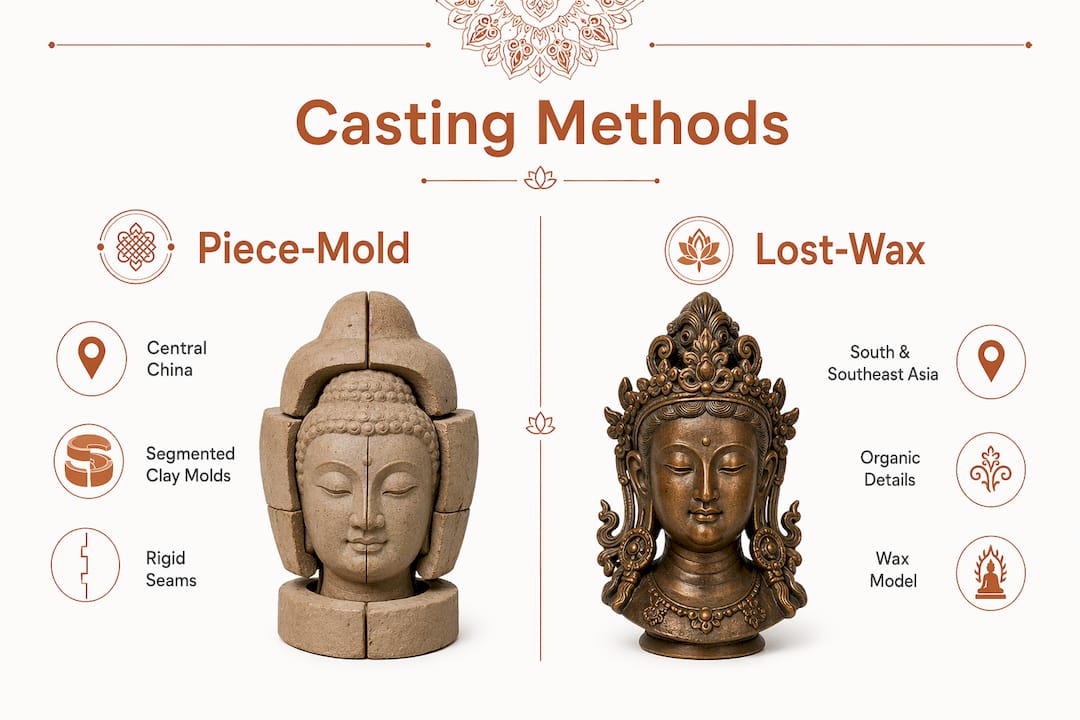
Stückguss zentral dominiert China von der Shang-Dynastie (ungefähr 1700–1100 v. Chr.) über die Zhou-Dynastie bis in die Han-Zeit. Der Wachsausschmelzguss dominierte in Südasien (Indus-Tal-Tradition, später indische Skulptur) und Südostasien (Dong-Son-Trommelkultur Vietnams, Khmer-Bronzen). Kambodscha, Thailändische buddhistische Statuen).
Die Wahl war bewusst. Technische Analyse von Getty zeigt, dass chinesische Gießer die Stückform besonders bevorzugten, weil sie extrem scharfe, kontrollierte Reliefdetails erzeugte, die für rituelle Bronzen geeignet waren. Im Gegensatz dazu zeichnete sich das Wachsausschmelzverfahren durch organische, dreidimensionale Formen aus: stehende Buddhas, vielarmige Hindu-Gottheiten und naturalistische Tierfiguren.
Chronologisch gesehen ist die Bronzezeit in China begann weit vor 1100 v. Chr., wobei die Stückformtechniken in der Shang-Zeit einen hohen Grad an Raffinesse erreichten. Südostasiatische Zinnbronze-Traditionen, einschließlich der Dong Son Schlagzeugwerden durch einige archäometallurgische Analysen auf nicht später als etwa 3000 v. Chr. datiert, was auf eine frühe und unabhängige Entwicklung von Cire Perdue in der Region hinweist.
Statistik: Ein einziges Grab für den Marquis Yi von Zeng brachte eine riesige Menge Bronze hervor, sodass ein großes Team von Handwerkern erforderlich war, um große Gefäße wie die großen 800 kg schweren Exemplare herzustellen.
Profi-Tipp: Wenn ein Verkäufer ein chinesisches Ritualgefäß als „Wachsausschmelzguss“ beschreibt, ist das ein Warnsignal. Stückform war während der Tang-Dynastie der Standard für chinesische Gefäße; Verwendung von Wachsausschmelzverfahren China war begrenzt und spezifisch. Ein behauptetes chinesisches Schiff im Wachsausschmelzverfahren bedarf einer besonderen Prüfung.
Schritt für Schritt: Wie durch Stückgießen chinesische Ritualbronzen hergestellt wurden
Die Stück-Form-Sequenz folgte einer präzisen, wiederholbaren Reihenfolge:
- Tonmodell. Kunsthandwerker formten ein vollständiges Tonmodell des Gefäßes, einschließlich aller Oberflächendekorationen.
- Äußere Formabschnitte. Eine zweite Tonschicht wurde über das Modell gepackt, trocknen gelassen, dann in Abschnitte geschnitten und gebrannt.
- Innerer Kern. Das ursprüngliche Modell wurde um die Dicke der vorgesehenen Bronzewand gekürzt und bildete den Kern.
- Zusammenbau. Die äußeren Formteile wurden um den Kern herum wieder zusammengesetzt, so dass ein schmaler Spalt für das Metall blieb.
- Bronzeguss. In den Spalt wurde geschmolzene Bronze gegossen. Manchmal hielten Chaplets (Abstandshalter aus Metall) den Kern in Position.
- Abschluss. Nach dem Abkühlen wurde die Form entfernt und die Oberfläche poliert.
Sammler können jeden Schritt sichtbaren Beweisen zuordnen:
- Erhöhte Formnähte Die Verbindungen an den Abschnitten sind normal und erwartungsgemäß, keine Anzeichen einer schlechten Qualität.
- Spuren des Rosenkranzes (kleine kreisförmige oder rechteckige Vertiefungen auf Innenflächen) zeigen an, wo Abstandshalter den Kern hielten. Archäometallurgische Studien Beachten Sie, dass weniger Rosenkränze manchmal mit höherer Handwerkskunst einhergehen, da erfahrene Gießer Störungen an der Oberfläche minimierten.
- Werkzeugspuren Die von der Endbearbeitung nach dem Guss stammenden Reste sind unter der Vergrößerung sichtbar, insbesondere an den Nahtlinien.
Profi-Tipp: Bitten Sie jeden Verkäufer um Nahaufnahmen des Innenhohlraums und aller vier Außenseiten unter Streiflicht. Schimmelnahtlinien und Kranzvertiefungen lassen sich bei einer echten Antiquität kaum überzeugend nachahmen und fehlen bei den meisten modernen Reproduktionen oder sind inkonsistent.
Schritt für Schritt: Wachsausschmelzguss in Süd- und Südostasien
Das in Süd- und Südostasien dokumentierte Wachsausschmelzverfahren funktioniert von innen nach außen:
- Ein Ton- oder Sandkern wird in die grobe Form des Objekts eingearbeitet.
- Wachs wird auf den Kern aufgetragen und in die endgültige Form gebracht, einschließlich aller Oberflächendetails.
- Wachskanäle und Entlüftungsöffnungen werden hinzugefügt, um geschmolzenes Metall zu kanalisieren und das Entweichen von Gasen zu ermöglichen.
- Die gesamte Baugruppe wird mit feinem Tonschlicker und anschließend mit einer gröberen Toneinbettmasse überzogen.
- Die Form wird gebrannt, dabei brennt das Wachs aus und die Tonschale wird hart.
- In den durch das Wachs entstandenen Hohlraum wird geschmolzene Bronze gegossen.
- Nach dem Abkühlen wird die Toneinbettmasse abgebrochen und das Stück ist fertig.
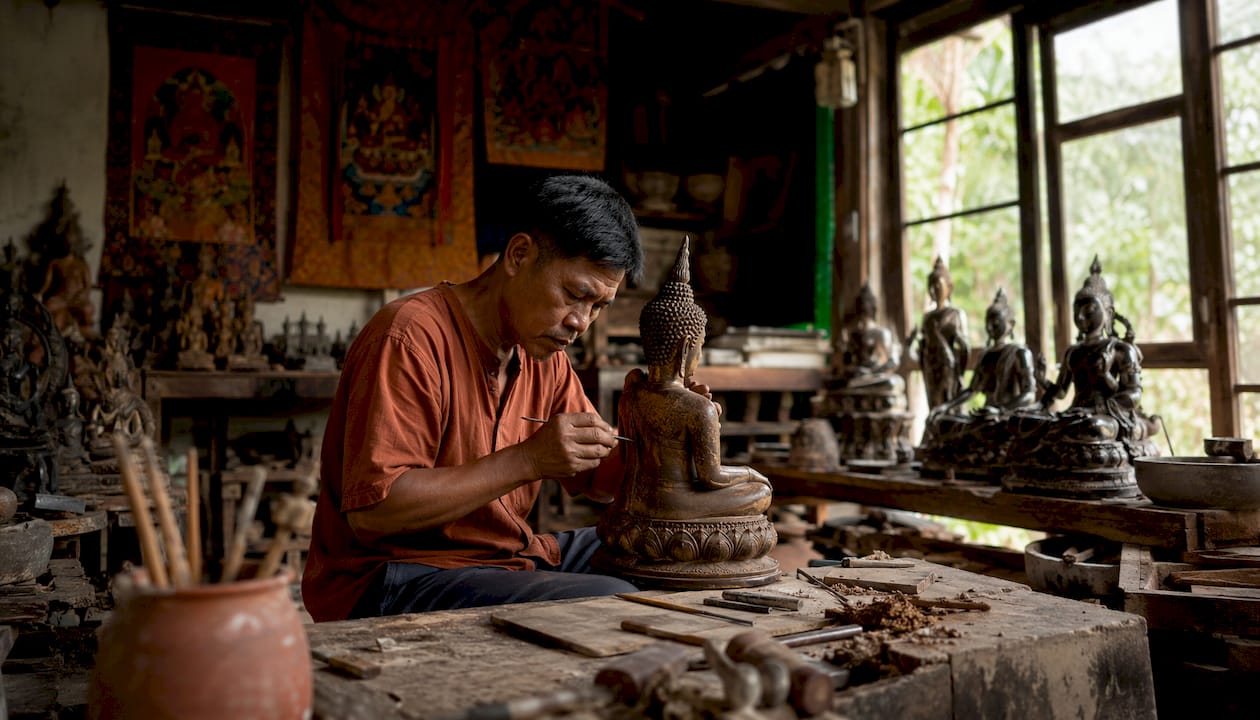
Die diagnostischen Oberflächenmerkmale von Wachsausschmelzstücken unterscheiden sich deutlich von Stückformarbeiten. Die Dekoration ist eher organisch und fließend als geometrisch. Nahtlinien sind, sofern vorhanden, dünner und weniger regelmäßig. Entlüftungsspuren erscheinen als kleine kreisförmige Markierungen, oft auf weniger sichtbaren Oberflächen. Die Gesamtoberflächenstruktur ist tendenziell glatter, mit Details, die natürlichen anatomischen oder drapierten Formen folgen.
Profi-Tipp: Für Südostasiatische buddhistische StatuenUntersuchen Sie Gewandfalten und Fingerdetails unter Vergrößerung. Authentische Cire-Perdue-Arbeiten zeigen subtile organische Variationen; Moderne Sandguss-Reproduktionen zeigen gleichmäßige, leicht verschwommene Details ohne Entlüftungsspuren.
Materialien, Legierungszusammensetzung und was sie Sammlern verraten
Antike asiatische Bronzen sind Kupfer-Zinn-Legierungen, deren Zusammensetzung jedoch je nach Region und Zeit erheblich schwankte. Blei wurde üblicherweise hinzugefügt, um den Fluss beim Gießen zu verbessern, insbesondere bei komplexen Formen. Chinesische Bronzen wiesen große Unterschiede im Zinnanteil auf, während südostasiatische Legierungen auf die reichhaltigen Zinnressourcen der Region zurückgriffen.
Sichtbare Hinweise, die Sammler ohne Labor beurteilen können:
- Oberflächenfarbe: Ein höherer Zinngehalt erzeugt eine hellere, silbrigere Patina. Bleireiche Legierungen neigen zu dunklerer, dichterer Korrosion.
- Gewicht: Bleizusätze erhöhen die Dichte spürbar. Ein Stück, das sich aufgrund seiner Größe schwerer anfühlt als erwartet, hat möglicherweise einen hohen Bleigehalt.
- Gussporosität: Kleine Vertiefungen auf der Oberfläche weisen auf Gasblasen beim Gießen hin, die bei großen oder komplexen Teilen häufig vorkommen.
Wenn die Zusammensetzung für die Authentifizierung von Bedeutung ist, fordern Sie einen Röntgenfluoreszenzbericht (RFA) an. RFA identifiziert die Elementzusammensetzung zerstörungsfrei und kann bestätigen, ob die Legierungsverhältnisse mit dem angegebenen Zeitraum und der angegebenen Region übereinstimmen. Die technischen Fallstudien von Getty nutzen genau diesen Ansatz, um echte Antiquitäten von späteren Reproduktionen zu unterscheiden.
Statistik: Der Zinngürtel Südostasiens erstreckt sich von Birma durch Thailand nach Malaysia und Indonesien, macht ungefähr aus 54 % der weltweiten Zinnproduktion Historisch gesehen erklärt dies, warum südostasiatische Gründer stets Zugang zu hochwertigen Zinn-Bronze-Legierungen hatten.
Profi-Tipp: Achten Sie bei der Durchsicht eines RFA-Berichts auf den Bleianteil neben Zinn. Ein Bleigehalt von über etwa 5–10 % in einem angeblichen Gefäß aus der Shang-Zeit ist nicht ungewöhnlich, aber ein ungewöhnlich niedriger Bleigehalt in einer angeblichen südostasiatischen Trommel oder Statue rechtfertigt eine Folgefrage an den Verkäufer.
Gießereien, Handwerksorganisationen und warum eine zentralisierte Produktion wichtig ist
Bronzeproduktion in der Antike China war keine Heimindustrie. Gießereischutt in Anyang, der ehemaligen Shang-Hauptstadt in der Provinz Henan, zeigt Handwerker, die Tonschnittformen und Hochtemperaturgüsse in großem Maßstab handhaben. Abfallfragmente, Fehlgussstücke und Ofenreste verraten mehr über die Produktionsorganisation als fertige Objekte allein.
Diese Zentralisierung erklärt das sich wiederholende dekorative Vokabular der Shang-Bronzen. Das Taotie (eine frontale Tiermaske), die Flechtmuster und die zoomorphen Griffe erscheinen einheitlich, weil sie in standardisierte Formabschnitte geschnitzt und nicht an jedem Stück freihändig ausgeführt wurden. Sammler, die diese Logik erkennen, können die Motivkonsistenz als ein Authentifizierungssignal verwenden.
Die südostasiatische Produktion verlief nach unterschiedlichen Mustern. Kleinere Werkstätten und regionale Handwerkernetzwerke stellten Trommeln, Statuen und Reliquien mit lokaleren Variationen her. Eine Khmer-Bronze aus Kambodscha und ein thailändischer Buddha aus der Ayutthaya-Zeit spiegeln unterschiedliche Workshop-Traditionen wider, kein einziges zentralisiertes Programm.
So authentifizieren Sie eine antike Bronze: eine praktische Checkliste
Authentifizierung erfordert eine systematische Untersuchung, keinen einzigen Test.
- Schimmelnähte untersuchen. Stücknahtnähte sind fein, erhaben und linear. Fehlende Nähte auf einem angeblichen chinesischen Schiff sind verdächtig.
- Auf Rosenkranzspuren prüfen. Innere Vertiefungen weisen auf ursprüngliche Kernstützen hin. Ihre Abwesenheit in einem beanspruchten Shang-Schiff ist ein Zeichen.
- Patinatiefe beurteilen. Authentische Patina dringt in die Metalloberfläche ein. Die künstlich aufgetragene Patina liegt oben und lässt sich sauber abkratzen.
- Suchen Sie nach Entlüftungs- und Angussspuren. Wachsausschmelzstücke weisen kleine kreisförmige Markierungen auf, an denen Lüftungsschlitze entfernt wurden. Ihr Standort und ihre Beschaffenheit sollten mit der beanspruchten Technik übereinstimmen.
- Gewicht und Akustik testen. Klopfen Sie vorsichtig auf das Stück. Dichte, bleihaltige Bronzen erzeugen einen dumpfen Klang; Bronzen mit hohem Zinngehalt klingen deutlicher.
- Fordern Sie eine Herkunftsdokumentation an. Exportlizenzen, Auktionsaufzeichnungen, Sammlungshistorien und Importpapiere sind alle relevant.
- Fordern Sie einen RFA- oder Metallographiebericht an Lassen Sie sich vor jedem größeren Kauf von einem unabhängigen Labor beraten.
Fragen, die Sie einem Verkäufer direkt stellen sollten: Können Sie hochauflösende Fotos aller Innenflächen bereitstellen? Haben Sie einen RFA- oder metallografischen Analysebericht? Wie ist die dokumentierte Sammlungshistorie vor Ihrem Erwerb?
Profi-Tipp: Eine inszenierte Provenienz, etwa ein getippter Brief ohne nachweisbaren Sammlernamen oder die vage Behauptung einer „Europäischen Privatsammlung“, ist eines der häufigsten Warnsignale auf dem Markt für antike Bronze. Bestehen Sie auf einer Dokumentation, in der bestimmte Auktionshäuser, Händler oder Institutionen mit überprüfbaren Aufzeichnungen genannt werden.
Konservierung, Lagerung und rechtliche Überlegungen für US-Sammler
Eine ordnungsgemäße Lagerung schützt sowohl das Objekt als auch seinen Wert. Bewahren Sie Bronzen bei stabiler Luftfeuchtigkeit (40–50 % relative Luftfeuchtigkeit) und vor direkter Sonneneinstrahlung geschützt auf. Verwenden Sie gepolsterte, nicht reaktive Stützen. Vermeiden Sie die Reinigung mit Wasser oder scheuernden Materialien; Konsultieren Sie einen professionellen Restaurator, bevor Sie aktive Korrosion (Bronzekrankheit, erkennbar an pudrigen, hellgrünen Flecken) behandeln.
US-Sammler müssen auch rechtliche und ethische Verpflichtungen erfüllen. Die Gesetz zur Umsetzung des Übereinkommens über Kulturgüter und bilaterale Abkommen zwischen den USA und mehreren asiatischen Ländern beschränken die Einfuhr von undokumentiertem Kulturgut. Jede Bronze, für die es keine eindeutige Herkunftsdokumentation aus der Zeit vor 1970 (Grundlinie des UNESCO-Übereinkommens) gibt, birgt ein rechtliches Risiko und ein Reputationsrisiko. Bei diesem Artikel handelt es sich um allgemeine Informationen und nicht um eine Rechtsberatung. Lassen Sie sich vor dem Kauf die aktuellen Einfuhrbestimmungen von einem qualifizierten Anwalt oder der US-Zoll- und Grenzschutzbehörde bestätigen.
Statistik: Das UNESCO-Übereinkommen von 1970 über Mittel zum Verbot und zur Verhinderung der unerlaubten Einfuhr, Ausfuhr und Eigentumsübertragung von Kulturgut bleibt das von US-Museen und großen Auktionshäusern verwendete Standardbasisdatum für die Provenienzdokumentation.
Profi-Tipp: Fotografieren Sie vor dem Kauf jede Oberfläche des Stücks und alle dazugehörigen Dokumente. HDAsianArt empfiehlt, für jedes Objekt eine eigene Datei zu führen: Kaufbeleg, Herkunftskette, Zustandsbericht und RFA-Daten, falls verfügbar. Diese Dokumentation unterstützt die Versicherungsbewertung und jeden zukünftigen Weiterverkauf.
Wichtige Erkenntnisse
Der alte asiatische Bronzeguss lässt sich in zwei technische Familien einteilen: Stückguss und Wachsausschmelzverfahren, die jeweils deutliche, lesbare Spuren auf der Oberfläche hinterlassen, anhand derer Sammler die Authentizität und die regionale Herkunft beurteilen können.
| Punkt | Einzelheiten |
|---|---|
| Zwei vorherrschende Methoden | Stückform definierte chinesische Ritualbronzen; Das Wachsausschmelzverfahren war in Süd- und Südostasien vorherrschend, wo die Dong-Son-Trommeltradition archäologisch auf nicht später als etwa 600 v. Chr. datiert wird. |
| Oberflächendiagnostik | Feine erhabene Nähte und Kranzspuren deuten auf Stückschimmel hin; Organische Formen und Löcher weisen auf Wachsausschmelzen hin. |
| Die Legierungszusammensetzung ist wichtig | Die RFA-Analyse bestätigt die zeitgerechten Kupfer-Zinn-Blei-Verhältnisse; Fordern Sie vor größeren Anschaffungen einen Bericht an. |
| Die Herkunft ist nicht verhandelbar | Dokumentation aus der Zeit vor 1970 ist der US-Marktstandard; vage Behauptungen über „Privatsammlung“ sind ein Warnsignal. |
| HDAsianArt als Ressource | HDAsianArt bietet individuell recherchierte Bronzen mit fachkundiger Beschreibung, Herkunftsdokumentation und weltweitem versichertem Versand. |
Eine Sammlerperspektive auf das, was Ihnen die Casting-Methode tatsächlich sagt
Die meisten Sammler konzentrieren sich zunächst auf die Ikonographie und fragen, welche Gottheit oder Periode ein Stück darstellt. Die Gussmethode wird oft als technische Fußnote behandelt. Diese Reihenfolge sollte umgekehrt werden.
Der Herstellungsprozess ist der objektivste verfügbare Beweis. Patina kann gefälscht werden. Beschriftungen können hinzugefügt werden. Ikonographie kann kopiert werden. Aber die innere Geometrie einer Formfuge, die Position einer Kranzlinie, die organische Variation in einer aus Wachs geformten Vorhangfalte: Diese lassen sich weitaus schwieriger überzeugend nachbilden. Ein Fälscher, der von einem echten Stück ausgeht, kann die Oberfläche kopieren. Die interne Logik eines 2.000 Jahre alten Produktionssystems nachzubilden ist ein ganz anderes Problem.
Die Forschung zur Forbes-Vorlesung auf Wachsausschmelzverfahren in der Antike China vertritt einen weitreichenden Standpunkt: Die Koexistenz von Techniken spiegelt spezialisierte Produktionssysteme wider, nicht schwächeres technisches Wissen. Handwerker wählten ihre Methode bewusst. Wenn die Oberflächenmorphologie eines Stücks nicht mit der beanspruchten Methode übereinstimmt, ist diese Nichtübereinstimmung das deutlichste Signal dafür, dass etwas nicht stimmt.
Für Sammler buddhistischer und hinduistischer Bronzen aus Kambodscha, Thailand, Sri Lanka, oder Indonesien, Das bedeutet, dass man lernen muss, diagnostische Zeichen im Wachsausschmelzverfahren ebenso fließend zu lesen wie ikonografische. Die beiden Wissensformen verstärken sich gegenseitig.
Authentifizierte antike Bronzen, beschafft und dokumentiert von HDAsianArt
Sammler, die authentische antike Bronzen suchen Kambodscha, Thailand, Indonesien, Sri Lanka, und Vietnam haben eine direkte Ressource in HDAsianArt. Jedes Stück in der Galerie wird individuell recherchiert, unter fachmännischen Bedingungen fotografiert und mit detaillierten Angaben zur Provenienz beschrieben. Zustandsberichte und Fachfotos sind auf Anfrage erhältlich.
HDAsianArt versendet weltweit per versichertem DHL, mit Dokumentation, die den Standards entspricht, die US-Sammler für Versicherung, Weiterverkauf und Einhaltung gesetzlicher Vorschriften benötigen. Die Galerie konzentriert sich auf museale Handwerkskunst und langfristige Sammlerfähigkeit, nicht auf Volumen.
Um die aktuelle Sammlung anzusehen oder einen Zustandsbericht für ein bestimmtes Stück anzufordern, besuchen Sie HDAsianArt.
Nützliche Quellen und weiterführende Literatur
| Quelle | Was es abdeckt | Wie man es benutzt |
|---|---|---|
| Smithsonian National Museum of Asian Art – Guss aus der Bronzezeit | Schritt-für-Schritt-Schritt-für-Schritt-Anleitung mit Diagrammen | Referenz bei der Beurteilung chinesischer Schiffsbau- und Schimmelnahtnachweise |
| Das Metropolitan Museum of Art – Shang- und Zhou-Dynastien | Dekoratives Vokabular, Taotie-Motiv, stilistische Entwicklung der Zhou-Zeit | Zur Identifizierung zeitgemäßer Dekorationen auf chinesischen Bronzen |
| Getty Publications – Bronze-Fallstudien | Technische Analyse von Stückform vs. Wachsausschmelzverfahren; RFA-Methodik | Fordern Sie ähnliche Analysen von unabhängigen Laboren an; Verwenden Sie die Getty-Methodik als Maßstab |
| Asiatische Archäologie – Gießereischutt und Organisation | Beweise für die Anyang-Gießerei; Produktionsorganisation | Unterstützt das Verständnis der zentralisierten Shang-Produktion und der Ergebnisse der Trümmeranalyse |
| ScienceDirect – Rosenkränze und Formtechnik | Verwendung des Rosenkranzes im Guss der Shang-Ära; innere Diagnosezeichen | Zur Interpretation von Innenflächenmarkierungen auf chinesischen Bronzen |
| ScienceDirect – Wachsausschmelzgussforschung in der Bronzezeit China | Regionale Verbreitung von Wachsausschmelzverfahren; Debatte über seinen Einsatz in China | Referenz, wenn ein Verkäufer Wachsverlust für ein chinesisches Schiff geltend macht |
| Columbia University – Asien für Pädagogen | Überblick über die Schnittformtechnik; dekorative Entwicklung von Shang zu Han | Gute einführende Referenz zum Verständnis chinesischer Bronzedekorationsprogramme |
Wenn Sie von einem Verkäufer Laborberichte oder Herkunftsdokumente anfordern, geben Sie als methodischen Standard die Ressourcen von Getty und Smithsonian an. Ein Verkäufer, der mit diesen Quellen vertraut ist, handelt eher auf professionellem Niveau.
Empfohlen
- Arten des Bronzegusses für asiatische Tempel: Ein Leitfaden für Gelehrte – HD Asian Art
- Südostasiatische Bronzetradition: Geschichte und Bedeutung – HD Asian Art
- So pflegen Sie antike Bronzestatuen: Ein Leitfaden für Sammler – HD Asian Art
- So authentifizieren Sie antike Bronze-Buddha-Statuen – HD Asian Art
