



Burmese Buddha Statues: How to Recognise Mandalay, Shan and Pagan Style
Burmese Buddha Statues: How to Recognise Mandalay, Shan and Pagan Style
You're standing at an auction viewing three Burmese Buddha statues that look almost interchangeable from across the room. One has a slender face and severe bronze presence, another wears a softer expression beneath flowing robes, and the third seems more angular, with a prominent nose and narrow mouth. The catalogue descriptions are brief, the photographs flatten the surfaces, and the question is immediate: which statue is Pagan, which is Mandalay, which is Shan, and what else should you verify before buying?
Burmese Buddha identification depends on more than a pleasing face or an “antique” label. Forehead width, eye shape, chin profile, lip modelling, robe treatment, gesture, casting details and surface finish all contribute to an attribution, while provenance determines whether that attribution can responsibly support a purchase in the UK. The most reliable approach combines visual reading with documentation, condition assessment and a realistic understanding of how Burmese material reaches the British market.
Table of Contents
- Reading Burmese Buddha Styles Beyond First Impressions
- Identifying Pagan Period Buddha Markers
- Distinguishing Mandalay and Shan Buddha Characteristics
- Comparing Posture, Gesture and Surface Treatment Across Styles
- Provenance, UK Market Realities and Responsible Collection
- A Practical Checklist for Identifying Burmese Buddha Statues
Reading Burmese Buddha Styles Beyond First Impressions
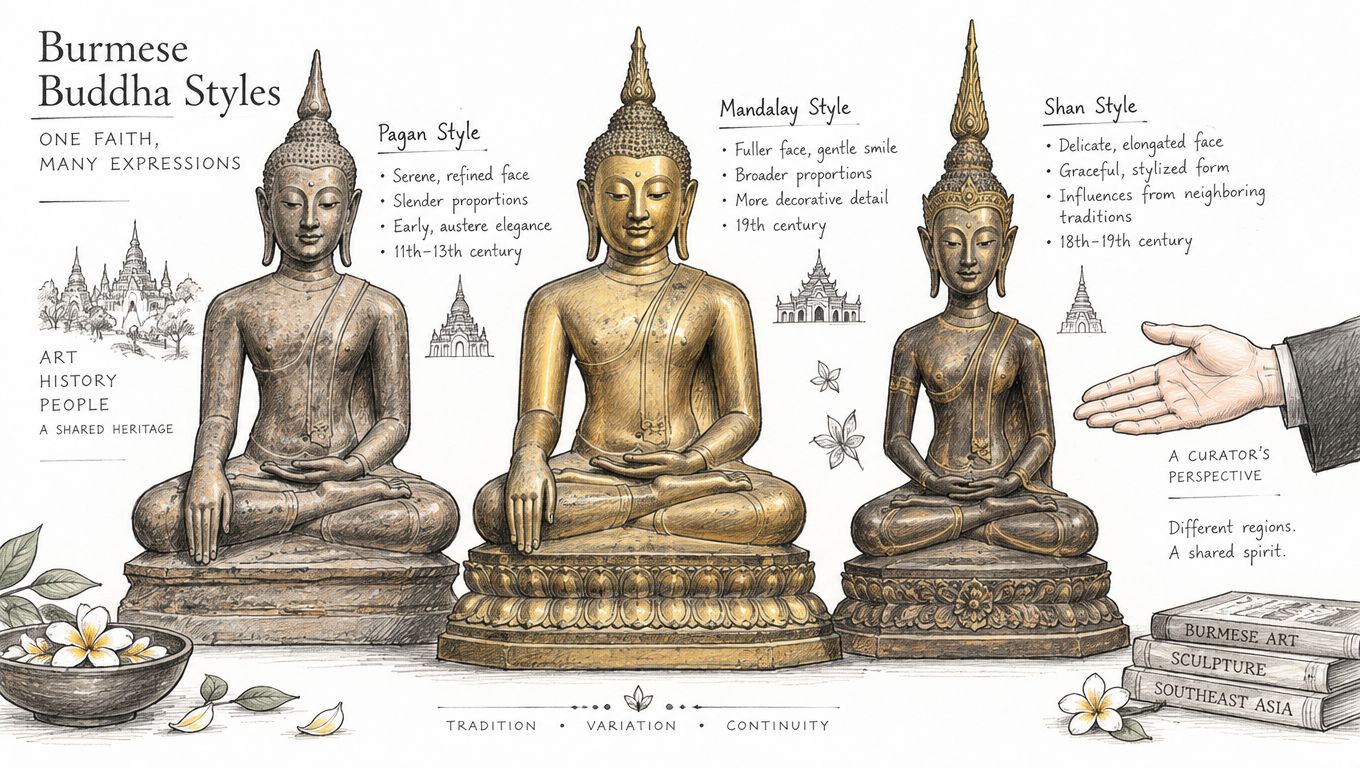
At an auction viewing in the UK, three Burmese bronzes can look almost identical from a distance. Closer inspection separates them. One may show a broad forehead, slightly Mongoloid eyes, a tapering face, pointed chin and high uṣṇīṣa, with controlled rather than fleshy modelling. That combination supports further research into a possible Pagan-period Burmese Buddha, but it does not establish attribution by itself.
A second figure may have fuller cheeks, naturally sloping brows and eyes, thicker lips, and robes arranged in deliberate cascades. Those features belong to the visual language associated with Mandalay style, which developed within the Konbaung court tradition. A third may appear more angular, with a projecting nose and thinner mouth, characteristics often associated with Shan-style Buddhas. The British Museum Shop's Burmese Buddha guide offers a useful visual comparison for UK collectors, although a retail guide should support, not replace, examination of the object and its paperwork.
Three visual languages, not three rigid boxes
Pagan, Mandalay and Shan should be treated as overlapping traditions rather than sealed categories. Workshop practice, materials, devotional use and later copying all affect an image. A later replica can borrow a Pagan face, while a modern decorative statue may combine Mandalay drapery with features from another regional style.
Build an attribution from several compatible observations:
- Pagan tends towards formal economy: a strongly narrowing face, broad forehead and conspicuous uṣṇīṣa create a disciplined silhouette.
- Mandalay favours softer modelling: fuller facial forms, thicker lips, sloping brows and flowing robes produce a more naturalistic presence.
- Shan often appears more angular: a projecting nose, thin mouth and slimmer face give the features sharper definition.
Practical rule: Start with the face, then test it against posture, gesture, material, casting and construction. A single attractive feature is weak evidence.
Style also affects how a statue should be presented to a buyer. Interior designers may begin with silhouette, but collectors need the historical proposition behind it. A Pagan bronze, a Konbaung court image and a Shan devotional figure carry different claims about date, region and use. The seller's description should identify those distinctions clearly, alongside photographs of the base, casting joins, repairs and surface. Provenance records, export history and any earlier collection references matter as much as stylistic resemblance when a UK purchase is being considered.
Identifying Pagan Period Buddha Markers
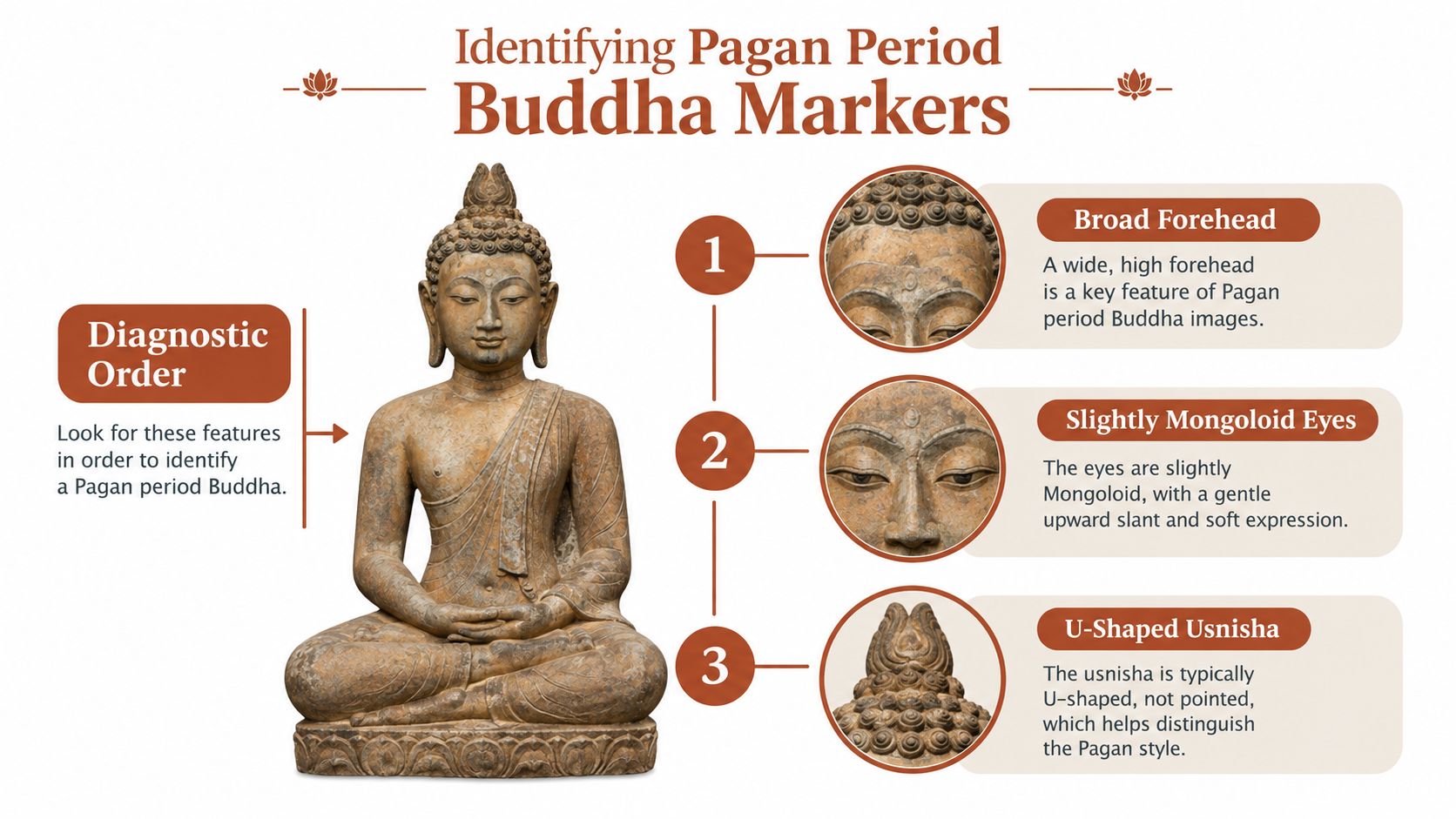
Pagan-period attribution begins with the head. Examine the forehead before looking at the jewellery, pedestal or patina. A broad forehead, slightly Mongoloid eyes, a tapering face and a high uṣṇīṣa form the most useful visual sequence for recognising Pagan style in Burmese bronzes.
The face should narrow progressively from the brow towards the chin. It isn't a long face. The characteristic effect is a controlled taper, often ending in a pointed or sharply defined chin. The eyes sit within a relatively restrained facial structure, and the high uṣṇīṣa gives the crown of the head a strong vertical emphasis.
Work from the upper face down
Use this order when assessing a possible Pagan image:
- Forehead: Look for breadth and a clear, open brow rather than a compact or heavily rounded upper face.
- Eyes: Check the slightly Mongoloid form and the way the eyelids are modelled. Soft, generic almond eyes on their own prove very little.
- Face profile: Follow the cheeks towards the chin. A genuine Pagan visual reading depends on the whole taper, not an isolated pointed chin.
- Uṣṇīṣa: Assess its height, shape and relationship to the head. Pagan-period examples are associated with a high uṣṇīṣa that may once have held a precious or semi-precious stone.The Pagan-period markers summarised by La Siè Exotique provide a useful checklist for this sequence.
- Gesture: The right-hand earth-touching gesture became by far the commonest pose in Burmese Buddha images, so a bhūmisparśa mudrā can support a Burmese attribution, although it can't independently establish period or authenticity.
A British museum object gives this visual vocabulary a valuable reference point. The British Museum records a key Pagan-period Burmese Buddha dated 1100–1199, cast in bronze and measuring 34 cm high. Its catalogue describes the work as “one of the finest known Burmese bronzes of the Pagan period” and notes the tapering face, broad forehead and uṣṇīṣa.
Read the body and construction as supporting evidence
The same recorded bronze has a strut at the back, suggesting a missing backplate. That small construction detail matters because it connects the figure to the way the object was made and originally completed, rather than merely to its visible front. A comparable strut won't authenticate a privately owned statue, but its presence, absence or alteration should be recorded and discussed.
Pagan bronzes also show a relationship to eastern Indian and Bodh Gayā influence. That connection helps prevent a common mistake, treating Pagan style as an isolated Burmese invention with no wider artistic context.
The style's austerity is another practical clue. Later images may have more relaxed bodily proportions, richer surface decoration or softer facial modelling. If a supposed Pagan Buddha has an unusually fleshy face, heavily theatrical drapery and a polished courtly finish, the attribution needs stronger explanation. Style is a pattern of relationships, and the strongest objects make those relationships consistent from crown to base.
Distinguishing Mandalay and Shan Buddha Characteristics
A small bronze arrives in a UK dealer's tray, photographed straight on and described as “Mandalay.” At first glance, that label may seem plausible. Mandalay and Shan images often appear in later Burmese collections, replicas and devotional settings, yet their modelling, finish and documentation can point in different directions. Mandalay style belongs to the Konbaung Dynasty, which lasted from 1752 to 1885, and became especially prominent in the late eighteenth and early nineteenth centuries. That historical setting is useful, but it should support close examination rather than replace it.
A Mandalay head generally feels more naturalistic. The face is fuller and fleshier, the eyebrows and eyes slope in a believable way, the lips have greater thickness, and the hair bun is often rounded. Flowing robes reinforce the impression of movement. A Shan head is usually more angular, with a prominent nose and thinner mouth. These distinctions can disappear in a small online photograph, then become obvious when three-dimensional modelling catches oblique light.
Mandalay modelling versus Shan structure
| Feature | Mandalay style | Shan style |
|---|---|---|
| Face | Fuller, softer and more naturalistic | More angular and slimmer in effect |
| Brows and eyes | Naturally slanted | Sharper, more linear impression |
| Mouth | Thicker lips | Thin mouth |
| Nose | Integrated into softer facial modelling | Often more prominent |
| Robe | Flowing, with elaborate drapery | More restrained or regionally varied |
| Surface | May include lacquer, gilding and mirror-glass inlay | Frequently encountered in wood and regional devotional forms |
Use the table as a working aid, not a verdict. A Shan figure may be carefully finished, while wear can strip a Mandalay image of lacquer, gilding or inlay. The face, robe and surface treatment should support the same attribution before you commit to it. For a UK purchase, ask whether the seller's description is based on those visible relationships, or repeats a broad market label.
Mandalay figures provide technical clues beyond facial features. The Victoria and Albert Museum describes a Mandalay recumbent Buddha with a gentle expression and naturalistic drapery forming distinctive “fish tail” folds. Related Burmese robes may leave the right shoulder bare, while another garment falls in cascades. Lacquered and gilded surfaces can also carry mirror-glass inlay, reflecting the decorative richness associated with later Burmese court presentation. On a privately owned statue, however, replacement glass, renewed gilding and over-cleaning can imitate that appearance, so inspect edges, recesses and joins rather than judging the surface alone.
Where Shan comparisons help
Shan images are often dismissed as inferior Mandalay pieces because their modelling looks less polished in a commercial photograph. That reading is misleading. Angular planes, a prominent nose and a thin mouth may belong to a distinct regional tradition shaped by highland connections and local devotional formats. The relevant question is whether those features remain coherent across the head, body, robe and base.
For a visual supplement on the serene facial and bodily qualities associated with Shan imagery, consult the Shan Buddha discussion from HD Asian Art. Use it alongside direct inspection, condition photographs and provenance records. A purchase file should identify where the statue was acquired, record earlier ownership where available, and distinguish old surface from later restoration.
The strongest attribution explains the whole object with few contradictions. A fleshy Mandalay face, flowing robes and courtly surface decoration form a consistent group. An angular Shan face, regional proportions and a restrained finish can form another. If documentation is thin, describe the attribution cautiously. A seller who calls every later Burmese image “Mandalay” without addressing these differences is offering a marketing category, not a properly supported identification.
Comparing Posture, Gesture and Surface Treatment Across Styles
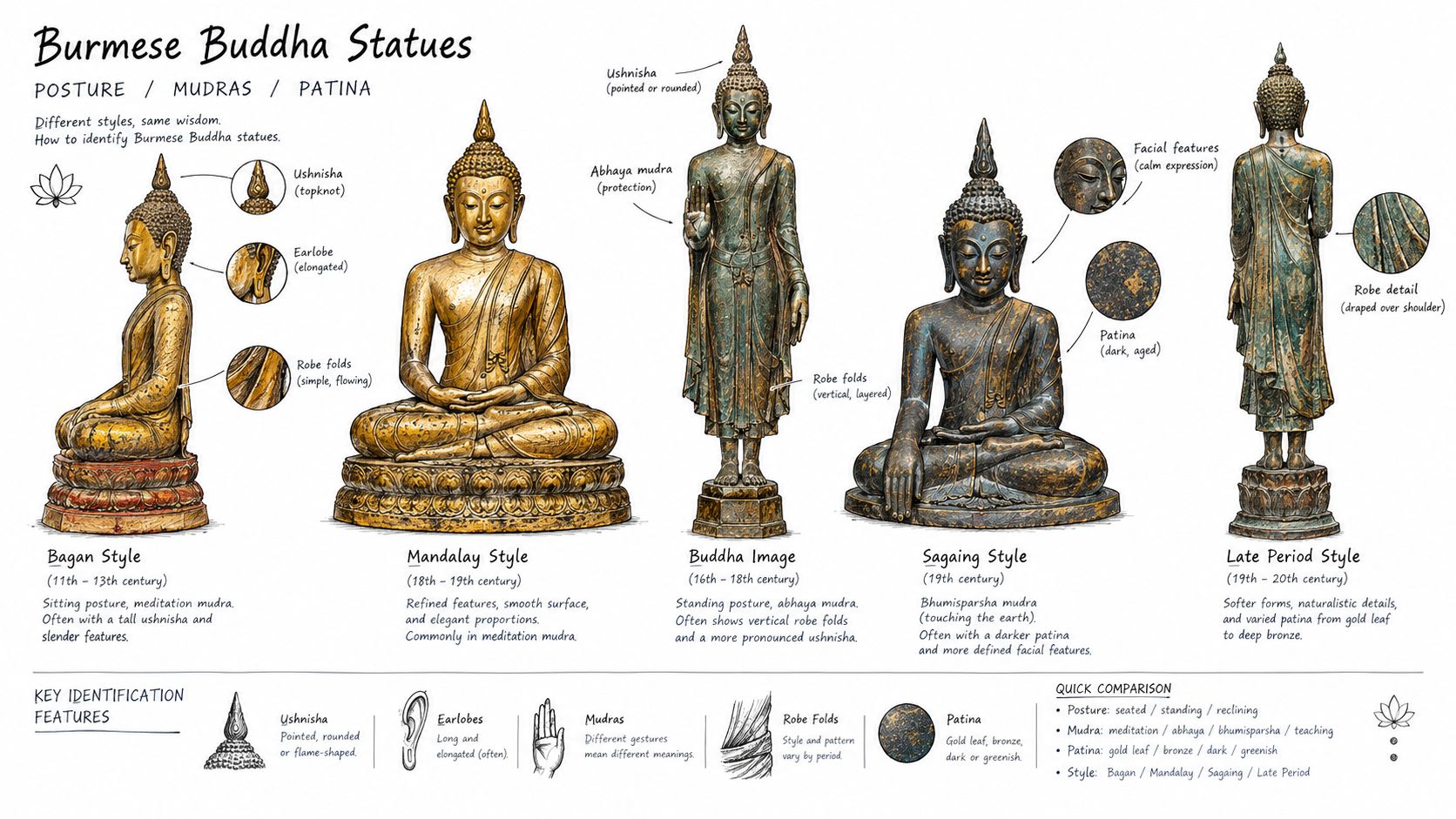
A bronze may look convincing until its posture, hands and robe are read together. Standing, seated and reclining postures occur across Burmese traditions, so posture narrows the possibilities rather than proving a date or regional attribution. The useful test is how the sculptor organises the body within that pose.
Pagan bronzes often have an architectonic presence. The torso, limbs and robe form a disciplined arrangement, with limited relaxed naturalism. Mandalay figures usually soften that structure. Their bodies can appear more natural, while the robe follows the figure as flowing material rather than a sequence of strictly formal lines.
Posture gives the face a context
A seated earth-touching Buddha with a tapering face and high uṣṇīṣa merits a Pagan-focused examination. The same pose, combined with a softer, fuller face and generous drapery, sits more comfortably within a Mandalay attribution. A standing image with an angular face, prominent nose and thinner mouth may support a Shan reading, particularly when its material, proportions and finish also suit a regional devotional object.
Reclining figures need separate attention because the robe must maintain a visual rhythm across a longer body. In many reclining Shan examples, folds can appear more segmented and rhythmically repeated, with a regional directness that differs from the broader, more naturalistic sweep often associated with Mandalay recumbent images. Compare the spacing of the folds from shoulder to feet, then inspect whether the head, torso and base follow the same treatment. A reclining pose alone does not settle the attribution.
Gesture remains useful, though it rarely identifies a region by itself. The earth-touching gesture is widespread in Burmese Buddha imagery, making it valuable for iconographic identification but weak as a standalone stylistic marker. Record the hand position, arm length, shoulder line and the way the gesture relates to the torso. A practical terminology guide to Buddhist mudrā hand gestures can help with description, but it cannot replace examination of the object.
Surface can support or undermine an attribution
Bronze, wood, marble, lacquer and gilding age in different ways. A Pagan bronze may retain a restrained cast surface and patina that keeps the modelling prominent. Mandalay work can combine bronze or marble with lacquer, gilding and mirror-glass details, creating a more elaborate effect. Shan figures are often encountered in wood or other regional devotional formats. Material therefore supports an attribution only when it agrees with facial structure, construction and finish.
Inspect the areas that online sellers often show poorly:
- Under the chin and around the ears: Look for casting joins, repairs, filling or disturbance to the surface.
- The back of the figure: A strut, mounting feature or absent backplate may clarify original construction.
- Robe edges and folds: Mechanically even repetition can raise questions about a modern replica, while irregularity warrants closer study.
- Lacquer and gilding: Check whether decoration follows the modelling or sits as a later surface layer.
- Base and feet: Alteration may conceal losses, re-mounting or changes to the original presentation.
No surface effect proves age. Dark patina can be manufactured, bright gilding may be historic or renewed, and worn lacquer may reflect devotional use. The soundest reading combines face, body, gesture, construction and finish, then tests that conclusion against condition photographs and provenance records. A stylistic match without supporting documentation remains a hypothesis, not a secure purchase.
Provenance, UK Market Realities and Responsible Collection
Stylistic confidence doesn't make a purchase safe. In the UK, a Burmese Buddha may have passed through several jurisdictions before reaching a London dealer, auction house or online listing. After Brexit, buyers need to ask not only “What style is this?” but also “What can the seller prove about its movement and condition?”
London auction coverage shows active trading in Burmese art. One reported example, a white marble Buddha, sold for £1,320, while wider market listings continue to show Mandalay- and Shan-style figures at high-value and large-format levels.A UK Burmese statue marketplace listing illustrates the range of material circulating in the market. These figures don't establish a value for your statue. They show why an attractive description or confident estimate can't replace object-specific documentation.
The documents that matter
Ask for a written record before paying a deposit. At minimum, request:
- Ownership history: Previous collection names, dealer records, auction references or catalogue appearances where available.
- Export history: The country from which the object was exported, any permits or declarations, and the date or period of export if documented.
- Condition report: Repairs, replaced elements, over-cleaning, re-gilding, cracks, losses and structural interventions should be stated plainly.
- Country-of-origin claim: Ask whether “Burmese”, “Mandalay” or “Shan” describes documented origin, stylistic comparison or seller opinion.
- Photography: Request clear images of the front, back, underside, face, hands, robe edges and base.
A provenance gap doesn't automatically mean an object is illicit, but silence about the gap is a serious warning. Museums and institutions need a stronger paper trail than a private buyer may accept, and interior designers should record the same information for clients whose purchases need insurance or resale documentation.
UK museums have also expanded interpretive access to Burmese sculpture, including the V&A's Buddhist galleries. That institutional interest makes context more important, not less. A responsibly collected object should arrive with an explanation of what is known, what remains uncertain and how the seller reached the attribution.
Plan for transport and future care
Documentation should travel with the object. Keep invoices, condition reports, images and correspondence together, especially if the statue moves between a dealer, storage facility, designer and final client. For practical handling advice during domestic or international relocation, these secure artwork transport tips provide a useful general framework, although fragile bronze, lacquer and gilded surfaces may still require specialist art handlers.
Responsible collecting also means understanding the ethical dimension of Southeast Asian material. The legal and ethical guide to collecting Southeast Asian art is a useful starting point for framing questions about ownership, export and cultural responsibility. The aim isn't to eliminate uncertainty through a label. It's to make uncertainty visible before the object enters your collection.
A Practical Checklist for Identifying Burmese Buddha Statues
Use this sequence at a viewing, and write down your observations rather than trusting memory.
- Start with the head. Does the figure have the broad forehead, slightly Mongoloid eyes, tapering face and high uṣṇīṣa associated with Pagan style? If yes, investigate the bronze's construction and possible eastern Indian or Bodh Gayā influence.
- Test the facial modelling. A fuller, fleshy face, slanted brows and eyes, thicker lips, round hair bun and flowing robes support a Mandalay reading. A more angular face, prominent nose and thin mouth support a Shan comparison.
- Read the robe and posture together. Standing, seated and reclining images appear across the traditions. Look at whether the drapery is austere and controlled, softly naturalistic, or regionally restrained.
- Inspect the gesture without overvaluing it. The earth-touching gesture is common in Burmese Buddha imagery, so use it to identify the iconographic subject, not to date the statue by itself.
- Examine the reverse and underside. A Pagan bronze may show a rear strut suggesting a missing backplate. Check for casting joins, filled holes, replacement bases and concealed repairs.
- Record the surface. Mandalay examples may combine bronze or marble with lacquer, gilding and mirror-glass inlay. Shan works are often encountered in wood or regional devotional formats. Patina and brightness are clues, not proof.
- Demand the paperwork. Ask for ownership history, export documentation, a condition report and a clear statement explaining whether the attribution is documented or stylistic.
For further context on Buddhist meanings, forms and placement, use specialist resources alongside the object itself. A catalogue entry should help you ask better questions, not discourage you from asking them. HD Asian Art offers Burmese-style, Mandalay and Shan-related Buddhist sculptures through its UK-based specialist catalogue, with research and condition information presented alongside selected pieces.
HD Asian Art offers Burmese Buddhist statues and related Southeast Asian sculpture for collectors, institutions and private interiors, with regional categories and supporting knowledge resources to help compare styles. Visit HD Asian Art to explore the current Burmese, Mandalay and Shan selections and review the available object details before you buy.
