


Asian Statues Meanings: A Guide to Gestures and Symbols
Asian Statues Meanings: A Guide to Gestures and Symbols
You're standing in a gallery or scrolling through listings late at night, looking at two seated Buddhas that seem almost identical. One seller calls the pose calming, another calls it powerful, and a third just says meditating. Meanwhile a four armed figure nearby could be Vishnu, a bodhisattva, or Shiva in another form, and you don't want to place, buy, or explain it on a guess.
That's the usual starting point for anyone trying to understand Asian statues meanings. The helpful way through is to read a figure in three layers. First, gesture and attributes establish who you're looking at. Second, regional style and period narrow what that gesture meant there. Third, setting and provenance shape how the statue should be treated now.
UK museum collections make that first point clearly. The Victoria and Albert Museum's Shakyamuni Buddha entry identifies the raised right hand as the abhaya mudra of reassurance and protection, notes lowered eyes meant to be viewed from below, and records marks such as curled hair, a cranial protuberance, and webbed fingers among the Buddha's 32 auspicious bodily marks. In other words, sculptors encoded identity in details, not in a general feeling of calm.
Table of Contents
- Mudras and What They Signal
- Buddhist and Hindu Figures Compared by Attribute
- Reading Attributes, Stories and Missing Parts
- Regional Styles and What Their Poses Signal
- How Setting Changes Meaning
- Provenance Questions That Shape a Statue's Meaning
- Confirm the Meaning Before You Buy or Place a Statue
Mudras and What They Signal
Hand positions usually settle the meaning before any other detail does. A mudra is a codified hand gesture, and two otherwise similar seated figures can tell different stories because one hand has moved a few centimetres.
| Gesture | Hand position | Meaning | Typical figure |
|---|---|---|---|
| Abhaya mudra | Right hand raised, palm out | Reassurance, protection, fearlessness | Standing or seated Buddha |
| Varada mudra | Hand lowered, palm out, fingers down | Generosity, granting wishes | Buddhas and Avalokitesvara as Padmapani |
| Bhumisparsha mudra | Right hand touches the earth | Calling the earth to witness; victory over Mara | Seated Buddha at enlightenment |
| Dhyana mudra | Both hands resting in the lap | Meditation and calm | Seated Buddha |
| Dharmachakra mudra | Hands at the chest, turning the wheel | Teaching the Dharma | Teaching Buddha |
| Vitarka mudra | Thumb and index finger touching | Discourse and argument | Seated or standing Buddha |
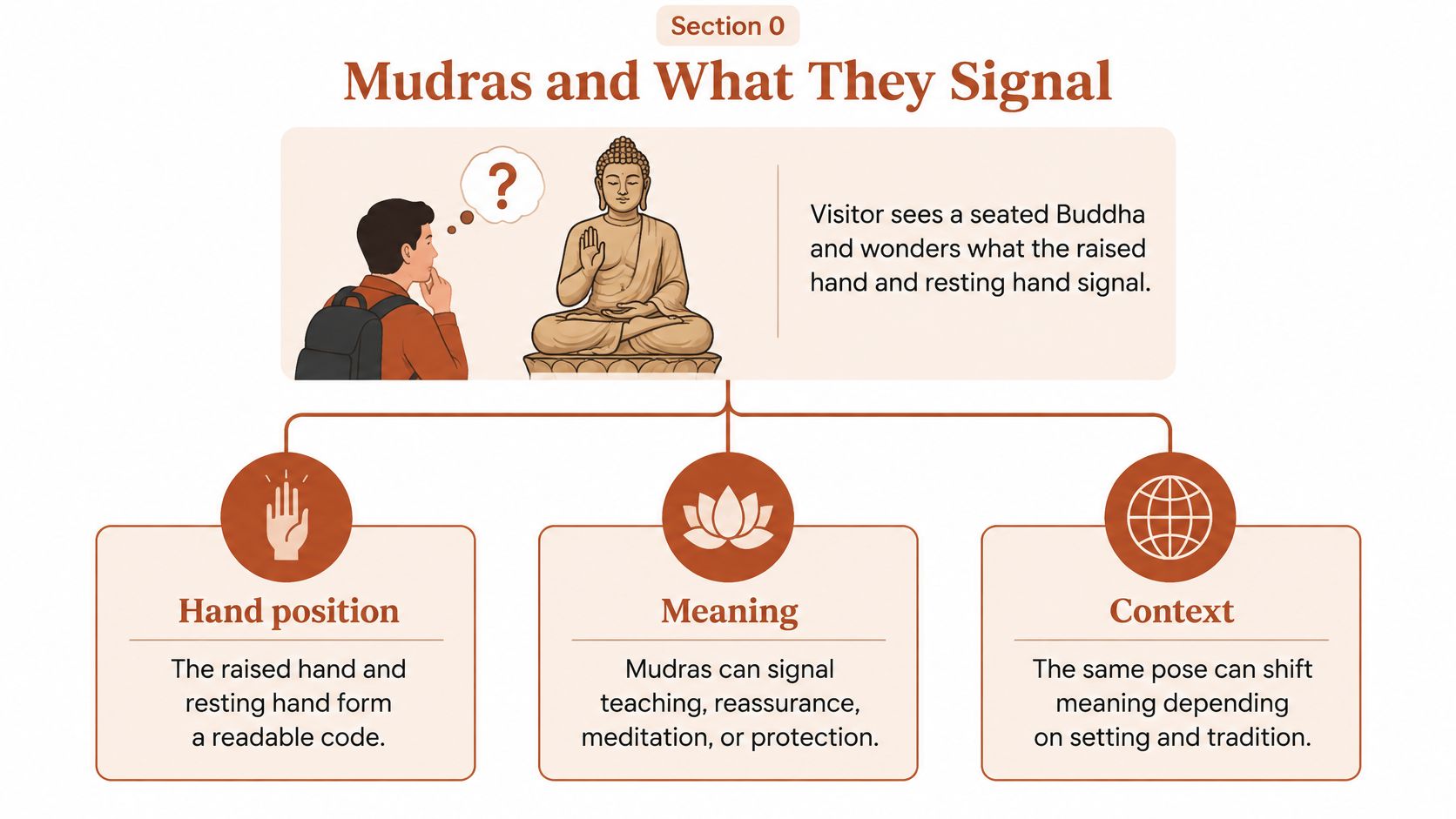
You pause in front of a seated Buddha. One hand is raised, palm outward, and the other rests low. Is the figure meditating, reassuring you, or doing two things at once? That question is exactly why you check each hand separately rather than naming the whole pose from the crossed legs.
Why a small movement changes the story
The British Museum's Buddha object record identifies the right hand touching the earth as the bhumisparsha mudra, associated with the moment of enlightenment. That single contact with the ground turns a seated figure from generic meditation into the Buddha's victory over doubt and attainment of awakening, calling the earth to witness his defeat of Mara, the personification of temptation.
Move both hands into the lap and you've changed the episode. That's the dhyana mudra, signifying meditation. Raise one open palm instead and you get reassurance. Turn the hands at the chest and the figure teaches. The legs, robe, and serene face may stay broadly the same, but the narrative doesn't.
Visitors often assume that a calm face means the subject represents calmness itself. It isn't. Sculptors expected informed viewers to read the hands first, then confirm that reading against the base, throne, robe, and anything the figure holds. For a fuller walk through of hand positions, see our guide to mudra hand gestures and compare each hand of the piece in front of you against it.
The base is part of the sentence
A lotus pedestal adds a second layer beneath the gesture. It represents purity, enlightenment, and divine birth. A figure in dhyana on a lotus isn't only meditating, it's also shown as having risen beyond ordinary worldly conditions, unstained by them.
That helps you avoid a common mix up. Don't treat the base as furniture put there to keep the sculpture upright. In Buddhist and Hindu art, the seat tells you what kind of being this is, whether that's an awakened figure on a lotus, a deity on a throne, or a deity shown with an animal vehicle. Look down before you decide you've understood what's above.
Three checks before you name the pose. Record the position of each hand separately, note what the second hand is doing while the first catches your eye, then check whether there's a lotus base or another pedestal underneath.
Those three checks won't date a statue for you, and they won't always identify a damaged piece. They will, however, stop you calling every cross legged figure a meditation Buddha, which is where most misreadings begin.
Buddhist and Hindu Figures Compared by Attribute
A seated figure has one hand lowered, palm out. Another wears a crown and holds a lotus. Both look serene, both sit on a lotus base, and a quick glance may file them together as Buddhist. The hands and the held object separate them.
Buddhist and Hindu sculpture share some visual tools, especially the lotus, multiple arms in certain forms, and a taste for symmetry. They use those tools to say different things. Buddhist figures are usually identified by bodily marks, monastic robes, mudras, and a small set of held objects. Hindu deities more often declare themselves through weapons, vehicles, crowns, and the particular story a sculptor has frozen mid action.
| Figure | Tradition | Key attributes | Core meaning |
|---|---|---|---|
| Shakyamuni Buddha | Buddhist | Topknot, curled hair, lowered eyes, mudra, lotus base | Enlightenment and teaching |
| Avalokitesvara (Padmapani) | Buddhist | Lotus, varada mudra, small Amitabha in crown | Compassion; bodhisattva who delays final nirvana |
| Medicine Buddha | Buddhist | Healing bowl | Healing and wellbeing |
| Maitreya | Buddhist | Stupa in crown in some traditions, often seated | The future Buddha and hope |
| Shiva | Hindu | Trident, drum, Nataraja dancing pose | Transformation and the cosmic cycle |
| Vishnu | Hindu | Chakra, gada, shankha, lotus, four arms | Preservation and cosmic order |
| Ganesha | Hindu | Elephant head, broken tusk, modak, mouse | Removing obstacles; new beginnings |
| Durga | Hindu | Trident, lion, multiple arms | Shakti; triumph over Mahishasura |
| Krishna | Hindu | Flute, cows, standing pose | Compassion and protection |
| Lakshmi | Hindu | Lotus, gold coins | Abundance and prosperity |
An attribute works like a passport stamp. It tells you which tradition issued the figure, not the whole biography.
Two traditions side by side
Start with Shakyamuni, the historical Buddha. You are looking for restraint rather than weaponry. The topknot, curled hair, elongated earlobes, lowered eyes, and plain robe all push your attention back to the mudra. If the figure holds a bowl connected with healing, you are more likely looking at the Medicine Buddha. If there is a small stupa in the crown in some traditions, consider Maitreya, the future Buddha. The differences are quiet, so look closely at crown, hands, and held object together.
Avalokitesvara is where Buddhist figures often confuse newcomers, because a bodhisattva can wear jewellery and a crown that look princely rather than monastic. Avalokitesvara is known as the Lord of Compassion, a bodhisattva who postpones final nirvana to help other beings attain salvation. As Padmapani, the lotus holder, his lowered hand makes varada, and a small image of Amitabha in the crown identifies him. That tiny Buddha in the headdress matters more than the jewellery that first caught your eye.
Hindu deities usually give you more objects to work with, and they are rarely interchangeable. Shiva carries a trident and drum, or dances as Nataraja within a ring of cosmic motion. Vishnu is typically four armed, carrying discus, mace, conch, and lotus. Ganesha is unmistakable once you see the elephant head, broken tusk, sweet modak, and mouse vehicle, but a worn small figure still deserves a check for those details rather than a quick label.
The goddess figures test whether you are reading or guessing. Lakshmi with lotus and gold coins speaks of abundance. Durga with many arms, weapons, and a lion speaks of protective power in active combat. Both may be beautiful, crowned, and frontal, yet their attributes place them in different stories. Beauty is a shared surface. Attributes are the identifying evidence.
Once attributes give you a candidate, regional style narrows the meaning further. A Khmer face and crown can tell you which local tradition shaped the figure. Setting and provenance then decide how the statue should be treated.
A starting point, not a verdict
Use the table to form a shortlist, then test it. If you think you have found Krishna, look for the flute and cows as well as the pose. If you think you have found Vishnu, count the arms and look for his emblems. If only one clue supports your identification and two others do not fit, you have not identified the figure yet.
That is not failure. It is good looking. A careful description, such as four armed male deity holding a discus, lower left hand in varada, is far more useful than a confident name you cannot defend when someone asks what told you so.
Reading Attributes, Stories and Missing Parts
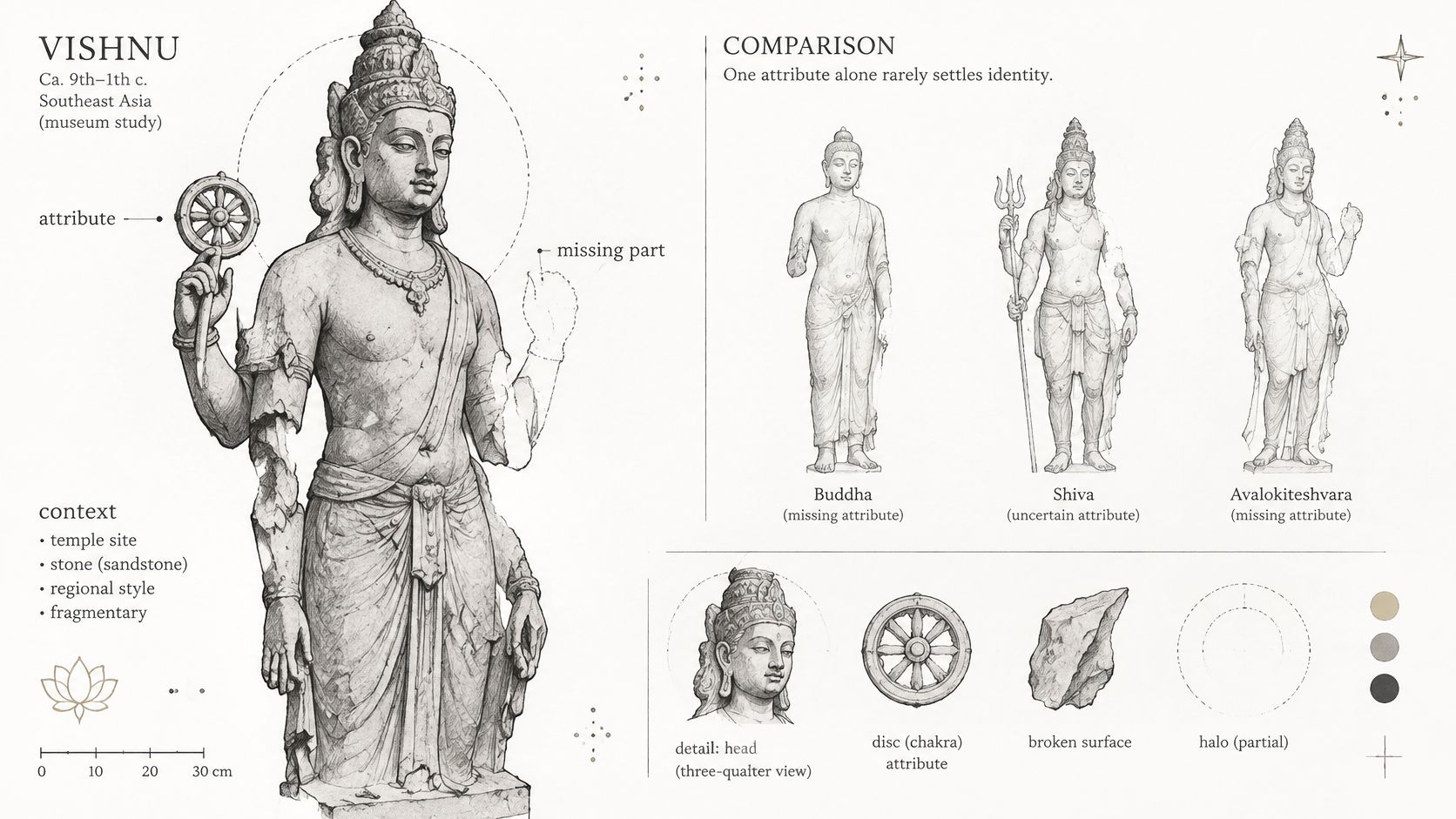
One attribute rarely settles an identification on its own. Sculptors built meaning from combinations, and time, wear, and repair often remove exactly the evidence you need most. Worked cases show the habit to copy. Name the clue, say what it signals, then ask what would make that reading uncertain.
Vishnu and Ardhanarishvara
The Victoria and Albert Museum's Vishnu figure record describes Vishnu as rigid and immovable, expressing his role as stabiliser and preserver of cosmic equilibrium. In another V&A sculpture, his four armed form is identified through the discus (chakra) and mace (gada), while varada indicates gift giving. The clue set is therefore posture, arm count, and attributes working together. Uncertainty rises sharply if an arm is missing or a hand held object has been lost, even when face and crown look right.
Ardhanarishvara makes the opposite demand on your eyes. Here the body itself is the message, divided vertically between Shiva and Parvati. One half is more muscular, the other more curved, and that contrast communicates the integration of masculine and feminine cosmic principles. It isn't a damaged figure or a hybrid portrait. The clue is the deliberate vertical division, and wear that blurs one half is what would weaken your reading.
Durga and Krishna
National Museums Scotland's account of Durga explains that her Sanskrit name means "the inaccessible" or "impassable", that she represents shakti, and that she uses the trishul, or trident, to defeat Mahishasura. That gives her the specific title Mahishasuramardini, "slayer of Mahishasura", symbolising the triumph of goodness over evil. The buffalo demon had gained an advantage because no man could kill him, so the story explains why this goddess, in this form, carries those weapons.
National Museums Scotland's bronze Krishna record shows him standing with a flute pointed to the right, right leg crossing over the left, and two small cows near his feet. The museum interprets him through guardianship, kindness, empathy, understanding, wisdom, social justice, and love. Remove the flute and cows, and the crossed legs alone become much weaker evidence. Pose supports the identification here. It doesn't carry it.
A missing attribute doesn't make a statue meaningless. It makes your identification provisional, and you should say so.
Field checklist
- Surviving attributes. List everything held, worn, or placed at the feet before you name the deity.
- Arm count. Count arms and empty sockets or breaks where arms or objects may be lost.
- Posture and mudra. Record standing, seated, dancing, or reclining, plus each hand position.
- Division of the body. Note any vertical split, multiple faces, or paired figures.
- Agreement of clues. Assign a name only when most of these points support the same figure.
Regional Styles and What Their Poses Signal
A gesture doesn't travel unchanged. As forms moved between India, China, and Southeast Asia, sculptors kept the broad iconography but reshaped faces, robes, crowns, and sometimes the meaning of a pose itself. That's why region and period come second in your reading, narrowing what the hands and attributes first suggested.
| Region | Typical features | What the pose or gesture signals |
|---|---|---|
| Khmer (Cambodia, Angkor style) | Strong, calm faces; refined crowns; stillness | Classical serenity; Naga Buddha sheltered by a serpent hood |
| Thai (Sukhothai and Ayutthaya) | Flame-shaped topknot; elongated features; five traditional postures | Raised hands may show ham samut, forbidding the ocean |
| Burmese (Bagan and later periods) | Robe, jewellery and crown styles vary by period | Pose meaning depends on dating the figure by style first |
| Indonesian (Java and Sumatra) | Stone figures, often in stupa niches | Meditation and enlightenment, especially dhyana and bhumisparsha |
| Sri Lankan | Tall, serene seated and standing figures | Teaching and protection, often with abhaya mudra |
| Chinese (Northern Qi) | Limestone figures with traces of paint and gilding | Abhaya in one hand and varada in the other, combining fearlessness and gift-giving |
When the same raised hand changes meaning
The British Museum's Thai Buddha record identifies the raised, open palmed abhaya mudra as reassurance, normally made with the right hand alone. A Thai Buddha with both hands raised, however, may show ham samut, "forbidding the ocean". In the associated story, the Buddha stops a river from flooding, and the miracle converts the ascetic Kasyapa and hundreds of his followers.
That example catches many readers out, because they learn abhaya as a fixed translation and apply it everywhere. Regional tradition adjusts the dictionary. One raised hand and two raised hands are not the same sentence, and a Thai figure asks you to consider a Thai narrative before you settle on a general label like protection.
Two hands, two messages
A Northern Qi Buddha in the Victoria and Albert Museum, dated approximately 550 to 577, combines abhaya in one raised hand with varada in the other open palm. The limestone retains traces of gesso, paint, and gilding. So a Chinese viewer wasn't being offered a single mood. Fearlessness and gift giving were presented together, each assigned to its own hand.
That should change how you photograph or describe any piece. Don't crop out the lower hand because the raised one looks more dramatic. You may be removing half the meaning. Our overview of regional Buddha statue styles is useful at this stage, when you need to place topknot shape, robe treatment, and crown within a regional sequence before you interpret the pose.
Khmer figures make the value of dating especially clear. Strong, calm faces and refined crowns can look timeless if you meet them without context, but changes in headdress, jewellery, and torso modelling help separate periods. Burmese figures ask the same discipline, because robe edges and crown styles shift meaningfully over time. Style isn't decoration added to meaning. It's often the evidence that tells you which meaning was available to the sculptor.
Record region and period before you finalise meaning. Gesture gives you the verb, but place and date often tell you which story that verb belongs to.
How Setting Changes Meaning
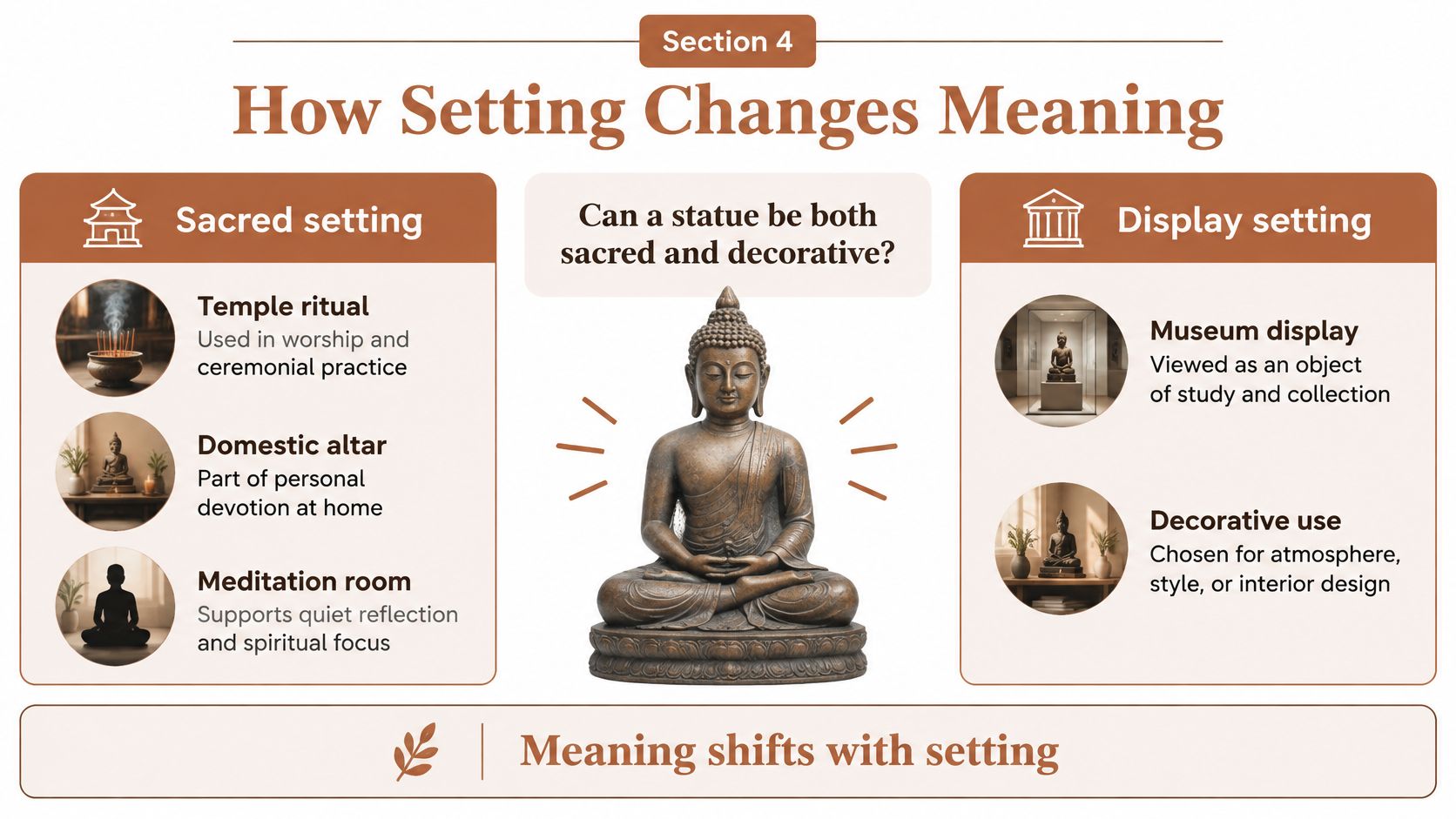
Walk into a room where a seated Buddha faces a low altar, with a cushion in front and a bowl of water beside it. The same bronze in a museum case, lit from above and set behind glass, asks for a different kind of attention. The figure has not changed. The room has changed what people are asked to do around it.
Can a statue be both sacred and decorative? Yes, but the balance shifts with the room. A ritual image in a shrine works like a tool in a workshop: it is cleaned, offered to and returned to daily. The same image in a collector's hallway becomes a cultural object, admired for carving, patina and style. Both readings can be sincere. Gesture and attributes establish who is shown, regional style narrows which tradition and period you are looking at, and setting decides how the image should be treated now.
| Setting | Meaning shift | Placement expectation |
|---|---|---|
| Devotional use | Ritually active image | Clean, raised and respectful place |
| Decorative ownership | Cultural-art object | Considered, dignified setting, not casual decor |
| Floor placement, alcohol nearby, a bedroom, a commercial interior | Read differently by tradition and household | Ask a practitioner from that tradition |
Why this matters in the UK now
This is not abstract etiquette. The UK is home to long-established Hindu and Buddhist communities, and many households meet these images as living devotional objects rather than as museum pieces or interior accents. A neighbour, colleague or family member may read your placement quite differently from you. Recognising that a setting carries a social meaning as well as a visual one matters more than guessing another person's view.
Museums are adjusting to that reality. The British Museum's 2025 Ancient India, Living Traditions exhibition involved local communities that donated objects and took part in curation. Interpretation is no longer only something an institution hands down. Practitioners help shape how objects are explained and handled.
A practical default you can adapt
When you do not yet know the expectations of a particular household or tradition, start conservatively. HD Asian Art recommends keeping a Buddha statue clean, raised off the floor, and away from bathrooms, bins and cluttered surfaces where it may be treated casually. Give Hindu deity figures the same basic care: a clear surface and room to be approached respectfully, not squeezed between unrelated ornaments.
Floor placement for larger garden pieces, proximity to alcohol, use in a bedroom, or display in a commercial interior do not have one universal answer. Hindu, Buddhist, regional and diaspora practices differ, and individual households differ within them. Ask a practitioner connected to the tradition the statue comes from, and be ready to hear that another family does it differently. Both answers can be sincere.
The mistake is hunting for a single rule that removes the need to think. A clean, raised, dignified position is a sound default for most settings. After that, the statue's tradition, its role in your home, and the people who will live with it should refine the decision.
Provenance Questions That Shape a Statue's Meaning
A symbol only guide can make every statue sound timeless, as if it arrived fresh from a workshop with its meaning neatly attached. Many pieces in UK collections travelled through excavation, export, colonial collecting, dealers, repairs, and re gilding before they reached a shelf. That journey affects what you can say about age, origin, and even identity.
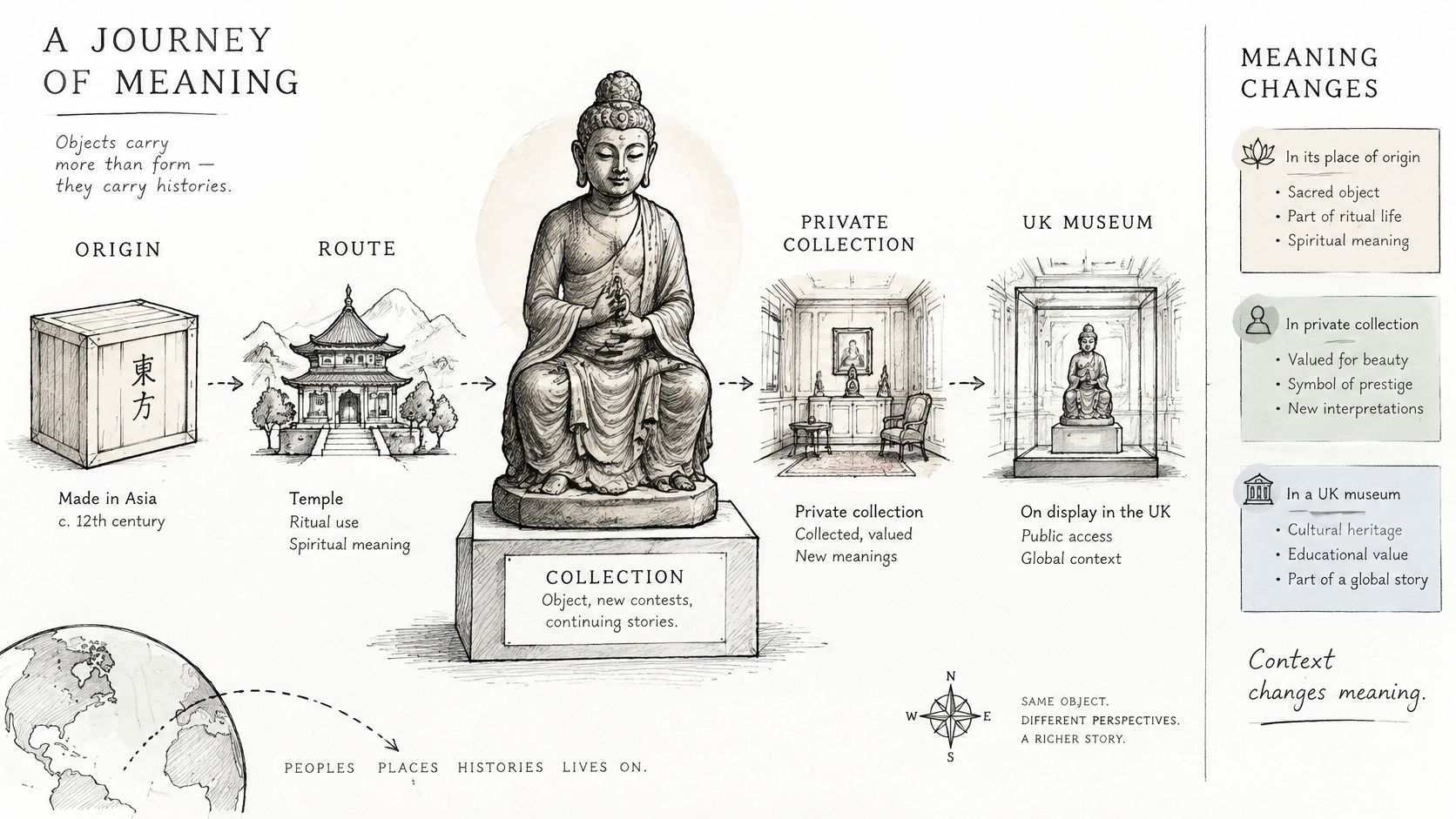
Manchester Museum's decolonisation guidance states that museums often documented and interpreted collections through a narrow colonial lens, and identifies transparency, return to communities of origin, and inclusion of diaspora knowledge as part of current practice. Colonial removal shaped the movement of religious images into European museums and markets. The Amaravati sculptures are a particularly complex example of nineteenth century extraction and documentation, and they remind you that missing context is itself a fact worth recording.
Five provenance questions
- Documented ownership history. A named chain of previous owners supports, or limits, claims about date and origin.
- Excavation or export information. Paperwork and findspot records affect whether an acquisition is responsible and describable with confidence.
- Conservation alterations. Repairs, re gilding, replaced hands, or new bases can change the iconography you're reading.
- Possible sacred site origin. A piece removed from an active or formerly active sacred site asks for different description and display decisions.
- What remains uncertain. A stated gap is more trustworthy than a polished story with no evidence behind it.
Each answer changes a practical choice. If a hand has been replaced, you shouldn't build your mudra reading on it without noting the intervention. If export history is unclear, you may decide not to acquire the piece, or a museum may choose to display that uncertainty openly. If a community of origin has a view on the object, that view belongs in interpretation, not in a footnote added afterwards.
Spiritual significance and ethical provenance aren't competing topics. A documented history makes your description more accurate, and it protects you from repeating a dealer's invented temple story as fact. For a fuller explanation of how to test that history, read our guide to provenance research for Asian antique sculpture before you rely on any single claim in a listing.
Ask not only what the mudra means, but whose interpretation counts, what's known about this object's route to you, and what's still uncertain.
Confirm the Meaning Before You Buy or Place a Statue
Don't buy or place a statue on a first impression. Work through a short confirmation while you can still change your mind, whether you're in a shop, at a fair, or comparing photographs at home.
- Name the tradition and likely figure using the gesture and attribute evidence together.
- Note material and surface, including signs of age, repair, re gilding, or a replaced base.
- Check date and style wording, so antique, vintage, and contemporary aren't blurred into one claim.
- Record provenance facts on ownership, export or excavation, conservation work, and any sacred site origin.
- Measure and photograph your space, then check floor level, cleanliness, and distance from bathrooms or clutter.
If a seller can't supply clear images of the face, hands, base, and any casting or patina detail, ask for them before buying. We can provide high resolution images of a statue's surface, face, hand, base, casting detail, or area of patina upon request, and we can help you choose the right statue if you share photos, measurements of your space, and preferences such as deity, material, or style.
Write down the figure, gesture, attributes, and provenance you've confirmed. Compare that note against the evidence. If it still agrees, you've earned the identification rather than borrowed it.
If you're choosing a Buddha or Hindu statue and want the gesture, attributes, style, and provenance checked before you commit, share your space measurements, photographs, and preferences with us and we'll help you compare suitable pieces. Visit HD Asian Art to browse our museum quality Buddhist and Hindu sculptures and request detailed images of any statue you're considering.
