



Was ist Khmer-Kunst? Geschichte, Bedeutung und Erbe
Was ist Khmer-Kunst? Geschichte, Bedeutung und Erbe
Khmer-Kunst wird als die visuelle und architektonische Produktion des Khmer-Reiches definiert, die sich etwa von 802 bis 1431 n. Chr. erstreckt, und gilt als eine der anspruchsvollsten künstlerischen Traditionen Südostasiens. Der Begriff umfasst religiöse Skulpturen, Tempelarchitektur, Bronzeguss, Textilien, Lackwaren und Holzschnitzereien, die alle durch eine Verschmelzung indischer religiöser Ikonographie mit eindeutig lokaler Khmer-Ästhetik vereint sind.
Im Kern diente die Khmer-Kunst zwei Zwecken: der Verehrung hinduistischer und buddhistischer Gottheiten und der Verherrlichung des Gottkönigs, der das Reich regierte. Um zu verstehen, was Khmer-Kunst ist, muss man erkennen, dass jedes geschnitzte Gesicht, jeder Tempelturm und jedes bronzene Mudra sowohl spirituelles Gewicht als auch politische Bedeutung hatte.
Was ist Khmer-Kunst und was zeichnet sie aus?
Khmer-Kunst ist die künstlerische Produktion des Khmer-Reiches von etwa 802 bis 1431 n. Chr., wobei sich sein Höhepunkt auf das 9. und 13. Jahrhundert konzentrierte. Dieser Gipfel steht im Zusammenhang mit dem Bau von Angkor Wat und den großen Tempelanlagen der Angkor-Region, die bis heute die sichtbarsten Zeugnisse dieser Tradition sind. Was die Khmer-Kunst von anderen süd- und südostasiatischen Traditionen unterscheidet, ist ihr Gleichgewicht zwischen importierten indischen Modellen und einer erkennbaren lokalen Identität. Bildhauer gaben den Figuren rundere Gesichter, breitere Brauen und eine physische Präsenz, die im Khmer-Volk selbst verwurzelt war und nicht in idealisierten indischen Prototypen.
Die Abkehr vom indischen Prototyp Die Umstellung auf einen ursprünglichen Khmer-Stil war im 10. Jahrhundert abgeschlossen. Dies war eine bewusste kulturelle Behauptung, keine allmähliche Abweichung. Die Khmer-Skulptur verfolgte auch einen in der Region einzigartigen technischen Ansatz: Die Figuren wurden vollständig rund geschnitzt, ohne rückseitige Stützstelen, wodurch sie körperlich verwundbar waren, aber dafür konzipiert waren, in Tempelheiligtümern aus verschiedenen Blickwinkeln betrachtet zu werden. Diese Wahl spiegelt das Vertrauen in das Material und die künstlerische Vision hinter jedem Werk wider.
Was sind die wichtigsten Arten und Medien der Khmer-Kunst?
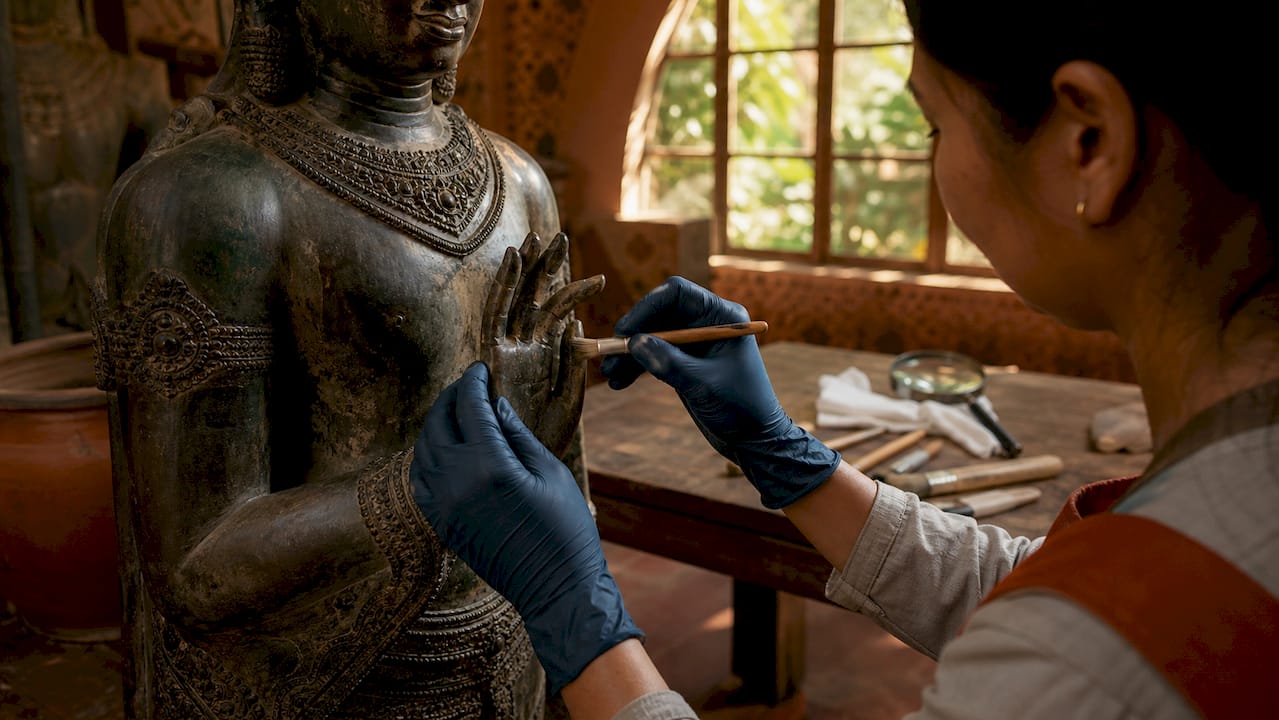
Die Khmer-Kunst umfasst weit mehr als die steinernen Tempelreliefs, denen die meisten Schüler zuerst begegnen. Die Tradition umfasst mehrere unterschiedliche Medien, jedes mit seiner eigenen Geschichte und seinem eigenen Zweck.
- Steinskulptur und Tempelarchitektur. Sandstein war das Hauptmaterial für religiöse Gebäude und freistehende Skulpturen. Tempel wie Angkor Wat, Bayon und Baphuon wurden vollständig aus Stein gebaut, weil religiöse Gebäude Beständigkeit erforderten, während königliche Paläste vergängliches Holz und Stroh verwendeten. Mehr über die technische Kunst hinter diesen Strukturen können Sie in dieser Übersicht von lesen Khmer-Architekturdesign.
- Bronzeguss. Der Bronzeguss der Khmer war eine heilige Kunst, die direkt mit den königlichen Höfen verbunden war. Werkstätten, die sich auf religiöse Ikonographie und königliche Porträts spezialisiert haben und Statuen von Gottheiten, Bodhisattvas und Königen herstellen. Eine zentrale Rolle spielen Bronzekunstwerke im spirituellen Ausdruck der Khmer, mit Mudras und Handgesten, die Konzepte von Macht und Mitgefühl verkörpern.
- Lackwaren. Die Lackwarenproduktion erreichte ihren Höhepunkt vom 12. bis 16. Jahrhundert. Kunsthandwerker verwendeten natürliche Materialien, wobei schwarze Pigmente aus Quecksilberverbindungen und gelbe aus Arsen gewonnen wurden, wodurch die Farbe selbst mit einer kosmologischen Bedeutung verknüpft wurde.
- Textilien. Der Hol Pidan, ein zeremoniell gewebter Stoff, der in buddhistischen Tempeln verwendet wird, stellt eine der technisch anspruchsvollsten Textilformen der Khmer dar. Weber verwendeten zusätzliche Schusstechniken, um narrative Szenen aus Jataka-Geschichten und königlichen Zeremonien zu schaffen.
- Silberschmiedekunst und Holzschnitzerei. Diese Handwerke dienten sowohl religiösen als auch häuslichen Zwecken und stellten zeremonielle Gefäße, dekorative Tafeln und architektonische Elemente für Tempel und Paläste her.
Profi-Tipp: Wenn Sie Khmer-Bronzestatuen studieren, schauen Sie sich zuerst die Hände an. Das Mudra oder die Handgeste identifiziert die Gottheit und ihre Funktion zuverlässiger als Gesichtszüge oder der Kronentyp.
Wie spiegelt die Kunst der Khmer religiöse und königliche Symbolik wider?
Die Khmer-Kunst verkörpert eine doppelte Botschaft: politische Macht und spirituelles Mitgefühl, ausgedrückt durch dasselbe Bild. Das ist kein Zufall. Das Khmer-Konzept des Deva-Raja oder Gottkönigs erforderte, dass der Herrscher als lebende Gottheit dargestellt wurde. Religiöse Statuen stellten Könige und Höflinge als Götter dar und nutzten die göttliche Ikonographie, um die königliche Autorität zu legitimieren. Eine Porträtstatue eines Königs könnte die Attribute von Shiva oder Vishnu tragen und den politischen Anspruch durch religiöse Form zum Ausdruck bringen.
Vier wiederkehrende symbolische Elemente definieren die visuelle Sprache der religiösen Kunst der Khmer:
- Mudras. Handgesten sowohl in Stein- als auch in Bronzestatuen signalisieren bestimmte spirituelle Zustände. Das Bhumisparsha Mudra, bei dem eine Hand die Erde berührt, markiert den Moment der Erleuchtung Buddhas. Das Abhaya-Mudra mit nach außen erhobener Handfläche signalisiert Schutz.
- Apsaras. Diese himmlischen Frauenfiguren erscheinen an den Tempelwänden, insbesondere in Angkor Wat, wo über 1.700 einzelne Apsara-Schnitzereien dokumentiert wurden. Sie repräsentieren göttliche Schönheit und die Fülle des himmlischen Reiches.
- Nagas. Die vielköpfige Schlangengottheit erscheint auf Tempeldammen, Balustraden und als Baldachin, der den meditierenden Buddha schützt. Die Nāga verbindet Erde und Wasser, das Menschliche und das Göttliche. Für eine tiefere Lektüre dieses Symbols: heilige Naga in der Khmer-Kultur trägt vielschichtige Bedeutungen, die sich durch Jahrhunderte kambodschanischen religiösen Lebens ziehen.
- Tempel als Kosmos. Die fünf Türme von Angkor Wat repräsentieren den Berg Meru, den kosmischen Berg im Zentrum der hinduistischen und buddhistischen Kosmologie. Der umgebende Wassergraben stellt den Ozean am Rande der Welt dar. Jede architektonische Entscheidung kodiert eine religiöse Landkarte.
„Um die Kunst der Khmer zu verstehen, muss man ihre Rolle erkennen, die sowohl der religiösen Hingabe als auch der politischen Agenda zur Legitimierung der königlichen Autorität dient. Die beiden Funktionen waren in der visuellen Kultur der Khmer untrennbar miteinander verbunden.“
Wie ist die historische Entwicklung der Khmer-Kunst?
Die Kunstgeschichte der Khmer folgt einem klaren Entwicklungsbogen, der von der engen Nachahmung indischer Vorbilder hin zu einer völlig eigenständigen Bildsprache führt. Die frühesten Khmer-Skulpturen aus der vorangkorischen Zeit vor 802 n. Chr. orientierten sich direkt an den indischen Gupta- und Pallava-Stilen. Die Figuren waren schlank, idealisiert und formal ihren südasiatischen Vorbildern nahe.
Die Angkor-Zeit brachte die Stile hervor, die für die meisten Studenten heute die Khmer-Kunst ausmachen.
| Stilperiode | Ungefähre Daten | Hauptmerkmale |
|---|---|---|
| Kulen | 9. Jahrhundert | Übergang von vorangkorianischen Formen; frühe Khmer-Identität |
| Koh Ker | Anfang des 10. Jahrhunderts | Monumentaler Maßstab; mutige, kraftvolle Figuren |
| Baphuon | Mitte 11. Jahrhundert | Raffinierte Proportionen; narrative Flachreliefs |
| Angkor Wat | Anfang des 12. Jahrhunderts | Klassische Harmonie; aufwendige Galeriereliefs |
| Bayon | Ende des 12. bis 13. Jahrhunderts | Buddhistischer Einfluss; heitere, nach innen gerichtete Gesichter |
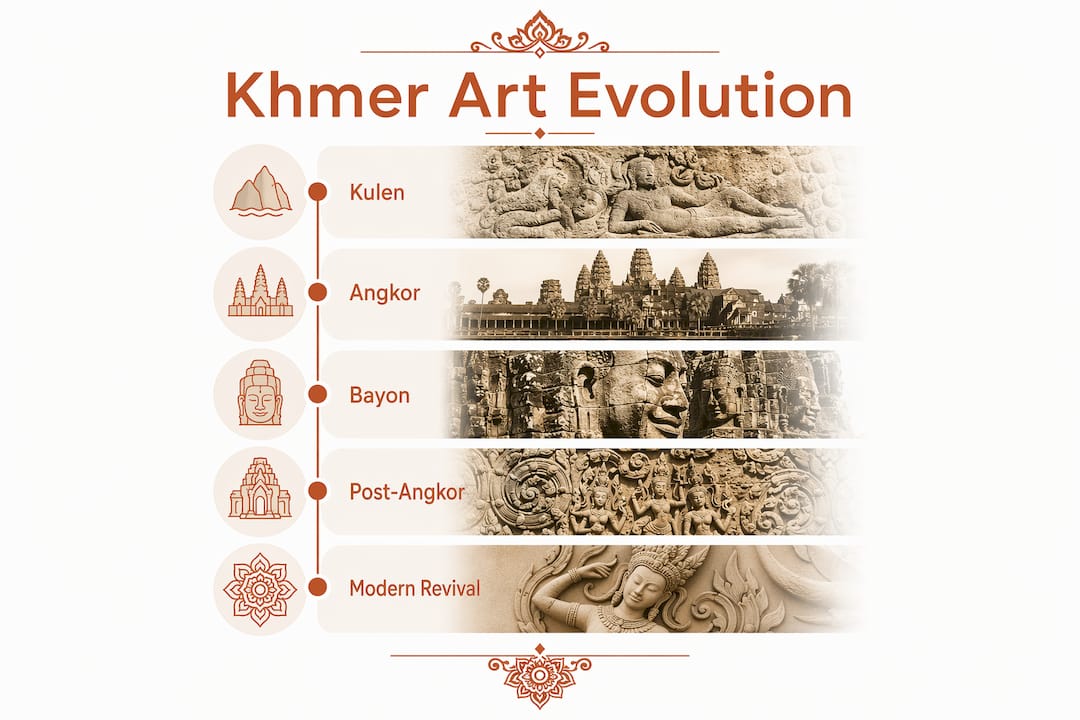
Die Bayon-Zeit ist besonders bedeutsam, weil sie die widerspiegelt Verschmelzung hinduistischer und buddhistischer Elemente das charakterisiert die spätere Khmer-Kunst. Frühere hinduistische Tempel wurden durch buddhistische Ikonographie neu interpretiert und den bestehenden Strukturen eine neue Bedeutung verliehen. Das war keine Zerstörung. Es war eine Akkumulation.
Profi-Tipp: Die Fronttürme des Bayon-Tempels werden oft als Bodhisattva Avalokiteshvara identifiziert, tragen aber auch die Merkmale von König Jayavarman VII. Diese absichtliche Mehrdeutigkeit ist das zu Stein gewordene Deva-Raja-Konzept.
Aufgrund politischer Unruhen ging die traditionelle Steinmetzarbeit im 20. Jahrhundert stark zurück. In den 1970er und 1980er Jahren war das Handwerk nahezu verschwunden, obwohl die Meisterwerke, die es hervorgebracht hatte, in Tempeln und Museen auf der ganzen Welt erhalten blieben. Der Verlust lebender Handwerker, nicht der Verlust von Gegenständen, war die tiefere Wunde.
Wie wird die Khmer-Kunst in der modernen kambodschanischen Kultur bewahrt?
Die Wiederbelebungs- und Erhaltungsbemühungen nahmen in den 1990er Jahren zu Kambodscha nach Jahrzehnten des Konflikts stabilisiert. Diese Bemühungen wirken auf mehreren Ebenen.
- Museen und internationale Ausstellungen. Institutionen wie das Nationalmuseum von Kambodscha in Phnom Penh und in großen westlichen Museen befinden sich bedeutende Khmer-Sammlungen. Ausstellungen und Museumsausstellungen weltweit Unterstützen Sie aktiv den Naturschutz und die öffentliche Bildung.
- Handwerksschulprogramme. Organisationen in Siem Reap und Phnom Penh bilden junge Kambodschaner in traditioneller Steinschnitzerei, Seidenweberei und Silberschmiedekunst aus. Diese Programme behandeln die handwerkliche Weitergabe als kulturelles Überleben und nicht als Nostalgie.
- Zeitgenössische kambodschanische Künstler. Eine Generation von Künstlern arbeitet mittlerweile mit der Khmer-Ikonographie in neuen Medien, darunter Malerei, Installation und digitale Kunst. Sie greifen auf das visuelle Vokabular von Apsaras, Nāgas und der Tempelgeometrie zurück, ohne historische Formen nachzubilden.
- Tourismus und nationale Identität. Angkor Wat erscheint auf der kambodschanischen Nationalflagge, der einzigen Nationalflagge der Welt, auf der ein Gebäude abgebildet ist. Diese Wahl zeigt, wie wichtig die architektonische Kunst der Khmer für die kambodschanische Identität ist. Die Stätte zieht jedes Jahr Millionen von Besuchern an und finanziert laufende Naturschutzarbeiten.
- Akademische Forschung. Institutionen wie die École française d’Extrême-Orient dokumentieren die Khmer-Kunst seit dem frühen 20. Jahrhundert systematisch. Digitale Dokumentationsprojekte erstellen mittlerweile dreidimensionale Aufzeichnungen von Tempelreliefs, die durch Witterungseinflüsse und Tourismusdruck gefährdet sind.
Die Khmer-Kunst bewahrt die kulturelle Identität und inspiriert weiterhin zeitgenössische Künstler, wobei sie sich kontinuierlich darum bemüht, historische Handwerke wiederzubeleben und neue Generationen kambodschanischer Praktizierender auszubilden.
Wichtige Erkenntnisse
Die Khmer-Kunst ist ein einheitliches visuelles System, das gleichzeitig religiöser Hingabe und königlicher Autorität diente. Sie erreichte ihren Höhepunkt zwischen dem 9. und 13. Jahrhundert und prägt auch heute noch die kambodschanische Identität.
| Punkt | Einzelheiten |
|---|---|
| Kerndefinition | Die Khmer-Kunst umfasst Skulpturen, Architektur, Bronze und Textilien, die vom Khmer-Reich von 802 bis 1431 n. Chr. hergestellt wurden. |
| Symbolische Sprache | Mudras, Apsaras, Nāgas und die Tempelkosmologie verschlüsseln alle spezifische religiöse und politische Bedeutungen. |
| Stilistische Unabhängigkeit | Bis zum 10. Jahrhundert waren die Khmer-Bildhauer über indische Vorbilder hinausgegangen und hatten eine völlig originelle visuelle Identität entwickelt. |
| Dringlichkeit der Erhaltung | In den 1980er-Jahren verschwand die traditionelle Steinmetzarbeit fast vollständig. Wiederbelebungsprogramme seit den 1990er Jahren bauen das Handwerk wieder auf. |
| Gelebte Tradition | Die Khmer-Kunst bleibt weltweit von zentraler Bedeutung für die nationale Identität, die zeitgenössische Kunst und die kulturelle Bildung Kambodschas. |
Warum die Khmer-Kunst immer noch ernsthafte Aufmerksamkeit erfordert
Ich habe Jahre damit verbracht, südostasiatische religiöse Kunst zu studieren, und die Khmer-Skulptur überrascht mich immer wieder. Die meisten Menschen erwarten, dass es sich wie eine regionale Variation indischer Kunst anfühlt. Das ist nicht der Fall. Sobald Sie vor einer Khmer-Sandsteinfigur aus dem 10. Jahrhundert stehen und ihr Gesicht betrachten, sehen Sie etwas, das zu einem bestimmten Volk und Ort gehört. Die Tradition der Sandsteinskulptur von Kambodscha ist nicht abgeleitet. Es handelt sich um eine der großen ursprünglichen Bildhauertraditionen der Welt und verdient es, als solche behandelt zu werden.
Was meiner Meinung nach am meisten unterschätzt wird, ist die politische Intelligenz, die in der Kunst der Khmer steckt. Studierende betrachten es oft als reinen religiösen Ausdruck. Es war auch Propaganda, und zwar raffinierte Propaganda. Ein König, der eine Porträtstatue mit den Attributen von Vishnu in Auftrag gibt, drückt nicht nur persönliche Frömmigkeit aus. Er erhebt einen Anspruch auf die Art seiner Autorität, mit dem kein schriftliches Dekret mithalten kann. Das Bild leistet die politische Arbeit effektiver als jeder Text.
Der Beinahe-Verlust des traditionellen Handwerkswissens im 20. Jahrhundert ist der Teil dieser Geschichte, der mir im Gedächtnis bleibt. Die Tempel blieben erhalten. Das Wissen darüber, wie man sie baut und schnitzt, war fast nicht vorhanden. Diese Asymmetrie sollte beeinflussen, wie wir über die Erhaltung denken. Der Schutz von Objekten ist notwendig. Wichtiger ist der Schutz der Menschen, die verstehen, wie man sie herstellt.
— James, HDAsianArt.com
Authentische Khmer- und südostasiatische Kunst bei HDAsianArt
HDAsianArt bietet eine kuratierte Sammlung antiker und traditioneller buddhistischer und hinduistischer Statuen, die dieselben künstlerischen Traditionen widerspiegeln, die in diesem Artikel untersucht werden.
Die Sammlung umfasst authentische Bronze-, Stein- und Holzstücke von Kambodscha, Thailand, Indonesien, Sri Lanka, und Vietnam. Jedes Werk wird individuell von Spezialisten recherchiert und beschrieben, wobei Ikonographie, Epoche und Provenienz berücksichtigt werden. Stücke wie dieses Bodhisattva-Statue spiegeln die gleichen Andachtstraditionen und die gleiche Mudra-Sprache wider, die in diesem Artikel diskutiert werden. Für Studenten und Sammler, die von der Lektüre über Khmer- und südostasiatische Kunst zum Besitz eines Stücks übergehen möchten, ist die HDAsianArt-Sammlung ist ein direkter Ausgangspunkt. Der weltweite versicherte DHL-Versand ist bei allen Bestellungen Standard.
FAQ
Was bedeutet Khmer-Kunst?
Khmer-Kunst hat eine doppelte Bedeutung: religiöse Hingabe an hinduistische und buddhistische Gottheiten und die politische Legitimierung des Khmer-Königs als Gottkönig oder Deva-Raja. Jedes größere Werk diente beiden Zwecken gleichzeitig.
Was stellt die Khmer-Kunst typischerweise dar?
Die Khmer-Kunst zeigt Gottheiten aus der hinduistischen und buddhistischen Tradition, darunter Vishnu, Shiva, Buddha und Bodhisattvas, neben königlichen Figuren, himmlischen Apsaras, Naga-Schlangen und Erzählszenen aus Texten wie dem Ramayana und dem Mahabharata.
Was sind die Haupteinflüsse auf die Khmer-Kunst?
Die Haupteinflüsse sind indische Gupta- und Pallava-Skulpturenstile, die durch Handel und religiösen Kontakt entstanden sind. Bis zum 10. Jahrhundert hatten Khmer-Künstler diese Einflüsse absorbiert und in eine völlig originelle visuelle Tradition umgewandelt.
Wie unterscheidet sich die Khmer-Kunst von anderen südostasiatischen Kunsttraditionen?
Die Khmer-Skulptur ist vollständig rund geschnitzt, ohne hintere Stützstrukturen, ein technisch anspruchsvoller Ansatz, der sie von thailändischen, javanischen und anderen regionalen Traditionen unterscheidet. Khmer-Figuren weisen auch deutlich lokale physische Merkmale auf und nicht idealisierte indische Proportionen.
Warum ist Khmer-Kunst heute wichtig?
Die Khmer-Kunst ist für die nationale Identität Kambodschas von zentraler Bedeutung, erscheint auf der Nationalflagge und beeinflusst weiterhin zeitgenössische kambodschanische Künstler und Kunsthandwerker. Erhaltungs- und Wiederbelebungsprogramme behandeln die Tradition als lebendiges kulturelles Erbe und nicht als historisches Artefakt.
Empfohlen
- Kambodschanische Sandsteinskulptur: Geschichte, Kunst und Bedeutung – HD Asian Art
- Strahlende Khmer-Träumerei: Erkundung des künstlerischen Wandteppichs von Kambodscha – HD Asian Art
- Lokeshvara in der Khmer-Kultur: Geschichte und Bedeutung aus der Zeit vor Angkor – HD Asian Art
- Die Phnom-Da-Zeit der Khmer-Geschichte: Ein Tor dazu Kambodschaist uralt – HD Asian Art
