



Sculpture khmère : identifier l'art cambodgien authentique
Sculpture khmère : identifier l'art cambodgien authentique
La plupart des acheteurs de sculptures bouddhistes et hindoues cambodgiennes n'ont aucune idée à quel point les sculptures authentiques sont radicalement différentes. Sculpture khmère vient d’autres traditions d’Asie du Sud-Est, et cette ignorance leur coûte cher. Ils achètent des pièces étiquetées « style cambodgien » qui sont des reproductions génériques d'ateliers thaïlandais, ou négligent de véritables œuvres d'influence khmère parce qu'ils n'ont pas le vocabulaire nécessaire pour reconnaître ce qu'ils regardent.
La civilisation khmère a produit, selon les mots d'un critique d'art largement cité, « certaines des plus grandes œuvres de sculpture sur pierre et de bronze de l'histoire de l'humanité », mais le nombre de personnes capables de lire une sculpture khmère, de comprendre son époque et de juger de sa qualité reste remarquablement faible. Ce guide est écrit pour changer cela pour les collectionneurs sérieux et les praticiens spirituels.
Table des matières
Points à retenir
|
Aperçu clé |
Explication |
|---|---|
|
La sculpture khmère est presque entièrement religieuse |
Presque toutes les sculptures khmères survivantes servaient dans des contextes de temples hindous ou bouddhistes. Il n’existe pratiquement aucune sculpture khmère laïque en pierre ou en bronze. |
|
Le grès est le matériau dominant |
La plupart des sculptures des temples khmers sont en grès, et non en marbre ou en calcaire. La texture chaude et granuleuse du grès cambodgien est un marqueur d’identification primordial. |
|
Les pièces en bronze sont exceptionnellement rares |
La sculpture en bronze khmère survivante est considérée comme un grand trésor. Tout marchand proposant de grandes quantités de bronze khmer « authentique » à des prix accessibles mérite un sérieux scepticisme. |
|
Les visages khmers ont une sérénité distincte |
L'expression khmère caractéristique, que l'on retrouve le plus clairement dans les têtes de la période d'Angkor, est un demi-sourire calme et replié sur lui-même, aux paupières baissées. Ce n’est pas le sourire plus large de la sculpture thaïlandaise. |
|
La restitution est une question active |
Des pièces majeures khmères continuent d'être restituées Cambodge des musées occidentaux. La recherche de provenance n’est pas facultative pour tout collectionneur sérieux. |
|
L'influence indienne ne signifie pas l'origine indienne |
L’art khmer a été fortement façonné par les traditions artistiques indiennes, mais il a développé une identité locale distincte. Confondre les deux est une erreur courante du débutant. |
|
La période compte pour l’identification |
L'art khmer s'étend sur environ 1 000 ans. Le style, le sujet et la technique ont tous changé de manière significative entre les périodes pré-Angkor, Angkor et Post-Angkor. |
Ce qui définit la sculpture khmère
La civilisation khmère était centrée sur ce qui est aujourd'hui Cambodge et a produit de l'art sur environ mille ans, du début de la période pré-Angkor jusqu'à l'ère post-Angkor. Presque tout l’art khmer qui survit aujourd’hui est de la sculpture, et l’écrasante majorité de cette sculpture est en pierre, en particulier en grès, associée aux complexes de temples. Les quelques œuvres en bronze qui survivent sont considérées comme de grands trésors précisément parce que très peu d’entre elles ont survécu.
Ce qui distingue la sculpture khmère de la catégorie plus large de l’art religieux d’Asie du Sud-Est est une combinaison très spécifique de retenue formelle, d’intensité spirituelle et de maîtrise technique de la sculpture. Là où la sculpture indienne pousse souvent vers la sensualité et le mouvement, l'œuvre khmère recule. Comme l’a souligné un observateur largement cité à propos de son attrait : tranquillité, spiritualité et sérénité sont les mots les plus systématiquement utilisés pour le décrire. Il y a une quiétude intérieure dans les figures khmères qui ne ressemble à rien de ce qui a été produit en Thaïlande, Java, ou Sri Lanka.
Le champ des sujets est volontairement restreint. Les images du Bouddha, du serpent Naga à sept têtes, des apsaras (femmes célestes) et des divinités hindoues dont Shiva, Brahma, Vishnu, Ganesha et Durga constituent l'essentiel de ce que la tradition a produit. Les bas-reliefs représentent également des événements historiques et des scènes de la littérature hindoue, mais la sculpture autonome reste proche de cet univers iconographique défini.
Conseil de pro : Si vous rencontrez une pièce prétendument khmère qui représente des scènes de genre, des animaux utilisés à des fins décoratives ou des sujets purement profanes, traitez l'attribution avec prudence. La sculpture khmère a un but presque entièrement dévotionnel.
Grandes périodes et leurs signatures visuelles
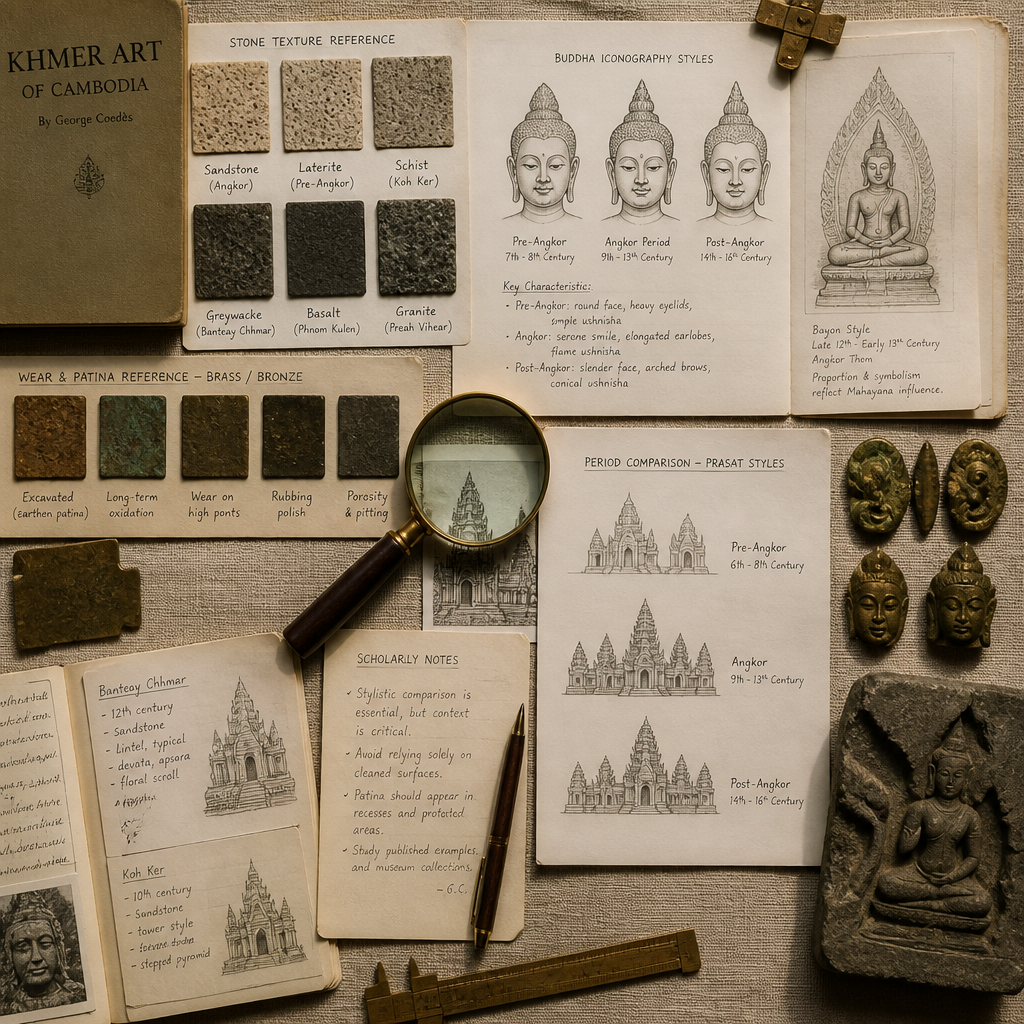
Comprendre les périodes de l’art khmer n’est pas du pédantisme académique. C'est la base pratique pour évaluer n'importe quelle pièce, qu'il s'agisse d'une sculpture de qualité muséale ou d'une œuvre contemporaine réalisée dans la tradition khmère.
Période pré-Angkor
La période pré-Angkor couvre approximativement le VIe au IXe siècle. L'influence artistique indienne est ici la plus forte, et les figures ont tendance à être frontales, formelles et architecturales. Le Hari-Hara debout, divinité composite réunissant Vishnu et Shiva en une seule figure, est l'un des sujets emblématiques de cette période. Les formes sont encore un peu rigides par rapport aux travaux ultérieurs, mais la capacité technique est déjà redoutable.
Période d'Angkor et Haut-Angkor
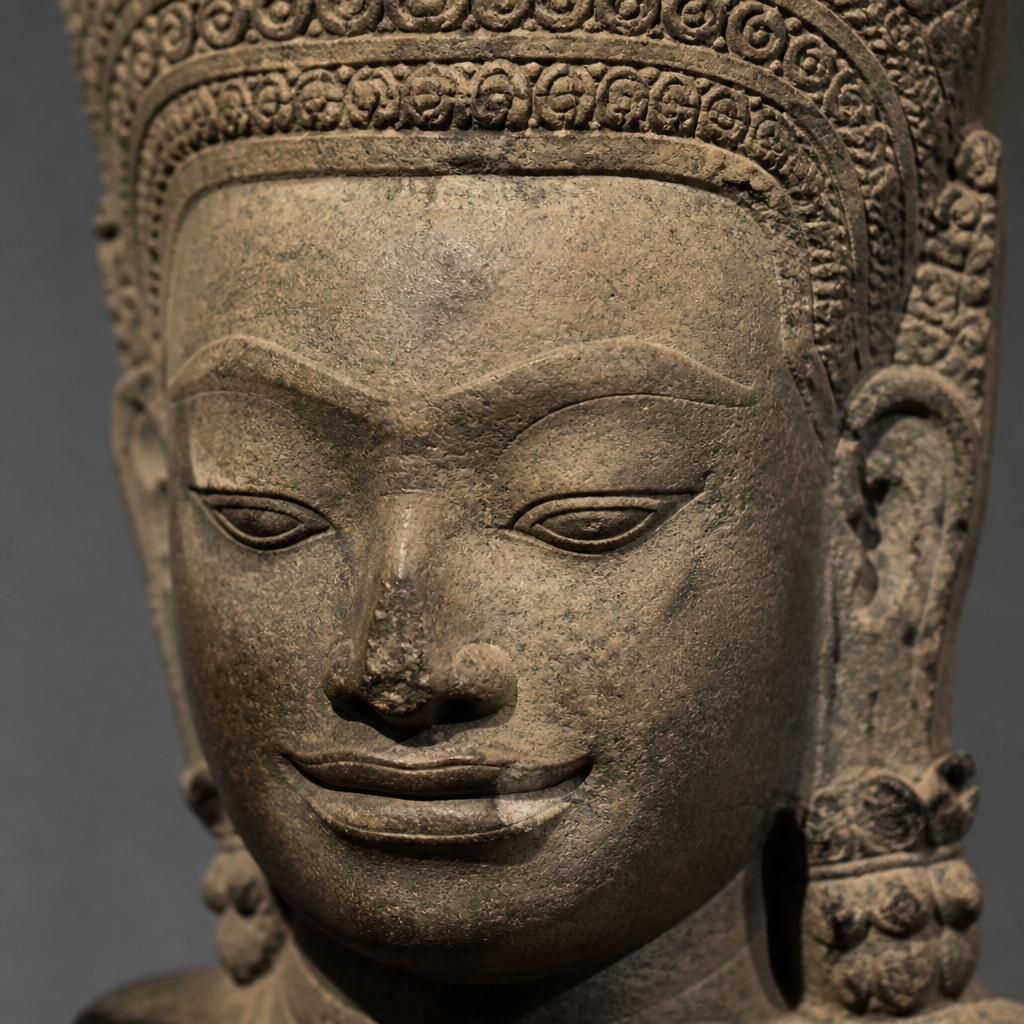
La période d'Angkor, qui s'étend approximativement du IXe au XVe siècle, constitue l'apogée de la réussite artistique khmère. Les travaux du Haut-Angkor, du XIe au XIIIe siècle environ, ont produit les sculptures les plus fortement associées à la tradition khmère dans l'imaginaire populaire. Les visages deviennent plus raffinés, avec le regard baissé caractéristique et le demi-sourire posé. Les personnages acquièrent un sentiment de présence intérieure véritablement extraordinaire. La tête en grès de Jayavarman du XIIe siècle, avec son « doux sourire et son expression sereine et contemplative remarquable », est souvent citée comme représentative de cette sensibilité. Les sujets hindous restent importants, mais l'imagerie bouddhiste augmente considérablement, en particulier les images du bodhisattva Avalokiteshvara et du Bouddha transcendant assis Vairochana.
Période post-Angkor
Après le XVe siècle, la production artistique khmère s'est poursuivie mais s'est orientée presque exclusivement vers des sujets bouddhistes Theravada. Les personnages tendent vers une plus grande stylisation et la tradition de la sculpture monumentale des temples prend fin en grande partie. Les statues de Bouddha cambodgiens post-Angkor peuvent encore être des œuvres de grande qualité, mais elles se lisent différemment des pièces de la période d'Angkor.
La statue du Bouddha cambodgien : une iconographie à connaître
Un Statue de Bouddha cambodgien possède des marqueurs iconographiques spécifiques qui le distinguent de ses équivalents thaïlandais, birmans ou chinois. Se tromper est l’une des erreurs les plus courantes commises par les acheteurs qui abordent la sculpture d’Asie du Sud-Est sans spécialisation régionale.
Le Bouddha protégé par Naga est peut-être l’image bouddhiste cambodgienne la plus distinctive. Le Bouddha est assis en méditation sur le corps enroulé du serpent Naga à plusieurs têtes, dont le capuchon s'étend au-dessus de la figure comme un dais. Ce sujet apparaît dans toute l’Asie du Sud-Est, mais le traitement khmer, avec sa sérénité faciale caractéristique et le rendu précis et formel des écailles et des têtes Naga, est indéniablement distinct. Une version thaïlandaise ou laotienne du même sujet se lit de manière très différente une fois que vous avez vu suffisamment d'exemples des deux.
Les mudras (gestes de la main) des statues de Bouddha cambodgiennes suivent les conventions iconographiques indiennes, mais le traitement global du corps diffère. Les figures khmères sont généralement moins détaillées anatomiquement que leurs équivalents indiens. Le corps est un véhicule de présence spirituelle et non une célébration de la forme physique. Il ne s'agit pas d'une limitation. Il s’agit d’un choix esthétique délibéré qui produit un autre type de pouvoir.
Conseil de pro : Lorsque vous évaluez une statue de Bouddha cambodgien, portez une attention particulière au traitement de l'ushnisha (la protubérance crânienne au sommet de la tête). Dans les pièces authentiques de la tradition khmère, il a tendance à être conique et rendu avec précision. Les formes vagues ou génériquement arrondies d'ushnisha sont souvent le signe d'une production générique en atelier en Asie du Sud-Est plutôt que d'un véritable savoir-faire de la tradition khmère.
L'art d'Angkor et ses sujets de divinités hindoues
L'art d'Angkor est autant hindou que bouddhiste, en particulier dans ses premières phases. Vishnu, Shiva et des divinités composites comme Harihara sont aussi centrales dans le canon artistique khmer que le Bouddha. Comprendre l'iconographie hindoue n'est pas facultatif si vous souhaitez vous engager sérieusement dans cette tradition.
Vishnu dans la sculpture khmère apparaît généralement avec quatre bras, chacun tenant l'un de ses attributs traditionnels : la conque, le disque, la massue et le lotus. Vishnu debout, à quatre bras, est l'un des sujets phares de l'art hindou khmer. Shiva apparaît à la fois sous sa forme de personnage debout et symboliquement à travers le linga. Durga, la déesse tueuse de démons, apparaît sous l'une de ses formes khmères les plus célèbres sous le nom de Durga Mahisasuramardini, la tueuse du démon buffle, un sujet qui a produit certaines des sculptures les plus techniquement abouties de toute la tradition.
Une caractéristique compositionnelle à noter dans l’art d’Angkor est le traitement de l’espace négatif. Les sculpteurs khmers travaillant en haut-relief sur les murs des temples ont créé des figures qui existent dans une relation architecturale précise avec leur environnement. Les personnages autonomes conservent une qualité similaire d’auto-confinement. La sculpture s’étend rarement vers l’espace comme le font la sculpture indienne ou grecque. Ce confinement formel fait partie de ce qui donne au travail khmer sa qualité méditative.
Comment identifier l'art khmer authentique
Identifier art khmer authentique dans un contexte de collection, il faut être honnête quant à la catégorie d'authenticité à laquelle vous avez réellement affaire. Il existe trois catégories distinctes : les pièces archéologiques authentiques (qui sont soumises à des contrôles d'exportation stricts et à des demandes de restitution actives), les pièces antiques fabriquées dans la tradition khmère du XIXe et du début du XXe siècle et les pièces contemporaines fabriquées dans la tradition stylistique khmère. Chacun nécessite un ensemble différent d’outils d’évaluation.
Matériau et surface
La véritable sculpture en pierre de la période d'Angkor est presque toujours en grès avec une surface qui présente des motifs d'altération spécifiques, une patine biologique (mousse, dépôts minéraux) et des marques d'outils compatibles avec la sculpture manuelle. Le vieillissement synthétique peut reproduire la patine de la surface, mais sous un grossissement, les marques des outils modernes à pointe de diamant diffèrent de celles des ciseaux en fer traditionnels. Pour une acquisition sérieuse, engager un restaurateur pour l’analyse des matériaux est de l’argent bien dépensé.
Précision iconographique
Les reproductions d'atelier réalisées pour le tourisme comportent souvent des erreurs dans les détails iconographiques. Une pièce « khmère » avec une ushnisha à flamme thaïlandaise, ou une figure de Vishnu avec des attributs incorrects, ne s'inspire pas de la véritable tradition khmère, indépendamment de ce que prétend le vendeur. Étudiez des exemples primaires dans les collections d’institutions telles que le Musée national de Cambodge avant de vous engager dans un achat.
Documentation de provenance
La question de la restitution de l’art khmer est active et médiatisée. Des pièces majeures ont été restituées à Cambodge des collections des musées occidentaux ces dernières années après avoir été attribuées à des fouilles illégales. Toute pièce prétendant être un artefact archéologique khmer sans provenance documentée antérieure à 1970 (la référence standard de l'UNESCO) n'est pas quelque chose qu'un collectionneur responsable devrait toucher. La question de la provenance n’est pas seulement éthique. C'est un risque juridique.
Cohérence des styles
Chaque période de l’art khmer présente des caractéristiques visuelles cohérentes en interne. Une pièce qui mélange le traitement du visage de la période d'Angkor avec les proportions du corps post-Angkor est presque certainement un composite ou une reproduction moderne. Apprendre suffisamment les styles de période pour repérer les incohérences est l’une des compétences d’identification les plus fiables qu’un collectionneur puisse développer.
Comparaison des traditions de sculpture khmère, thaïlandaise et javanaise
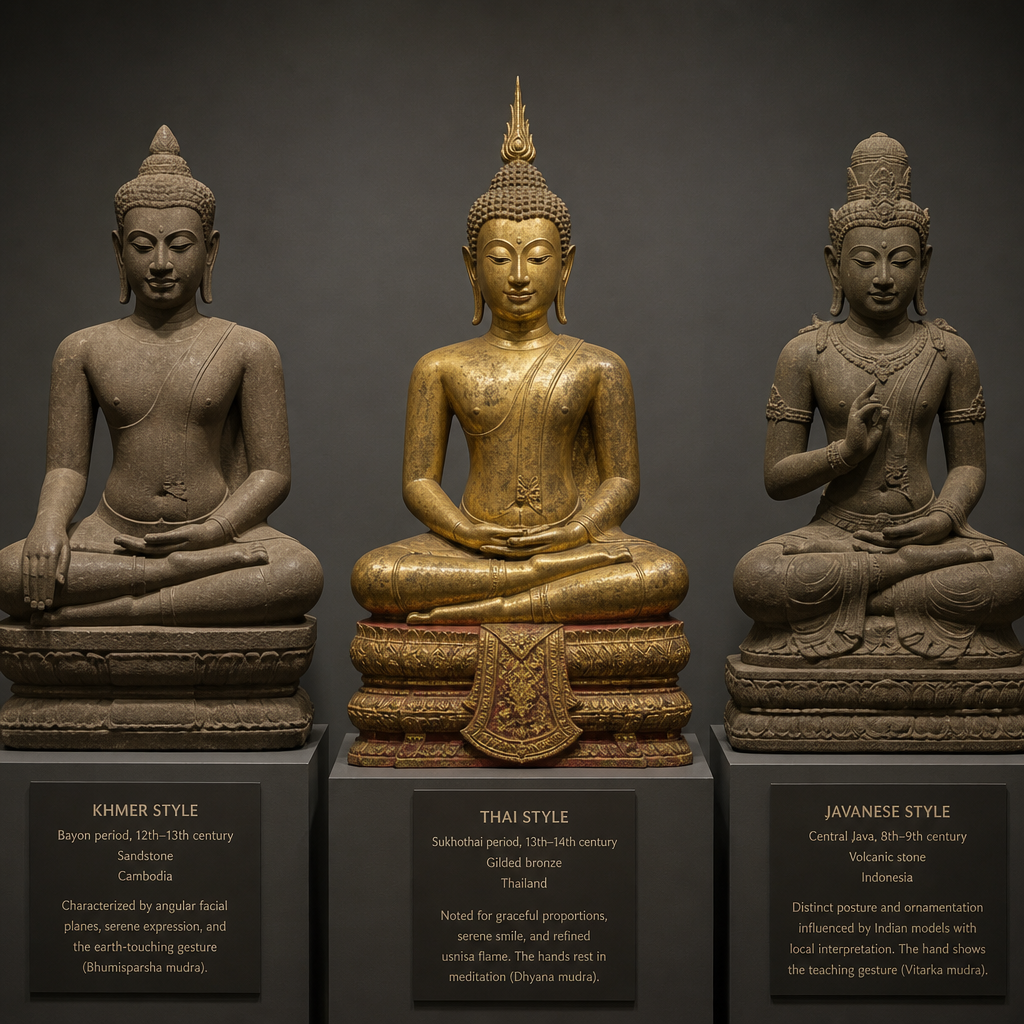
Les collectionneurs rencontrent régulièrement des sculptures khmères, thaïlandaises et javanaises décrites de manière interchangeable comme « l'art bouddhiste d'Asie du Sud-Est ». Ils ne sont pas interchangeables. Le tableau ci-dessous présente les principales différences entre les trois traditions.
|
Caractéristique |
Khmer (Cambodge) |
Thaï (Thaïlande) |
javanais (Indonésie) |
|---|---|---|---|
|
Matériau primaire |
Grès, avec une importante tradition de bronze |
Bronze, bois doré, stuc |
Pierre d'andésite volcanique, bronze |
|
Religion dominante |
Bouddhiste hindou et mahayana (historiquement), bouddhiste Theravada (plus tard) |
Bouddhiste Theravada |
Bouddhiste hindou et mahayana |
|
Expression du visage |
Calme intérieur, regard baissé, demi-sourire retenu |
Sourire plus prononcé, expression ouverte |
Serein mais avec une plus grande douceur anatomique |
|
Traitement du corps |
Confinement formel, mouvements vers l'extérieur minimes |
Posture plus fluide, doigts allongés |
Modelage de chair arrondi et plus doux |
|
Des sujets distinctifs |
Bouddha protégé par les Nagas, Harihara, apsaras |
Bouddha marcheur, bouddhas couronnés |
Têtes de Kala, stupas de style Borobudur, Prajnaparamita |
Acheter une sculpture d'influence khmère : ce qu'il faut rechercher
Pour les collectionneurs et les praticiens spirituels qui s'approvisionnent en sculptures de tradition khmère auprès d'un détaillant spécialisé, la question pratique est de savoir comment évaluer la qualité des pièces contemporaines fabriquées dans le style khmer. Il s'agit d'un marché légitime et important. Des artisans cambodgiens qualifiés continuent de travailler dans la tradition khmère, produisant des pièces d'une véritable valeur artistique qui honorent les principes esthétiques de la sculpture originale sans les complications éthiques et juridiques du marché archéologique.
Le visage est toujours le test principal. Une pièce de tradition khmère bien réalisée aura le calme caractéristique vers le bas qui définit la tradition. La production générique en atelier a tendance à produire des visages soit vides, soit arborant le sourire plus large de la sculpture bouddhiste contemporaine d'influence thaïlandaise. Ceux-ci ne sont pas équivalents et ne doivent pas être tarifés comme s’ils l’étaient.
Faites attention au traitement des bijoux et des insignes sur les divinités hindoues. Dans un travail authentique de la tradition khmère, la couronne, les boucles d'oreilles et les ornements sont rendus avec précision et suivent les conventions iconographiques établies. Dans une production en atelier précipitée, ces détails sont vagues ou stylistiquement incohérents.
L’attrait de l’art khmer réside dans son ampleur, sa continuité et sa pure majesté esthétique. Il y a très peu de l’érotisme de la sculpture indienne. Ce qui reste, c'est la tranquillité, la spiritualité et la sérénité.
À HD Asian Art, les sculptures cambodgiennes de la collection sont sélectionnées précisément parce qu'elles reflètent de véritables principes artistiques khmers plutôt qu'une production générique de « décor asiatique ». Lorsque vous comparez les sources, la question à poser à n'importe quel détaillant n'est pas seulement « est-ce cambodgien ? mais "cette pièce démontre-t-elle une connaissance de l'iconographie khmère et du style d'époque ?" Un détaillant qui ne peut pas répondre à cette question en détail n’est pas la bonne source pour une collection sérieuse.
La sculpture d’Asie du Sud-Est, en tant que catégorie de collection, récompense également l’alphabétisation interrégionale. Comprendre les liens entre une statue de Bouddha cambodgien de la tradition khmère et des œuvres comparables de Birmanie, Laos, ou Thaïlande approfondit votre capacité à évaluer n’importe quelle pièce individuelle. Les différences ne sont pas arbitraires. Ils reflètent des accents religieux distincts, des traditions d'ateliers régionaux et des périodes historiques qui ont chacune leur propre logique visuelle.
Foire aux questions
Quelle pierre était la plus couramment utilisée dans la sculpture khmère ?
Le matériau dominant dans la sculpture des temples khmers est le grès, qui confère à l’œuvre sa surface chaude et granuleuse caractéristique. Le grès spécifique utilisé sur les sites de la période d'Angkor a une qualité distinctive qui diffère du calcaire ou du granit utilisé dans d'autres traditions sculpturales asiatiques. Le bronze a également été utilisé pour des œuvres importantes, mais les exemples survivants sont rares et traités comme des trésors majeurs.
Comment distinguer une statue de Bouddha khmère d’une statue thaïlandaise ?
L’expression du visage est le point de départ le plus fiable. Les visages des Bouddhas khmers ont tendance à avoir une qualité plus intérieure et méditative, avec une expression plus subtile et plus retenue et un regard baissé. Les visages des Bouddhas thaïlandais arborent généralement un sourire plus large et plus ouvertement exprimé. L'ushnisha (protubérance crânienne) diffère également : la tradition khmère utilise une forme conique, tandis que la sculpture thaïlandaise utilise souvent une usnishha en forme de flamme. Les proportions du corps et le traitement de la robe sont des éléments distinctifs supplémentaires.
Est-il légal d'acheter et de posséder une sculpture khmère ?
Les pièces contemporaines fabriquées dans la tradition artistique khmère par des artisans vivants sont tout à fait légales à l'achat et à la possession. La complexité juridique et éthique s'applique spécifiquement aux objets archéologiques, en particulier ceux dont la provenance n'est pas documentée avant 1970. La restitution des pièces khmères aux Cambodge des musées occidentaux est un problème actif et permanent. Toute pièce présentée comme une découverte archéologique sans documentation solide de provenance antérieure à 1970 doit être entièrement évitée.
Quelles divinités hindoues apparaissent le plus souvent dans la sculpture khmère ?
Vishnu et Shiva sont les sujets hindous les plus importants de l'art khmer, à la fois individuellement et sous forme composite comme Harihara. Brahma, Ganesha et Durga (en particulier sous sa forme de Mahisasuramardini) apparaissent également régulièrement. La déesse Uma, souvent associée à Shiva, est un autre sujet khmer important. Cette gamme iconographique hindoue reflète la culture royale et religieuse de la période d'Angkor, où le roi était souvent identifié à une divinité particulière.
Que signifie concrètement la « sculpture d’Asie du Sud-Est » pour un collectionneur ?
En pratique, cela signifie que vous travaillez sur plusieurs traditions nationales et régionales distinctes, chacune avec ses propres conventions iconographiques, préférences matérielles et périodes historiques. La sculpture khmère cambodgienne, la sculpture bouddhiste thaïlandaise, l'œuvre birmane de la période Mandalay, la sculpture hindou-bouddhiste javanaise et les figures en bronze laotiennes sont toutes asiatiques du Sud-Est, mais elles ne sont pas interchangeables. Un détaillant spécialisé qui s'approvisionne à travers ces traditions et peut expliquer les différences est bien plus utile à un collectionneur sérieux que celui qui les regroupe tous sous une étiquette régionale générique.
Pourquoi y a-t-il si peu d’artistes khmers nommés ?
Tout au long de l’histoire millénaire de l’art khmer, aucun artiste ou sculpteur n’est mentionné nommément. Ce n’est pas inhabituel pour l’art religieux de l’époque. L’œuvre était considérée comme un service de dévotion plutôt que comme une expression individuelle, et l’identité de l’auteur était considérée comme moins importante que la fonction spirituelle de l’objet. Cet anonymat fait de l’analyse des périodes et des styles les principaux outils d’évaluation scientifique.
Références
