



Comment savoir si une statue de Bouddha est consacrée
Comment savoir si une statue de Bouddha est consacrée
Table des matières
Que signifie la consécration d’une statue de Bouddha ?
La consécration est un rituel sacré qui transforme une statue de Bouddha d'un objet d'art ordinaire en un point focal spirituellement activé pour la méditation et la dévotion. Lorsqu’une statue subit ce processus cérémonial, les pratiquants bouddhistes croient qu’elle s’imprègne d’énergie spirituelle et de bénédiction. Le rituel de consécration implique généralement des moines ou des praticiens expérimentés exécutant des mantras spécifiques, des cérémonies d'autonomisation et des pratiques de scellement sacrées qui consacrent la statue à la pratique du dharma.
Comprendre la consécration est important, que vous construisiez un autel chez vous, collectionniez des pièces antiques ou recherchiez un point focal de méditation significatif. Une statue consacrée porte signification spirituelle différente que ceux non consacrés, même s'ils semblent identiques à un œil non averti.
Marqueurs physiques indiquant une statue de Bouddha consacrée
Plusieurs caractéristiques physiques indiquent si une statue de Bouddha a subi une consécration formelle, car le processus nécessite des méthodes de construction et de scellement spécifiques qui laissent des traces visibles.
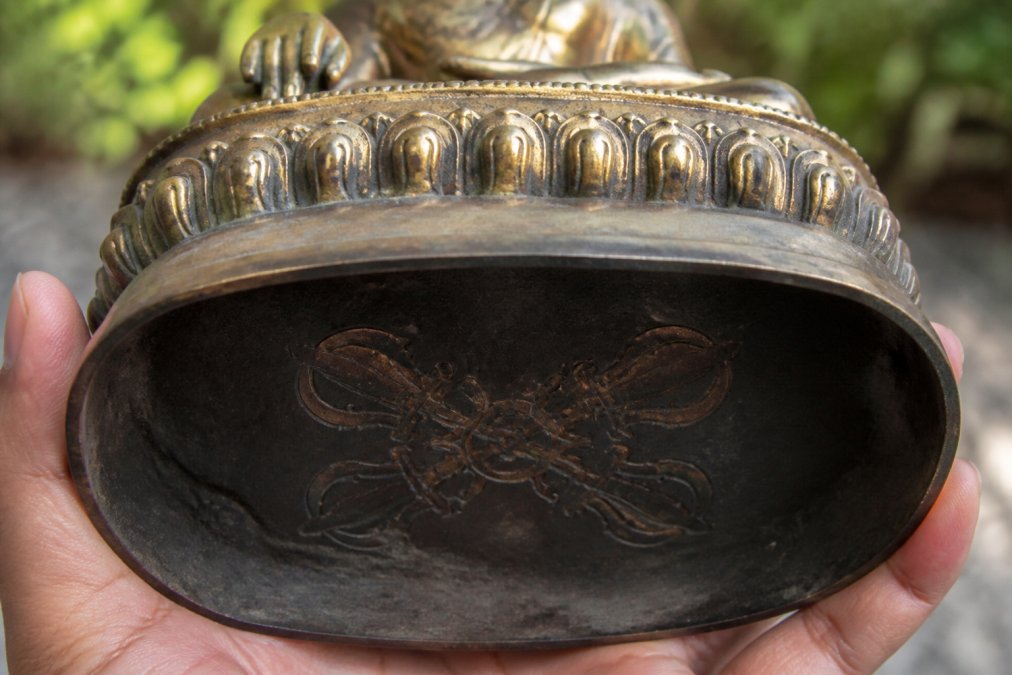
Le double sceau Vajra
Le double sceau vajra, un motif de foudre croisé, est généralement estampillé ou gravé sur la base ou le bas de la statue, servant de verrou spirituel indiquant la bénédiction formelle et l'autonomisation. Une véritable statue consacrée aura ce sceau clairement visible, souvent accompagné d'autres marques sacrées ou d'inscriptions sanscrites.
Plaque de base et construction creuse
Consacré Statues de Bouddha sont presque toujours creux avec une plaque de base amovible ou scellée, créant ainsi un espace pour le contenu sacré. Examinez la base pour déceler des espaces visibles minimes et une étanchéité professionnelle, qui distingue une statue consacrée des pièces décoratives solides.
Reliques et pilules de Mani à l'intérieur
L'intérieur creux contient des objets sacrés : des pilules de mani (petites pastilles bénies), des textes ou mantras bouddhistes, et parfois des reliques de maîtres éclairés. Secouez doucement la statue pour écouter les sons subtils indiquant le contenu interne. Les évaluateurs professionnels peuvent utiliser une imagerie non invasive pour confirmer la présence de contenus internes sans ouvrir la statue.
Comprendre le rituel de remplissage de la statue de Bouddha
Le rituel de remplissage de la statue de Bouddha est au cœur de la consécration. Des moines qualifiés ou des praticiens expérimentés placent des objets sacrés dans la statue creuse tout en récitant des mantras spécifiques et en effectuant des pratiques de méditation, généralement sur plusieurs heures ou jours selon la taille et la tradition de la statue.
La structure rituelle et la phase de préparation
Le rituel commence par la purification de la statue et des objets sacrés à l'aide d'eau rituelle ou de substances bénies. Les pratiquants disposent ensuite les reliques, les pilules de manucure et les textes du dharma dans la chambre creuse selon la tradition. Dans la pratique bouddhiste tibétaine, les reliques sont placées au centre, les pilules de mani les entourent et les textes du dharma forment la couche externe. Les traditions thaïlandaises et asiatiques du Sud-Est peuvent utiliser des arrangements différents.
La phase de récitation du mantra et d’autonomisation
Les pratiquants récitent ensuite des mantras associés au Bouddha ou au bodhisattva de la statue, souvent pendant un minimum de 108 répétitions (recherche évaluée par des pairs). Les consécrations bouddhistes tibétaines intègrent souvent des pratiques de visualisation, les praticiens visualisant des rayons lumineux remplissant la statue d'énergie spirituelle. Certaines traditions incluent des prosternations, des circumambulations ou des offrandes d'encens et d'eau. La phase d’autonomisation peut durer plusieurs heures et peut être répétée sur plusieurs jours consécutifs.
La phase de scellement
La plaque de base est ensuite scellée à l'aide de substances rituelles comme de la cire d'abeille bénie ou de l'argile mélangée à des poudres sacrées, tandis que les pratiquants continuent de chanter des mantras (recherche évaluée par des pairs). Le double sceau vajra est imprimé dans le matériau de scellement, souvent accompagné d'inscriptions sanscrites, des initiales du pratiquant, de la date ou du nom du lama président. Ce scellement marque l'achèvement officiel de la consécration.
Variations selon les traditions bouddhistes
Les consécrations bouddhistes tibétaines ont tendance à être élaborées, impliquant plusieurs jours et des lamas seniors. Les traditions Theravada mettent l'accent sur les moines seniors et peuvent inclure la participation de la communauté. Les traditions zen et mahayana d'Asie de l'Est peuvent effectuer des consécrations plus courtes en une seule cérémonie. Quelle que soit la tradition, les éléments fondamentaux restent cohérents : la purification, le placement du contenu sacré, la récitation du mantra et le scellement.
Comment bénir une statue de Bouddha à la maison
Pour bénir une statue non consacrée chez vous, créez un espace propre et dédié avec des offrandes d'eau, d'encens et de fleurs. Méditez devant la statue, en définissant des intentions claires sur son rôle dans votre pratique. Récitez des mantras associés à votre tradition (comme le mantra du Bouddha de la Médecine ou d'Avalokiteshvara) pendant au moins 108 répétitions.
De nombreux pratiquants oignent la statue avec de l'eau ou de l'huile bénie et visualisent la lumière qui en émane. Une intention sincère et une pratique constante consacrent progressivement une statue grâce à l’énergie spirituelle accumulée.
Méthodes de vérification des statues antiques et d’occasion
Lors de l’achat de statues anciennes ou d’occasion, la vérification est importante puisque vous ne pouvez pas observer le rituel de consécration original. Utiliser des méthodes concrètes visuelles et documentaires pour authentifier la consécration.
Vérification documentaire
Demandez toute la documentation disponible au vendeur. La documentation légitime comprend des certificats de temple avec le sceau du temple et le nom du lama président, des lettres de provenance des propriétaires précédents, des catalogues de maisons de ventes indiquant « consacré par » ou « rempli de reliques » et les garanties des revendeurs. Méfiez-vous des vendeurs qui ne peuvent pas fournir de documents, car l'absence de documents réduit votre capacité à vérifier l'authenticité.
Inspection visuelle : la plaque de base et le joint
Examinez la plaque de base à la recherche de signes de consécration authentique : des coutures propres et précises avec un minimum d'espaces ; matériau d'étanchéité uniforme appliqué uniformément ; patine adaptée à l'âge ; un ajustement parfait sans cliquetis ; et des inscriptions comprenant un double sceau vajra ou les initiales du praticien. Les drapeaux rouges incluent des espaces visibles, une étanchéité inégale, une plaque de base cliquetante, des adhésifs modernes incompatibles avec l'âge de la statue, l'absence de sceaux ou d'inscriptions, ou une plaque de base semblant être un ajout ultérieur.
Le double sceau Vajra : authentique ou décoratif
Des sceaux de consécration authentiques apparaissent sur la plaque de base ou sur le fond, sont imprimés ou gravés avec des bords clairs, sont accompagnés d'inscriptions ou d'initiales sanscrites, présentent une usure adaptée à l'âge et sont positionnés au centre. Les symboles vajra décoratifs apparaissent sur le devant ou sur les côtés, sont en relief ou en relief, sont seuls sans inscriptions, semblent trop vierges ou sont positionnés de manière asymétrique. En cas de doute, photographiez la plaque de base et consultez un praticien ou un évaluateur expérimenté.
Le test sonore et le contenu interne
Secouez doucement la statue et écoutez les sons subtils indiquant le contenu interne. Ce test n'est pas définitif (certaines méthodes de scellement étouffent le son, et certaines statues décoratives contiennent du sable pour les peser), mais combiné à d'autres marqueurs, il conforte une évaluation de la consécration. Pour les pièces de valeur, les évaluateurs professionnels peuvent utiliser la fluoroscopie à rayons X ou l'échographie pour confirmer le contenu interne sans ouvrir la statue.
Conseil en évaluateurs experts
Pour les statues ayant une importance personnelle ou spirituelle significative, une évaluation professionnelle en vaut la peine. Les évaluateurs expérimentés peuvent examiner le style et l'âge de la statue, la qualité du travail de scellement, le style du double sceau vajra et comparer les inscriptions avec des exemples connus de temples spécifiques. De nombreux temples bouddhistes proposent des services d'évaluation aux membres de la communauté, gratuitement ou moyennant un petit don.
Considérations sur l’âge et l’origine
Considérez l'âge et l'origine de la statue : les statues tibétaines à partir du XVIIIe siècle montrent des pratiques de consécration cohérentes (recherche évaluée par des pairs). Les pièces des temples thaïlandais et cambodgiens subissaient généralement une consécration formelle ; les pièces artisanales séculaires n’en ont peut-être pas. Les pièces des temples chinois et japonais sont plus susceptibles d'être consacrées que les objets d'art profanes. Les pièces modernes produites en série subissent rarement une consécration formelle à moins qu'elles ne soient spécifiquement commandées par un temple. Si une statue prétendument vieille de 200 ans présente des matériaux de scellement modernes, cela suggère soit une reconsécration ultérieure, soit une fausse déclaration.
Construire votre liste de contrôle de vérification
Utilisez cette liste de contrôle lors de l’évaluation d’une statue antique ou d’occasion : demandez toute la documentation ; examiner la plaque de base pour une étanchéité professionnelle ; recherchez un authentique double sceau vajra avec des inscriptions ; effectuer le test sonore ; vérifier que l'âge et l'origine de la statue correspondent à sa consécration revendiquée ; consulter un évaluateur s'il a de la valeur ; envisagez l’imagerie non invasive pour les pièces de grande valeur. Même sans preuve définitive de consécration, une statue peut servir de point focal de méditation significatif.
La consécration est-elle obligatoire pour les autels domestiques ?
La consécration n’est pas obligatoire pour les autels domestiques, bien que de nombreux pratiquants sérieux la préfèrent. Votre pratique personnelle reste valable avec ou sans statue formellement consacrée. Certaines traditions soulignent que la consécration est essentielle ; d’autres le considèrent comme bénéfique mais pas nécessaire. Une statue non consacrée peut servir de point focal de méditation significatif. De nombreux pratiquants bénissent leurs statues progressivement au fil des années de pratique, créant ainsi une consécration personnelle grâce à l'énergie spirituelle accumulée. Si vous souhaitez garantir une bénédiction formelle, recherchez une consécration professionnelle dans les temples locaux ou effectuez votre propre rituel de bénédiction.
Comprendre la consécration approfondit votre lien avec les statues de Bouddha, que vous soyez attiré par elles pour la pratique de la méditation, l'appréciation culturelle ou la beauté esthétique. Que vous choisissiez une pièce consacrée avec une provenance spirituelle documentée ou une statue non consacrée prête pour votre travail de bénédiction personnelle, chaque pièce peut servir de point focal significatif pour votre espace de méditation ou votre autel.
Foire aux questions
Qu’y a-t-il réellement à l’intérieur d’une statue de Bouddha consacrée ?
Une statue de Bouddha consacrée contient généralement des reliques, des pilules de mani (pastilles bénies inscrites avec des mantras) et parfois des prières écrites ou des textes du dharma. Ces contenus sacrés sont placés lors du rituel de remplissage et scellés à l'intérieur de la base creuse. Le contenu spécifique dépend de la tradition et du lama ou du moine effectuant la cérémonie de consécration. Les reliques peuvent inclure des fragments censés avoir une signification spirituelle, tandis que les pilules de mani représentent les enseignements et les bénédictions du Bouddha.
Pouvez-vous dire si une statue a été remplie et consacrée en la regardant ?
Oui, il existe des indicateurs visuels. Recherchez un double sceau vajra ou des marques sacrées sur la plaque de base, qui apparaissent généralement sous ou à l'arrière de la statue. La base doit être légèrement surélevée ou avoir une couture visible à l'endroit où elle a été scellée. Cependant, certaines statues consacrées peuvent ne pas présenter de signes extérieurs évidents, notamment les pièces antiques. Une vérification professionnelle au moyen de documents, d'enregistrements de provenance ou d'une consultation avec un enseignant bouddhiste fournit une confirmation plus fiable que la seule inspection visuelle.
Est-il nécessaire de consacrer une statue de Bouddha pour l’exposer à la maison ?
La consécration n’est pas strictement requise pour l’exposition à la maison, mais elle revêt une profonde signification spirituelle dans la pratique bouddhiste. Une statue consacrée sert de point focal pour la dévotion et la méditation, transportant l’énergie bénie et l’intention d’illumination. Pour les pratiquants sérieux, la consécration transforme la statue d’œuvre d’art en objet sacré. Si vous considérez principalement votre statue comme un décor, la consécration est facultative. Cependant, de nombreux praticiens pensent qu’une statue consacrée améliore l’atmosphère spirituelle d’un espace de méditation ou d’un autel.
Que dois-je faire si j’achète une statue de Bouddha antique et que je ne peux pas vérifier son histoire de consécration ?
Demandez au vendeur de la documentation ou des informations sur la provenance détaillant l'histoire de la statue et toute consécration antérieure. Si les documents ne sont pas disponibles, vous pouvez demander à un professeur bouddhiste qualifié ou à un lama d'examiner la pièce et d'effectuer une cérémonie de reconsécration si vous le souhaitez. De nombreux praticiens choisissent de bénir les statues à la maison au moyen de rituels simples et de récitations de mantras, ce qui établit un lien spirituel personnel, quel que soit l'historique de consécration antérieur. Cette approche honore à la fois la valeur artistique de la statue et votre propre pratique de dévotion.
