



Comment sélectionner une statue hindoue pour l'autel de votre maison
Comment sélectionner une statue hindoue pour l'autel de votre maison
Un autel de maison hindou, connu en sanskrit sous le nom de puja mandir, est un espace dédié à la dévotion quotidienne centré sur une murti, ou statue sacrée, qui représente une divinité choisie. Choisir la bonne statue hindoue pour votre autel domestique détermine la qualité de votre pratique quotidienne plus que toute autre décision.
La statue que vous choisissez détermine votre orientation dévotionnelle, le symbolisme présent dans votre espace et l'énergie spirituelle que vous cultivez chaque jour. Ce guide couvre la sélection des divinités, les matériaux, la taille, le placement et les soins afin que vous puissiez construire un autel qui reflète véritablement vos croyances.
Ce qu'il faut considérer lors du choix d'une statue de divinité pour votre autel domestique
Le divinités d'autel domestiques les plus populaires sont Ganesha, Hanuman, Shiva, Lakshmi et Saraswati. Chaque divinité porte un symbolisme distinct qui doit correspondre à vos objectifs spirituels personnels.
Voici un aperçu rapide de ce que représente chaque divinité :
- Ganesh est celui qui élimine les obstacles et le seigneur des nouveaux départs. Il est la première divinité la plus courante sur un autel domestique, en particulier lorsqu'on commence un nouveau chapitre de la vie ou des affaires.
- Lakshmi régit la prospérité, l’abondance et l’harmonie domestique. Ses statues la montrent souvent assise sur un lotus avec des pièces d'or coulant de ses mains.
- Shiva représente la transformation, la méditation et le cycle de création et de destruction. Son mythologie et art sacré font de lui un choix judicieux pour les praticiens axés sur la croissance intérieure.
- Sarasvati est la divinité de la connaissance, de la musique et des arts. Les étudiants et les artistes placent fréquemment sa statue sur leurs autels.
- Hanuman incarne le dévouement, la force et la protection. On dit que sa présence sur un autel éloigne les énergies négatives.
La sélection des divinités doit s’aligner sur les qualités spirituelles personnelles plutôt que sur les seules habitudes culturelles. Demandez-vous quelle qualité vous souhaitez cultiver, puis choisissez la divinité qui l'incarne.
Au-delà de l’identité de la divinité, la posture et les gestes de la main de la statue portent une signification théologique précise. Mudras et asanas tels que l'Abhaya Mudra, qui montre une paume ouverte levée, signale la protection et l'intrépidité. Une posture assise en méditation signale le calme intérieur. Choisir une statue dont la posture correspond à votre intention de dévotion ajoute une réelle profondeur à votre pratique.
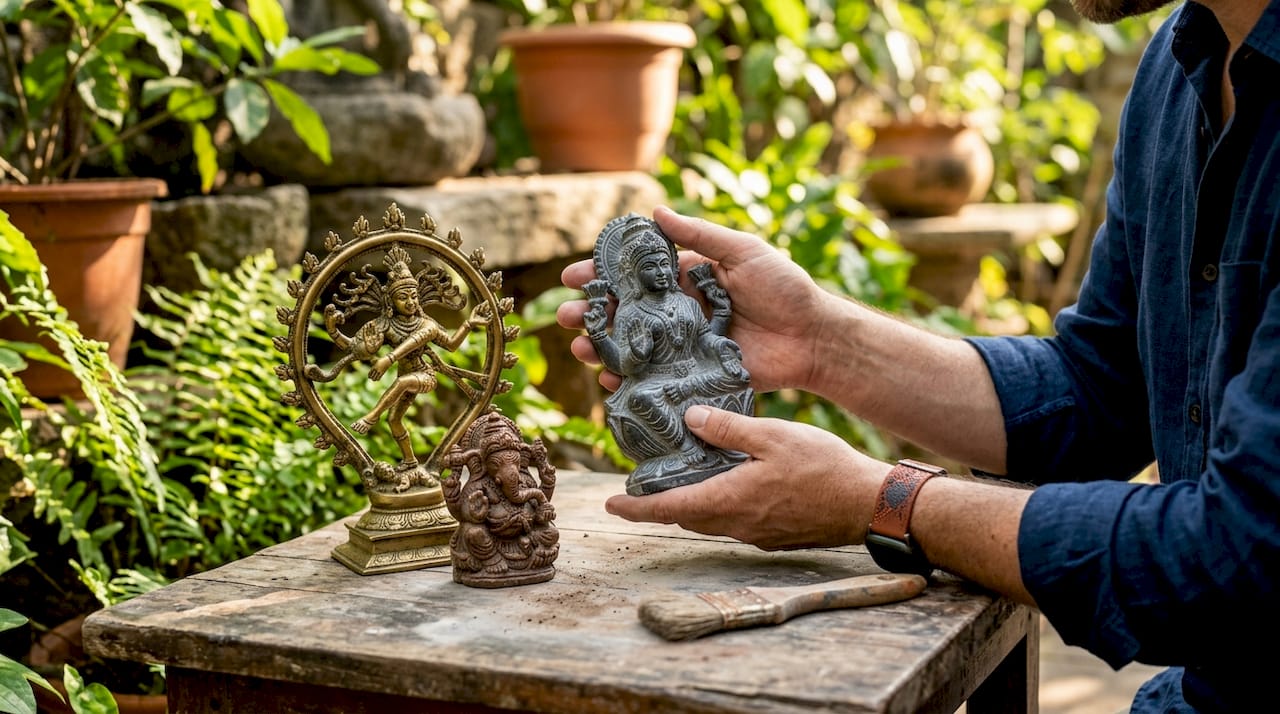
Conseil de pro : Si vous êtes nouveau dans le culte hindou, commencez par un seul Ganesha murti. Il est traditionnellement invoqué en premier dans tout rituel hindou, ce qui en fait le point d'ancrage naturel de tout autel.
Comment le matériau et la taille affectent-ils votre choix de statue hindoue ?
Le matériau d'une idole hindoue pour votre autel affecte son apparence, sa durabilité et ses exigences d'entretien. Les matériaux les plus courants sont le laiton, le composite de poussière de marbre, la pierre pure et la polyrésine.
| Matériel | Durabilité | Entretien | Idéal pour |
|---|---|---|---|
| Laiton | Très élevé | Huilage occasionnel, pas de produits chimiques agressifs | Utilisation dévotionnelle à long terme |
| Marbre ou pierre | Très élevé | Chiffon sec, éviter l'humidité | Autels traditionnels et formels |
| Polyrésine | Modéré | Facile à nettoyer | Autels économiques ou de démarrage |
| Bois | Haut avec soin | Eviter l'humidité, les huilages légers | Esthétique rustique ou traditionnelle |
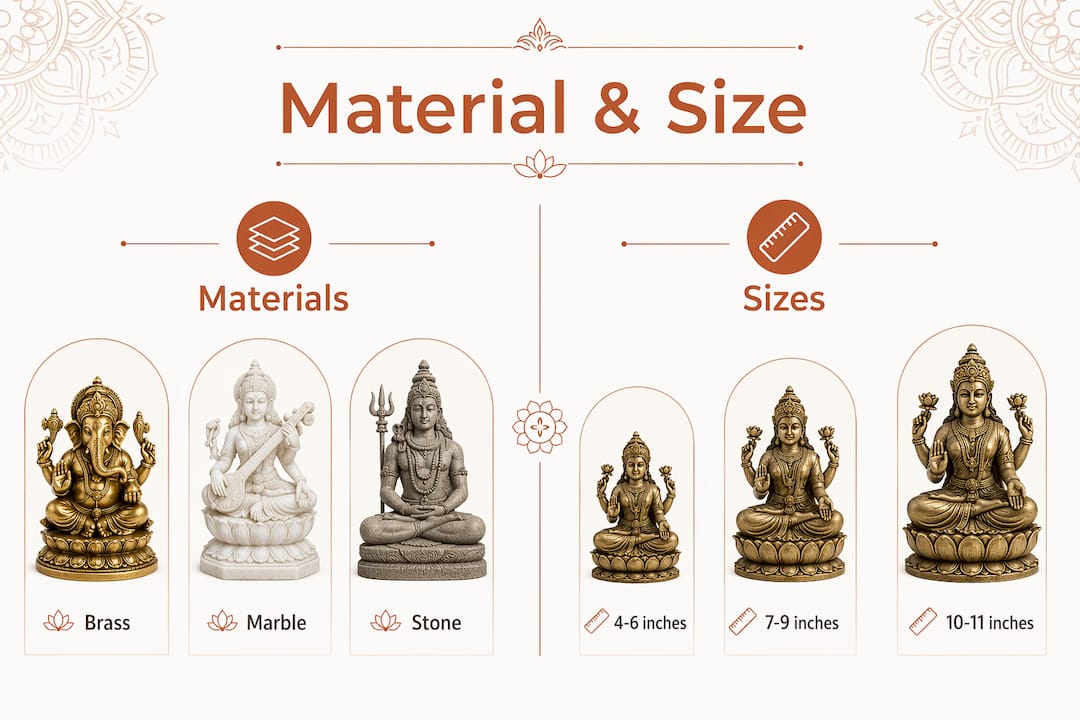
Statues en laiton, marbre et pierre chacun nécessite des soins différents pour rester dynamique spirituellement et physiquement. Le laiton bénéficie d’un huilage périodique avec de l’huile de noix de coco ou de sésame. La pierre et le marbre doivent être conservés au sec et nettoyés avec un chiffon doux. Les nettoyants chimiques agressifs endommagent la finition de surface des trois matériaux.
Les tailles courantes des statues vont de 4 à 11 pouces pour les autels domestiques. Cette gamme convient à la plupart des configurations d'étagères ou de table sans dominer l'espace. Une statue de 4 à 6 pouces fonctionne bien sur une petite étagère ou un autel de bureau. Une statue de 9 à 11 pouces crée une présence visuelle plus forte et convient à une table ou une armoire d'autel dédiée.
La taille affecte également la présence spirituelle de la statue. Un murti plus grand attire le regard et ancre l’espace. Un plus petit permet une pratique plus intime et personnelle. Ni l’un ni l’autre n’est supérieur. La bonne taille est celle qui s'adapte à votre espace et qui vous convient lorsque vous êtes assis devant.
Conseil de pro : Mesurez votre étagère d'autel avant d'acheter. Une statue trop haute pour l'étagère oblige à un placement difficile et perturbe l'équilibre visuel de votre espace sacré.
Où placer votre statue hindoue sur l’autel de la maison ?
Le placement suit à la fois les directives traditionnelles du Vastu Shastra et la logique pratique de la maison. Vastu Shastra recommande de placer l'autel face à l'est ou au nord. Les autels orientés à l’est s’alignent sur le soleil levant, ce qui revêt une signification symbolique dans la tradition hindoue. Les autels orientés au nord sont également considérés comme de bon augure.
Suivez ces étapes pour placer correctement votre statue :
- Choisissez la chambre. Une pièce propre et calme, éloignée de la chambre ou de la salle de bain, est préférable. Un coin salon ou une salle de prière dédiée fonctionnent tous deux bien.
- Réglez la hauteur de l'autel. Placez la surface de l'autel de manière à ce que la statue soit au niveau ou légèrement en dessous du niveau de vos yeux lorsque vous êtes assis en prière. Placement au niveau des yeux permet un regard direct et connectif avec la divinité, que les praticiens appellent drishti.
- Orientez la statue. Faites face à la divinité vers vous, l’adorateur. Si l'autel fait face à l'est, vous faites face à l'ouest lorsque vous priez. La divinité regarde dans la pièce.
- Dégagez les environs. Retirez le désordre de la surface de l’autel. Seuls les objets de dévotion tels qu'une lampe, un porte-encens, des fleurs et un récipient à eau appartiennent à la surface de l'autel avec le murti.
- Vérifiez l'accessibilité. Vous devriez pouvoir atteindre la statue confortablement pour le nettoyage quotidien et les offrandes sans forcer ni déplacer d'autres objets.
Un autel domestique peut être installé sur une simple étagère ou dans un coin avec un entretien régulier. Une salle dédiée n’est pas nécessaire. De nombreux pratiquants entretiennent des autels significatifs dans un seul coin d’un salon ou d’une alcôve d’une chambre.
Pour des conseils spécifiques aux statues de Ganesha, l'article HDAsianArt sur Placement de la statue de Ganesh couvre en détail les principes Vastu et les considérations intérieures modernes.
Erreurs courantes à éviter lors de la sélection et de l'entretien des statues d'autel
L’erreur la plus fréquente est d’acheter une statue produite en série sans en examiner la qualité d’exécution. Les statues de mauvaise qualité ont souvent des traits du visage flous, des proportions inégales et aucune précision symbolique dans les mudras. Ces détails sont importants car le murti est le point central de votre pratique quotidienne.
Évitez ces erreurs courantes :
- Ignorer le sens du mudra. Un Ganesha avec un mauvais geste de la main change complètement le message symbolique. Recherchez le mudra spécifique avant d’acheter.
- Choisir la taille uniquement par le prix. Une statue en laiton plus petite et bien conçue surpasse une grande pièce en polyrésine de mauvaise qualité en termes de longévité et de qualité de dévotion.
- Sauter les soins quotidiens. Petits actes de dévotion cohérents établir une connexion spirituelle significative. Essuyez quotidiennement la statue avec un chiffon propre. Offrez des fleurs fraîches ou de l’eau chaque matin.
- Placer l'autel dans une zone à fort trafic. Les autels situés près des portes ou des couloirs accumulent rapidement la poussière et sont sujets à des contacts accidentels.
- Mélanger les divinités sans intention. Plusieurs statues sur un autel sont acceptables, mais chacune doit être choisie délibérément. Les regroupements aléatoires diluent la concentration sur la dévotion.
La résonance personnelle avec une divinité et le symbolisme de la statue comptent plus que la complexité ou la taille de l’autel pour une pratique spirituelle significative. Un seul murti bien choisi sur une étagère propre surpasse un autel bondé sans centre de dévotion clair.
Conseil de pro : Lorsque vous achetez des statues sacrées en ligne, demandez des photographies détaillées du visage, des mains et de la base avant d'acheter. Des galeries réputées comme HDAsianArt photographient chaque pièce individuellement et fournissent des descriptions d'experts afin que vous sachiez exactement ce que vous recevez.
Points clés à retenir
La sélection d'une statue hindoue pour votre autel domestique nécessite de faire correspondre le symbolisme de la divinité à vos objectifs spirituels, de choisir un matériau durable pour votre espace et de placer le murti au niveau des yeux dans une position orientée à l'est ou au nord.
| Point | Détails |
|---|---|
| Associer la divinité à l'intention | Choisissez Ganesha pour un nouveau départ, Lakshmi pour la prospérité, Shiva pour la transformation et Saraswati pour la connaissance. |
| Privilégier la qualité des matériaux | Le laiton et la pierre durent plus longtemps que la polyrésine et récompensent les soins appropriés par des décennies d'utilisation. |
| Adaptez la taille à votre espace | Les statues entre 4 et 11 pouces conviennent à la plupart des configurations d’autel domestique sans surcharger l’espace. |
| Placer au niveau des yeux | Positionnez le murti de manière à rencontrer directement le regard de la divinité lorsque vous êtes assis en prière. |
| Entretenir quotidiennement | Essuyez la statue chaque jour et proposez régulièrement des objets frais pour maintenir l’énergie de dévotion de l’autel. |
Ce que j'ai appris sur le choix des statues pour un autel domestique
Travaillant avec l’art sacré hindou et bouddhiste depuis des années, j’ai vu un schéma se répéter sans exception : les autels qui semblent les plus vivants ne sont pas les plus grands ni les plus chers. Ils appartiennent à des personnes qui ont choisi une statue avec une intention réelle et qui se sont ensuite présentées chaque jour.
Le détail théologique que la plupart des acheteurs négligent est le mudra. J'ai vu des acheteurs sélectionner un Ganesha dans le Varada Mudra, le geste de donner, alors qu'ils voulaient en réalité l'Abhaya Mudra pour se protéger. Ce sont deux belles statues. Mais un seul correspond à ce que la personne recherchait. Passer dix minutes à apprendre les mudras avant d'acheter vous évite des années de désalignement subtil entre votre intention et votre autel.
Le matériel est le deuxième endroit où je vois que les gens sous-estiment l'impact à long terme. La polyrésine convient parfaitement pour un autel de départ. Mais le laiton et la pierre développent au fil du temps une présence que la polyrésine ne peut tout simplement pas reproduire. Un Lakshmi en laiton bien entretenu provenant d'une fonderie de qualité durera des décennies plus longtemps que n'importe quelle pièce synthétique et approfondira son caractère en vieillissant.
Ma recommandation honnête : achetez moins, achetez mieux et placez la statue là où vous serez réellement assis avec elle chaque jour. Le énergie spirituelle de la sculpture asiatique vient d’une attention humaine constante, et non du prix.
— Jacques, HDAsianArt.com
La collection HDAsianArt pour votre autel domestique
HDAsianArt se spécialise dans les statues hindoues et bouddhistes antiques et artisanales de Cambodge, Thaïlande, Indonésie, Sri Lanka, Le Vietnam et au-delà. Chaque pièce de la collection est recherchée individuellement, photographiée et décrite par des experts avant d'être répertoriée.
Chaque statue est expédiée dans le monde entier avec une livraison DHL assurée, de sorte que les pièces de qualité musée arrivent en toute sécurité, quel que soit votre emplacement. La collection comprend des pièces en bronze, en pierre et en bois dans une gamme de tailles adaptées aux configurations d'autel domestiques. Pour les acheteurs qui souhaitent l'authenticité et la possibilité de collectionner à long terme en un seul achat, parcourez la collection complète hindoue et bouddhiste chez HDAsianArt pour trouver un murti qui correspond aux besoins de votre autel et à votre dévotion personnelle.
FAQ
Quelle est la meilleure statue de divinité pour un premier autel domestique ?
Ganesha est la première divinité la plus largement recommandée pour un autel domestique hindou. Il est traditionnellement invoqué au début de tous les rituels hindous, ce qui en fait le point d'ancrage naturel de tout nouvel autel.
Quelle taille de statue convient le mieux à un autel domestique ?
Les statues entre 4 et 11 pouces constituent la gamme standard pour les autels domestiques. Une statue de 4 à 6 pouces convient à une petite étagère, tandis qu'une pièce de 9 à 11 pouces fonctionne mieux sur une table d'autel dédiée.
Dans quelle direction un autel de maison hindoue doit-il être orienté ?
Vastu Shastra recommande un autel orienté à l'est ou au nord. L’orientation est est le choix le plus traditionnel, car elle s’aligne avec la direction du soleil levant.
Que signifient les mudras sur les statues hindoues ?
Les mudras sont des gestes de la main qui portent des significations théologiques spécifiques. L'Abhaya Mudra signale la protection, tandis que le Varada Mudra représente le don et la générosité. Choisir le bon mudra aligne le symbolisme de la statue avec votre intention de dévotion.
Comment entretenir une statue hindoue en laiton ou en pierre ?
Nettoyez périodiquement les statues en laiton avec un chiffon doux et de l'huile légère, en évitant les produits chimiques agressifs. Les statues en pierre doivent être conservées au sec et essuyées avec un chiffon sec ou légèrement humide pour préserver la finition de la surface.
