



Art bouddhiste authentique à vendre : guide du collectionneur
Art bouddhiste authentique à vendre : guide du collectionneur
Quand les collectionneurs recherchent l'authentique art bouddhiste à vendre, ils naviguent dans un paysage complexe de provenance, de styles régionaux et de signification spirituelle. Ce guide vous guide dans la sélection, la vérification et l'entretien d'œuvres d'art bouddhistes authentiques, que vous construisiez votre premier autel de méditation ou que vous agrandissiez une collection sérieuse.
Table des matières
Comprendre l’art bouddhiste authentique à vendre
Le marché de l’art bouddhiste authentique à vendre s’est considérablement développé, tout comme les défis de vérification. Ce qui distingue les pièces authentiques des reproductions dépend des matériaux, de l'iconographie, de l'origine régionale et de la provenance documentée. Une statue de Bouddha en bronze coulée au Népal selon des méthodes traditionnelles a une valeur fondamentalement différente de celle d'une copie en résine produite en série.
Les collectionneurs supposent souvent que le prix seul indique l’authenticité. Les véritables repères résident dans l'examen des techniques de construction, la compréhension des détails de la main de l'artiste et la retrace de l'histoire de l'objet.
Ce qui rend l’art bouddhiste collectionnable
L’art bouddhiste de collection combine âge, rareté, qualité artistique, iconographie spirituelle et état. Une peinture thangka tibétaine du XIXe siècle avec des pigments minéraux vibrants et des feuilles d'or coûte cher car chaque élément est vérifiable et irremplaçable.
Les pièces les plus collectionnables proviennent de périodes et de régions spécifiques. Les moulages en bronze népalais des XVIIIe et XIXe siècles, les thangkas tibétaines peintes à la main et les sculptures bouddhistes japonaises en bois représentent des traditions distinctes avec des bases de collection dévouées. Les pièces dont les origines monastiques ou les collections royales sont documentées ont des valeurs nettement plus élevées que celles dont l'histoire est peu claire.
L’attribution régionale est extrêmement importante. Une statue qualifiée de « bouddhiste » sans spécificité régionale pourrait provenir du Tibet, du Népal, Indie, Chine, ou Japon, chacun avec des conventions iconographiques et des techniques artistiques différentes. Comprendre ces différences aide les collectionneurs faire des acquisitions éclairées.
L'art sacré à travers les traditions
L'art bouddhiste englobe des approches esthétiques très différentes selon la tradition et la région. Le bouddhisme tibétain met l'accent sur les couleurs vibrantes, l'iconographie complexe et les surfaces dorées. Le bouddhisme zen japonais privilégie la simplicité, l’espace négatif et les matériaux naturels. L'artisanat népalais mélange des éléments hindous et bouddhistes avec des techniques distinctives de moulage du bronze.
Chaque tradition porte des significations spirituelles spécifiques. Une statue de Tara verte diffère fondamentalement d'un mandala de Kalachakra par son objectif, son iconographie et son origine régionale. La Roue de la Vie apparaît dans toutes les cultures bouddhistes, mais avec des variations régionales : les versions tibétaines présentent des détails élaborés et des couleurs vives, les versions chinoises mettent l'accent sur les éléments calligraphiques et les interprétations népalaises présentent des techniques de moulage distinctives.
Comment vérifier l'authenticité de l'art bouddhiste
La vérification nécessite l’examen simultané de plusieurs flux de preuves. Aucun test ne prouve l’authenticité ; au lieu de cela, les collectionneurs construisent un dossier cumulatif en examinant les matériaux, le savoir-faire, la provenance et l'iconographie.
Examen des matériaux et de l'artisanat
Les matériaux utilisés dans l’art bouddhiste authentique suivent des modèles régionaux constants depuis des siècles. Les statues en bronze du Népal utilisent des compositions d'alliages spécifiques qui diffèrent du travail indien ou tibétain. Les thangkas peintes à la main utilisent des pigments traditionnels dérivés de minéraux, de plantes et de matériaux précieux comme le lapis-lazuli et la feuille d'or.
Le bronze coulé à la main présente des marques d'outils, des motifs de patine et une répartition du poids que les pièces produites en série ne peuvent pas reproduire. Les véritables statues en bronze semblent plus lourdes qu’elles ne le paraissent en raison de la densité du métal. En comparaison, les reproductions en plâtre ou en résine semblent plus légères et creuses.
Les techniques de dorure révèlent des marqueurs d'authenticité. L'application traditionnelle de feuilles d'or crée des coups de pinceau visibles et des imperfections occasionnelles. Le revêtement doré appliqué à la machine semble uniformément lisse, sans variation d'épaisseur. Les pièces antiques présentent des motifs d’usure sélective où des siècles de manipulation ont poli certaines zones.
La sculpture sur bois de pièces authentiques présente des marques d'outils conformes aux ciseaux à main et aux techniques traditionnelles. Les reproductions modernes utilisent des outils électriques qui créent différents motifs de surface.
Provenance et documentation
La provenance, l'histoire documentée d'un objet, sépare les pièces de collection légitimes des acquisitions douteuses. Un thangka contenant les archives du monastère, les documents du propriétaire précédent et l'historique de l'exposition est bien plus crédible qu'une pièce d'apparence identique avec « origine inconnue ».
Demandez une documentation écrite pour les achats importants. Les revendeurs légitimes fournissent les dates d'acquisition, les informations sur les propriétaires précédents, les notes de conservation et les références publiées. Méfiez-vous des pièces prétendument provenant de « ventes immobilières » ou de « collections familiales » sans pièces justificatives.
Les certificats d'authenticité n'ont d'importance que si le revendeur a établi ses références. Recherchez la réputation du marchand, l’historique des expositions et sa position dans la communauté des collectionneurs. Pièces avec plusieurs couches de provenance documentée commandez des prix premium précisément parce que la vérification est approfondie.
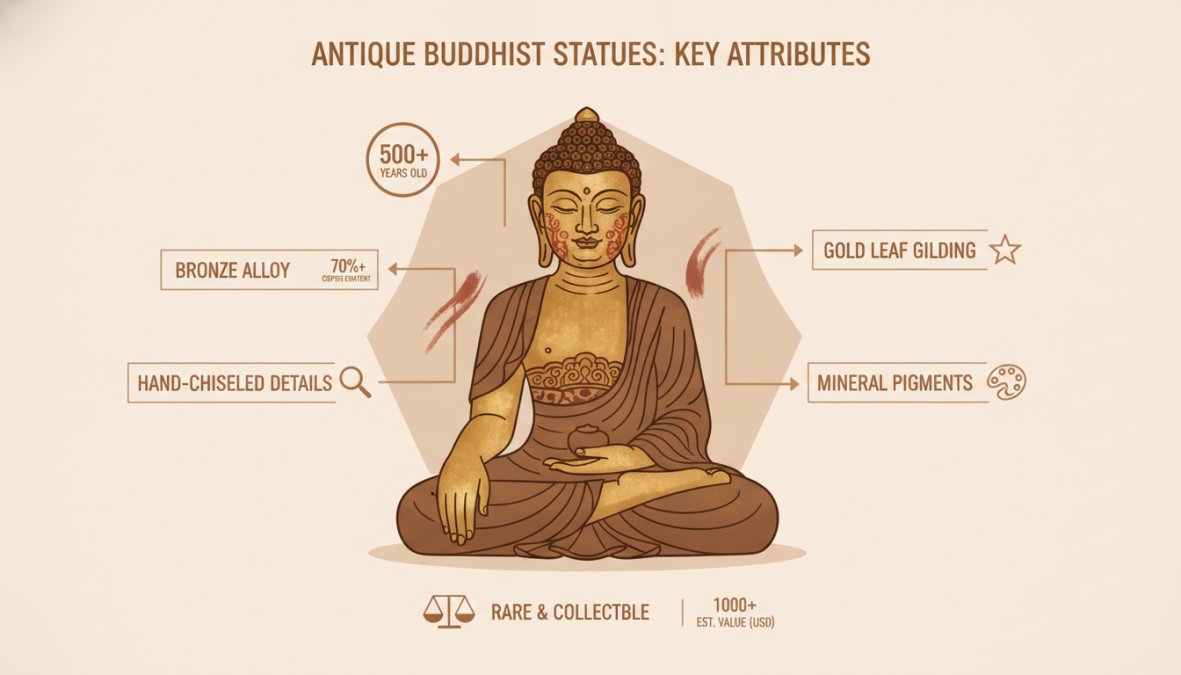
Statues bouddhistes antiques à vendre : ce qu’il faut savoir
Le marché des statues bouddhistes antiques à vendre nécessite une compréhension des styles, des matériaux et des conventions iconographiques régionales. L'âge, l'origine et l'état d'une statue déterminent sa valeur et sa signification spirituelle.
Styles régionaux et iconographie
Les statues bouddhistes tibétaines mettent l'accent sur des ornements élaborés, des images de divinités féroces et des gestes symboliques de la main appelés mudras. Ces pièces présentent souvent des expressions féroces et des postures dynamiques représentant des forces protectrices.
Les statues népalaises présentent des techniques de moulage distinctives transmises de génération en génération par des familles d'artisans. Le travail en bronze népalais présente des proportions délicates, des expressions sereines et des détails raffinés. La vallée de Katmandou est un centre de production artistique bouddhiste depuis plus de mille ans.
Les statues bouddhistes chinoises reflètent l'accent mis par le bouddhisme Mahayana sur la compassion et l'accessibilité, présentant souvent des expressions douces, des robes fluides et des poses de méditation assises. Les statues bouddhistes japonaises incarnent les principes esthétiques du bouddhisme zen, la simplicité, la retenue et la suggestion plutôt que des détails explicites. Les statues bouddhistes indiennes représentent le berceau de la tradition et le vocabulaire artistique fondateur.
Comprendre ces différences régionales évite les erreurs d’attribution et approfondit l’appréciation du contexte culturel spécifique des acquisitions.
Bronze, bois et pierre : les matériaux comptent
La coulée du bronze nécessite des connaissances techniques pointues et des alliages spécifiques. Le travail traditionnel consiste à créer un modèle en cire, à construire un moule en argile et à couler du bronze en fusion. Les pièces en bronze antique développent une patine, une couche d'oxydation superficielle qui se forme au fil des décennies ou des siècles, variant selon le climat et la manipulation.
La sculpture sur bois utilise des préférences régionales en matière de bois reflétant la disponibilité et la signification spirituelle. Les pièces tibétaines utilisent souvent du bois de rose ou du bois de santal. Les sculpteurs népalais travaillent avec des bois durs locaux. Les sculpteurs japonais utilisaient traditionnellement le cyprès hinoki. Le type de bois influence la couleur, le motif du grain et le vieillissement.
La sculpture sur pierre représente la forme la plus durable de sculpture bouddhiste. Les morceaux de marbre, de granit et de calcaire survivent avec une conservation remarquable. Les collectionneurs devraient examiner les morceaux de pierre à la recherche de marques d'outils correspondant à un ciselage manuel plutôt qu'à des outils électriques modernes.
Approvisionnement éthique d’artefacts bouddhistes
Le marché de l’art bouddhiste recoupe de sérieuses préoccupations éthiques concernant le patrimoine culturel, le retrait d’objets sacrés et la juste rémunération des artisans. Collectionner de manière responsable, c'est comprendre ces enjeux et prendre des décisions d'achat qui respectent à la fois les traditions spirituelles et les communautés humaines.
Commerce équitable et soutien artisanal
De nombreuses œuvres d'art bouddhistes proviennent de communautés d'artisans vivants au Népal, au Tibet et Indie. Soutenir ces communautés par le biais d'achats issus du commerce équitable a un impact direct sur les moyens de subsistance des artisans et préserve l'artisanat traditionnel. Les marchands du commerce équitable veillent à ce que les artisans reçoivent une rémunération raisonnable, travaillent dans des conditions sûres et conservent la propriété de leurs connaissances culturelles.
Lorsque vous achetez auprès d’artisans contemporains, vérifiez que le revendeur rémunère équitablement les fabricants et maintient des chaînes d’approvisionnement transparentes. Des revendeurs réputés travaillent directement avec les communautés d'artisans, visitent des ateliers et documentent le processus de production.
Les objets sacrés retirés des monastères ou des temples soulèvent de sérieuses préoccupations éthiques. De nombreuses communautés bouddhistes considèrent certaines statues et thangkas comme des objets spirituellement actifs destinés à rester à leur emplacement d'origine. Les collectionneurs peuvent faire des choix éthiques en donnant la priorité aux pièces dont la provenance est documentée, en soutenant les artisans contemporains par l'intermédiaire de revendeurs du commerce équitable et en évitant les objets portant des indicateurs de déplacement de temple.
Construire votre authentique collection d’art bouddhiste
Développer une collection significative nécessite de la patience, de l’éducation et des objectifs de collection clairs. Certains collectionneurs se concentrent sur des traditions spécifiques, les thangkas tibétaines, les sculptures japonaises en bois ou les travaux en bronze népalais. D'autres organisent des collections par iconographie, rassemblant différentes représentations de Tara verte ou de la Roue de la Vie à travers des variations régionales.
Thangkas, mandalas et art mural sacré
Les peintures Thangka représentent des points d’entrée accessibles pour les collectionneurs novices dans l’art bouddhiste. Ces rouleaux peints à la main combinent portrait, narration et iconographie spirituelle. Les thangkas authentiques utilisent des pigments minéraux préparés selon des méthodes séculaires. Le lapis lazuli crée un bleu distinctif. Le vermillon produit des rouges. La feuille d'or ajoute de l'éclat et une signification spirituelle.
Les mandalas fonctionnent comme des outils de méditation et des cartes cosmologiques. Les mandalas peints à la main sur toile ou les rouleaux de style thangka coûtent plus cher que les reproductions imprimées, reflétant les mois de travail de l'artiste et la permanence des matériaux. Les tirages d’art de dessins thangka classiques offrent aux collectionneurs un accès abordable à l’imagerie traditionnelle.
Entretien et maintenance des pièces antiques
Des soins appropriés prolongent la vie de l’art bouddhiste et préservent son intégrité spirituelle. Les pièces en bronze bénéficient d'un nettoyage doux occasionnel avec des chiffons doux ; n'utilisez jamais de produits chimiques agressifs qui endommagent la patine. Exposez les statues de bronze à l’abri de la lumière directe du soleil.
Les thangkas nécessitent des environnements climatisés pour éviter les fissures de la peinture et la détérioration des tissus. Les conditions idéales maintiennent une humidité de 40 à 50 % et des températures comprises entre 65 et 72 degrés Fahrenheit. Enveloppez les thangkas sans serrer dans un mouchoir sans acide et conservez-les à plat ou enroulés sans serrer dans des endroits frais et secs.
Les sculptures en bois bénéficient d’un léger dépoussiérage occasionnel avec des brosses douces. Évitez l’exposition à l’eau, qui provoque le gonflement et la fissuration du bois. Dans les climats secs, une légère application d’huile de bois de qualité musée toutes les quelques années aide à maintenir l’intégrité. N’utilisez jamais de cirage pour meubles du commerce.
Les pièces de pierre nécessitent un entretien minimal au-delà d’un époussetage occasionnel. Évitez les nettoyants acides sur le marbre ou le calcaire. Exposez toutes les pièces sous une lumière indirecte, à l’abri de la lumière directe du soleil qui atténue les couleurs et endommage les matériaux.
| Élément de soins | Statuettes en bronze | Peintures de thangka | Sculptures en bois | Morceaux de pierre |
|---|---|---|---|---|
| Climat idéal | Humidité stable et modérée | 40-50% d'humidité, 65-72°F | Humidité modérée, éviter les extrêmes | Température stable |
| Méthode de nettoyage | Chiffon doux, sans produits chimiques | Épousseter doucement, pas d'eau | Brosse douce, huile légère de temps en temps | Eau distillée, brosse douce |
| Stockage | Emplacement stable et sec | Mouchoir plat ou légèrement roulé, sans acide | Climatisé, éviter l'eau | Endroit frais et sec |
| Affichage | Lumière indirecte, montage sécurisé | Protégé du soleil direct | Lumière indirecte, surface stable | A l'abri des intempéries |
Conclusion : investir dans l’art bouddhiste authentique
Construire une collection d’art bouddhiste authentique à vendre nécessite d’équilibrer l’appréciation esthétique avec le respect spirituel et la conscience éthique. Le marché offre de véritables opportunités d'acquérir des pièces significatives, allant des œuvres artisanales contemporaines aux antiquités de qualité musée, mais le succès dépend de l'éducation, d'une vérification minutieuse et d'un approvisionnement réfléchi.
Le défi auquel sont confrontés la plupart des collectionneurs est de trouver des pièces authentiques qui correspondent à leurs valeurs et à leurs objectifs de collection. Guide d’iconographie de l’art bouddhiste fournit des documents de référence complets pour comprendre les significations symboliques. À HD Asian Art, nous nous spécialisons dans les collections organisées de statues bouddhistes et hindoues authentiques, de pièces antiques triées sur le volet et d'œuvres contemporaines d'artisans établis. Notre sélection met l'accent sur la provenance documentée, l'approvisionnement du commerce équitable et les pièces conçues pour améliorer les espaces de méditation et les intérieurs de maisons spirituelles. Parcourez notre collection pour découvrir des pièces authentiques qui apportent à la fois beauté artistique et présence spirituelle à votre sanctuaire.
Foire aux questions
Comment savoir si l’art bouddhiste est authentique ?
L'art bouddhiste authentique présente un savoir-faire cohérent, une patine appropriée à son âge revendiqué et une iconographie appropriée. Examinez les matériaux de près, le véritable moulage en bronze montre un poids et une qualité de finition qui manquent aux reproductions. Vérifiez la provenance grâce à la documentation, aux certificats d'authenticité et à la réputation du vendeur. Recherchez des détails peints à la main, des surfaces dorées montrant une usure naturelle et des marqueurs stylistiques régionaux. Des revendeurs réputés fournissent des garanties d'authenticité détaillées et des informations d'approvisionnement transparentes pour des pièces de qualité musée.
Que dois-je rechercher lors de l’achat de statues bouddhistes antiques à vendre ?
Évaluez l'origine régionale (les styles tibétain, népalais, chinois, japonais ou indien ont chacun des caractéristiques distinctes), les matériaux (coulage en bronze, sculpture sur bois ou pierre) et la précision iconographique. Vérifiez la signification spirituelle de la statue, les représentations de la Tara verte, du Kalachakra et du Bouddha nécessitent chacune des conventions artistiques spécifiques. Vérifiez la patine appropriée, les détails sculptés à la main et l’authenticité de la dorure. Demandez des documents de provenance et des certificats d’authenticité. Tenez compte de l'état de la pièce, de sa taille et si elle convient à votre espace de méditation ou à votre collection. Les pièces fabriquées artisanalement prennent souvent de la valeur.
Est-il éthique d’acheter et de vendre de l’art bouddhiste ?
Oui, lorsqu'ils proviennent de sources éthiques. Donnez la priorité aux revendeurs engagés dans des pratiques de commerce équitable et soutenant directement les artisans himalayens. Évitez les pièces pillées dans les temples ou les sites culturellement sensibles. Vérifier que les ventes profitent aux communautés artisanales et préservent le patrimoine culturel. Des vendeurs réputés assurent un approvisionnement transparent, soutiennent un savoir-faire éthique et garantissent que les pièces ne sont pas des artefacts volés. Acheter dans des collections organisées qui mettent l'accent sur les œuvres artisanales et peintes à la main soutient les pratiques durables. L'approvisionnement éthique signifie respecter les traditions bouddhistes tout en permettant aux collectionneurs de posséder des œuvres d'art sacrées significatives.
Où puis-je trouver de l’art bouddhiste authentique à vendre avec des garanties d’authenticité ?
Achetez auprès de revendeurs spécialisés offrant une provenance détaillée, des pièces de qualité musée et des garanties d'authenticité écrites. HD Asian Art propose des collections soigneusement sélectionnées de statues bouddhistes anciennes et contemporaines avec un approvisionnement transparent et une livraison gratuite. Recherchez des vendeurs spécialisés dans les sculptures khmères et d'Asie du Sud-Est, l'art du bouddhisme tibétain et la décoration inspirée des temples. Vérifiez les informations d'identification du vendeur, lisez les avis et confirmez qu'ils fournissent des certificats d'authenticité. Les marchands établis conservent souvent des collections mettant l'accent sur les thangkas peintes à la main, les sculptures dorées et les pièces artisanales au patrimoine culturel documenté.
